
Want to become a notary in Oregon? You’ll need to be at least 18 years old, live here (or work here), speak English, and pass a background check. Sounds simple enough, but there’s more to it than meets the eye.

Table of Contents
-
Getting Started: What You Actually Need to Know
-
Meeting Oregon’s Basic Requirements (And Why They Matter)
-
The Education and Testing Reality Check
-
Money Talk: What This Will Actually Cost You
-
Navigating the Application Maze
-
Your Day-to-Day Life as a Notary
-
Staying Compliant and Growing Your Skills
-
When You Need Help With Documentation
TL;DR
-
You must be 18+, an Oregon resident (or work in Oregon while living in a bordering state), speak English, and have a clean criminal record
-
Complete a 3-hour approved training course and pass the state exam with 80% or higher
-
Budget for application fees, background checks, training costs, and a mandatory $10,000 surety bond
-
The application process takes 4-6 weeks once you submit complete documentation
-
Your commission lasts 4 years and requires ongoing record-keeping and continuing education
-
You can perform acknowledgments, jurats, copy certifications, and administer oaths
-
Maintain detailed journals for 10 years and follow strict ethical guidelines
Getting Started: What You Actually Need to Know
I’ve watched too many people jump into the Oregon notary process without understanding what they’re signing up for. The state makes it sound straightforward—complete some training, pass a test, pay some fees. Reality hits differently when you’re sitting across from someone who needs their power of attorney notarized and you realize the weight of responsibility on your shoulders.

Why I’m Writing This Guide (And Why You Should Care)
Most guides about becoming an Oregon notary read like government manuals—technically accurate but missing the human element. I’m writing this because I remember feeling overwhelmed by the bureaucratic language and wondering what the process actually looked like day-to-day.
Recent cases of document fraud show why this matters. A “dramatic rise in fraudulent deeds” reported by Willamette Week demonstrates why qualified notaries are essential for protecting property ownership and preventing document forgery.
Understanding the importance of proper documentation is crucial, and if you’re considering professional development opportunities, you might also want to explore how long it takes to get various professional certificates to complement your notary career.
The fraud cases in Portland show exactly why Oregon takes notary qualifications seriously. When someone’s home gets stolen through forged documents, the notary who should have caught the fraud becomes part of the legal investigation. That’s not meant to scare you away—it’s meant to help you understand that this role carries real responsibility.
The Reality Check Nobody Talks About
Here’s what nobody mentions upfront: you’re not just stamping papers. You’ll be there when someone’s getting divorced, buying their first house, or setting up their will. These aren’t just documents—they’re people’s biggest life moments, and they’re counting on you to get it right.
Sarah thought she’d just help neighbors occasionally. Six months later, she was notarizing business deals and real estate transactions. Her “simple side gig” became a serious professional commitment requiring ongoing education and meticulous record-keeping.
The time commitment extends beyond the actual notarizations. You’ll spend time maintaining records, staying current with law changes, and occasionally dealing with questions from people whose documents you notarized months ago. Some weeks you might not notarize anything. Other weeks, you might have multiple requests that require careful scheduling around your regular job.
Meeting Oregon’s Basic Requirements (And Why They Matter)
Oregon requires that applicants be “Resident of Oregon or have a place of employment or practice in this state”, which provides flexibility for border-state workers while ensuring notaries have meaningful connections to the communities they serve.
The state didn’t create these requirements arbitrarily. Each one addresses a specific concern about public safety and notary competence. When you understand the reasoning behind the rules, the application process makes more sense.
The Non-Negotiable Basics Everyone Must Meet
Oregon’s eligibility requirements might seem straightforward, but I’ve seen applications delayed because people misunderstood what documentation actually works. The state wants proof, not promises, that you meet their standards.
|
Requirement |
Details |
Documentation Needed |
|---|---|---|
|
Age |
18+ years old |
Government-issued photo ID |
|
Residency |
Oregon resident OR work in Oregon |
Utility bill, lease, employment verification |
|
Language |
Read and write English |
Demonstrated through application process |
|
Criminal Record |
No disqualifying convictions in past 10 years |
Background check conducted by state |
|
Training |
Complete approved course within 6 months |
Certificate of completion |
Proving You Belong Here (Residency and Age Documentation)
Age verification is usually the easiest requirement—any government-issued photo ID works. Driver’s license, passport, state ID card—they all count. The residency requirement trips up more people, especially those who recently moved to Oregon or work here but live across the border.
For Oregon residents, utility bills work well as proof. Your electric, gas, water, or trash service bill shows your name and Oregon address. Bank statements work too, as do lease agreements or mortgage documents. The key is having your name and current Oregon address clearly visible.
If you’ve recently moved to Oregon and need to establish documentation, understanding how to get essential documents can help streamline your notary application process.
Border-state workers have additional options. Employment verification from your Oregon employer works, as does documentation showing you conduct business regularly in Oregon. I’ve seen people use business licenses, professional licenses, or letters from Oregon-based clients to establish their connection to the state.

The Background Check Process (What They’re Really Looking For)
Oregon conducts “A background check is conducted on all applications for a notary public commission” to ensure public trust and safety in notarial services.
The background check isn’t designed to exclude people with minor infractions. Oregon focuses on crimes that would affect your ability to serve the public trustworthily. Felonies involving dishonesty, fraud, or violence within the past 10 years typically disqualify applicants. Traffic tickets won’t hurt you, but identity theft or forgery will.
The fingerprinting process happens at approved locations throughout Oregon. You’ll pay the fee directly to the fingerprinting service, and they’ll submit your prints electronically to the state. The whole appointment usually takes 15-20 minutes, though you might wait longer during busy periods.
If you have questions about whether something in your background might disqualify you, contact the Secretary of State’s office before applying. They can provide guidance about specific situations without requiring you to go through the full application process first.
The Skills and Character Standards
Beyond meeting the paperwork requirements, Oregon expects notaries to demonstrate competency and good moral character. The training and testing requirements ensure you understand your legal responsibilities, while the background check addresses character concerns.
Character evaluation continues throughout your commission. If you’re convicted of disqualifying crimes while serving as a notary, the state can revoke your commission. This ongoing accountability helps maintain public trust in notarial services.
The English language requirement ensures you can communicate effectively with signers and understand the legal documents you’ll encounter. You don’t need perfect grammar or extensive vocabulary, but you must be able to read documents accurately and explain basic notarial procedures to signers.
The Education and Testing Reality Check
Oregon’s training requirement isn’t busy work—it’s preparation for real situations you’ll encounter as a notary. The state requires specific training that covers legal requirements, proper procedures, and ethical standards. You can’t skip this step or substitute experience for formal education.
The training covers more than just rules and regulations. You’ll learn how to identify acceptable identification, recognize signs of coercion or fraud, and handle situations where signers don’t speak English fluently. These practical skills matter when you’re working with real people in real situations.
Choosing Your Training Path (Online vs. In-Person)
Oregon offers multiple training options, and importantly, “All notary trainings offered through the Secretary of State are free”, making the education requirement accessible to all qualified applicants.
The free training through the Secretary of State covers everything you need to know to pass the exam and start working as a notary. Private training companies offer additional courses, but they’re not required and won’t give you any advantage in the application process.
Mark chose the self-paced online training because of his irregular work schedule, completing modules during lunch breaks over two weeks. Jennifer preferred the in-person workshop format, finding the interactive practice sessions and immediate feedback from instructors more valuable for her learning style.
Online training offers flexibility—you can complete modules when convenient and review material as needed. The interactive elements include practice scenarios and knowledge checks that help reinforce key concepts. You’ll need a reliable internet connection and the ability to focus on the material without distractions.
In-person workshops provide immediate feedback and the opportunity to ask questions in real-time. You’ll practice notarial procedures with other students and get hands-on experience with the forms and certificates you’ll use regularly. The structured schedule helps some people stay focused and complete the training more quickly.
For those considering various professional development paths, you might also be interested in how long it takes to get a teaching certificate as another way to serve your community professionally.
What You’ll Actually Learn (Beyond the Boring Stuff)
The training curriculum covers Oregon’s notary laws, but it also teaches practical skills you’ll use regularly. You’ll learn how to properly identify signers, including what to do when someone’s ID doesn’t match their signature exactly. The course covers different types of notarial acts and when each one is appropriate.
Fraud prevention gets significant attention in the training. You’ll learn to recognize common fraud schemes and understand your role in preventing document fraud. The course covers what to do when you suspect fraud and how to protect yourself legally when refusing to notarize suspicious documents.

Record-keeping requirements receive thorough coverage because your journal protects both you and the public. You’ll learn what information to record, how to handle situations where signers are reluctant to provide details, and how to maintain your records properly throughout your commission term.
Conquering the State Exam
Oregon requires applicants to have “Passed the Secretary of State’s Notary Public examination” as part of the commission process, ensuring all notaries understand their legal responsibilities.
The exam tests your understanding of Oregon notary law and proper procedures. You need 80% or higher to pass, which means you can miss some questions and still succeed. The test focuses on practical knowledge you’ll use as a working notary rather than obscure legal details.
Study the training materials thoroughly, paying special attention to the differences between acknowledgments and jurats. Many exam questions focus on when to use each type of notarial act and what procedures apply to each one. Understanding identification requirements and record-keeping obligations also appears frequently on the exam.
Practice scenarios help prepare you for the exam’s practical focus. Work through examples of different notarial situations and think about what you would do in each case. The exam often presents scenarios and asks you to identify the correct procedure or recognize potential problems.
Continuing Education: Your Ongoing Learning Journey
Oregon doesn’t currently require continuing education for notary renewal, but staying current with law changes and best practices benefits both you and the people you serve. The Secretary of State’s office provides updates about law changes and new guidance for notaries.
Professional organizations offer additional training opportunities throughout your commission term. These sessions often cover advanced topics, new fraud schemes, and changes in related laws that affect notarial practice. Attending these sessions helps you maintain high professional standards and stay connected with other notaries.
Reading industry publications and participating in online forums keeps you informed about trends and challenges in notarial practice. Other notaries often share experiences and solutions that can help you handle unusual situations more effectively.
Money Talk: What This Will Actually Cost You
Let’s talk numbers. Becoming an Oregon notary isn’t free, and I’ve seen too many people get sticker shock halfway through the process. You’re looking at around $200 upfront, plus ongoing costs.
The total investment varies depending on your choices for optional services and equipment, but you should plan for at least $167 in required expenses. Some costs are one-time investments, while others recur annually or when you renew your commission.

What You’ll Pay Right Away
Understanding the cost structure helps you plan your budget and decide whether becoming a notary makes financial sense for your situation. Some expenses are required by law, while others are optional but recommended for professional practice.
|
Expense Category |
Estimated Cost |
Notes |
|---|---|---|
|
Application Fee |
$40 |
Non-refundable |
|
Background Check |
$37 |
Fingerprinting included |
|
Training Course |
$0 |
Free through state |
|
Surety Bond |
$50-100 |
Annual premium for $10,000 coverage |
|
Notary Seal |
$25-50 |
Required for official acts |
|
Journal |
$15-25 |
Record-keeping requirement |
|
Total Initial Investment |
$167-252 |
Plus optional E&O insurance |
The application fee and background check costs are fixed—every applicant pays the same amount. These fees are non-refundable, so make sure you meet all eligibility requirements before submitting your application.
Your notary seal and journal are tools you’ll use throughout your commission term. Higher-quality seals last longer and produce clearer impressions, while well-designed journals make record-keeping easier and more organized. Consider these purchases as professional investments rather than just required expenses.
Understanding Your Surety Bond Requirement
Oregon requires all notaries to maintain a $10,000 surety bond throughout their commission term. This bond protects the public if you make errors that cause financial harm, but it doesn’t protect you personally—you’re still liable for damages caused by your mistakes.
When Lisa compared surety bond providers, she found premiums ranging from $50 to $100 annually for the required $10,000 coverage. The lowest-cost provider offered the same protection as more expensive options, but she chose a mid-range provider with better customer service ratings for peace of mind.
Shopping for surety bonds involves comparing premiums from different providers, but remember that all bonds must meet Oregon’s specific requirements. The bond must name the State of Oregon as the obligee and provide exactly $10,000 in coverage. Some providers offer multi-year discounts, which can reduce your annual costs.
Bond premiums depend on your credit score and the provider’s underwriting standards. Applicants with excellent credit typically qualify for the lowest rates, while those with credit challenges might pay higher premiums. The bond premium is separate from any application or processing fees the provider might charge.
Ongoing Expenses
Your bond renews annually at $50-100. Consider errors and omissions insurance too—it’s not required but costs about $25-50 yearly and covers your legal defense if someone sues you.
Active notaries might need multiple journals during their four-year term. Occasional notaries usually get by with one.
Navigating the Application Maze
Oregon processes applications in order, but incomplete ones get sent back—you don’t get to fix missing pieces. That means starting over if you mess up.
The state processes applications in the order received, but incomplete applications get returned rather than held for missing information. This means starting over with a new application if you miss something important the first time.

Your Application Checklist
Get everything together before you start:
-
☐ Form NP-1 (must be notarized—yes, you need a notary to become one)
-
☐ Government photo ID
-
☐ Proof you live or work in Oregon
-
☐ Training certificate (good for 6 months)
-
☐ Exam results showing you passed
-
☐ $40 application fee
-
☐ $37 background check fee
-
☐ Surety bond certificate
Organizing your documents before starting the application saves time and reduces errors. Make copies of everything for your records, and double-check that all information matches exactly across different documents. Inconsistencies in names, addresses, or dates can trigger additional review.
If you need help understanding what constitutes proper documentation, our guide on academic documents can help you understand various document types and their authentication requirements.
Form NP-1: Getting It Right the First Time
Pro tip: Use your full legal name exactly as it appears on your ID. Nicknames and abbreviations cause delays.
Oregon’s notary application form requires careful attention to detail. Every field must be completed accurately, and the form itself must be notarized by a current Oregon notary. Yes, you need a notary to become a notary—one of those bureaucratic quirks that makes sense once you understand the verification purpose.
Common errors include incomplete addresses, inconsistent name formatting, and missing signatures. The employment section requires specific information about your current job, even if you plan to notarize documents only occasionally. Oregon uses this information to verify your connection to the state and ensure you meet residency requirements.
Supporting Documents That Actually Work
For residency proof, recent utility bills work great. If you work in Oregon but live elsewhere, get an employment letter on company letterhead.
Acceptable identification includes driver’s licenses, state ID cards, passports, and military ID cards. The ID must be current and include a photograph. Expired documents don’t count, even if the expiration was recent.
Residency documentation must show your current Oregon address. Utility bills work well, but they must be recent—typically within the past 60 days. Bank statements, lease agreements, and mortgage documents also work if they clearly show your name and Oregon address.
Employment verification for border-state residents requires official documentation from your Oregon employer. A letter on company letterhead works, as does a pay stub or employment contract that clearly identifies your Oregon workplace.
The Waiting Game
Expect 4-6 weeks for processing. The state runs background checks through multiple databases, which takes time if you have a common name or lived in several states.
The state conducts background checks through multiple databases, which can take additional time if you’ve lived in multiple states or have a common name that requires additional verification. Most applicants receive their commission without complications, but some situations require additional review.
Don’t call every week asking for updates—it won’t speed things up. Use the waiting time to buy your supplies and practice with your seal.
From Approval to Active Status
Receiving your commission certificate marks the beginning of your active status as an Oregon notary. You must take the oath of office before performing any notarial acts, and this oath can be administered by any current notary, judge, or other authorized official.
Your commission certificate includes important information about your term limits and authority. Keep the original in a safe place and make copies for your records. Some notaries frame their certificate for display in their office or workspace.
Before performing your first notarial act, make sure you have all required supplies: your official seal, journal, and any certificates or forms you might need. Practice using your seal to ensure clear, complete impressions that meet Oregon’s requirements.

Your Day-to-Day Life as a Notary
Being a notary means dealing with people during important moments. You’ll see divorce papers, business deals, medical directives, and house purchases. Each signature matters.
Each notarial act carries legal significance, and the people requesting your services often depend on your expertise to ensure their documents are properly executed. This responsibility can feel overwhelming at first, but most notaries find the work rewarding once they develop confidence in their abilities.
What You’ll Actually Do
Oregon notaries perform several types of notarial acts, each with specific procedures and requirements. Understanding when to use each type and how to execute them properly forms the foundation of competent notarial practice.
Recent developments in neighboring states show the importance of proper procedures. “Sign in front of a notary public and have them attach their seal in the space provided” Clark County Auditor demonstrates how notaries play crucial roles in important legal documents like marriage license applications.
Most requests are acknowledgments—verifying someone signed a document willingly. The person appears before you, shows ID, and confirms they signed voluntarily. You don’t read the whole document or give legal advice.
Mastering Acknowledgments (The Most Common Request)
Acknowledgments verify that signers executed documents voluntarily and with understanding of their contents. The signer must appear before you personally and acknowledge that they signed the document willingly.
Your role involves verifying the signer’s identity through acceptable identification and confirming they understand what they’re signing. You don’t need to read the entire document or provide legal advice, but you should ensure the signer appears competent and willing.
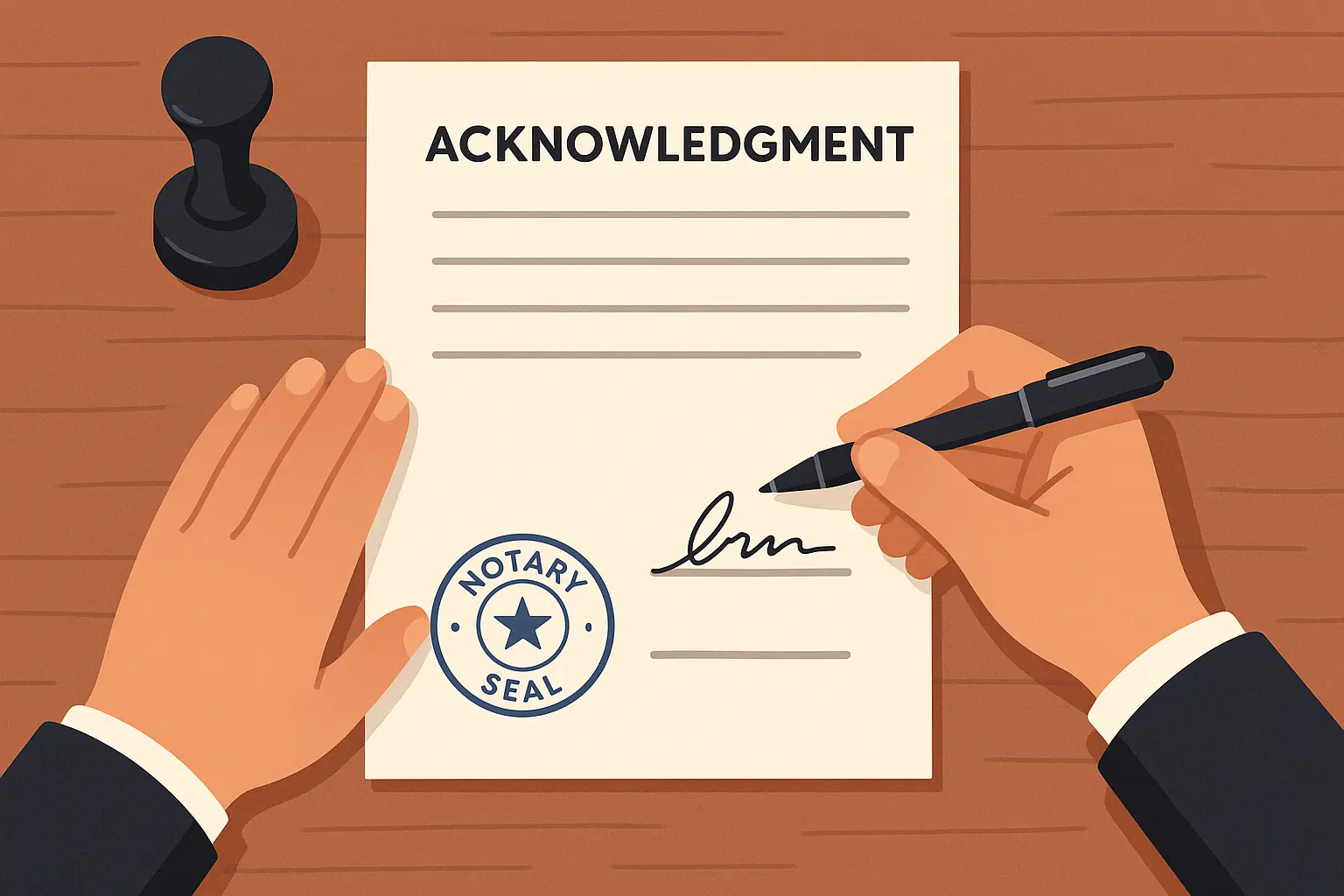
The acknowledgment certificate must be completed accurately with the correct date, location, and signer information. Your signature and seal make the acknowledgment official, so double-check all details before applying your seal.
Jurats and Oath Administration
Jurats are different. The person swears the document contents are true. You witness both the signature and the oath.
Jurats require signers to swear or affirm that document contents are true to the best of their knowledge. This differs from acknowledgments because you’re witnessing both the signing and the oath-taking.
The oath can be administered using traditional religious language or secular affirmation language, depending on the signer’s preference. The key requirement is that signers understand they’re making a solemn promise about the document’s truthfulness.
Proper jurat procedures include verifying identity, witnessing the signature, administering the oath, and completing the jurat certificate. Each step is essential—skipping any part invalidates the notarization.
Copy Certifications: What You Can and Can’t Do
Copy certifications let you verify copies match originals, but you can’t certify vital records like birth certificates—those need official copies from the issuing agency.
Oregon allows notaries to certify copies of certain documents, but important restrictions apply. You cannot certify copies of vital records like birth certificates, death certificates, or marriage licenses—these require certified copies from the issuing agency.
The certification process involves comparing the copy to the original document and confirming they’re identical. You must personally make this comparison—you cannot rely on someone else’s assurance that the copy is accurate.
Acceptable documents for copy certification include contracts, correspondence, photographs, and other non-vital records. When in doubt about whether you can certify a particular document type, consult Oregon’s notary handbook or contact the Secretary of State’s office.
Your Journal Is Everything
Oregon requires detailed records of every notarization. Your journal protects you legally and helps resolve questions years later.
Record immediately: date, time, document type, signer’s name, ID details, and notarial act performed. Signers sometimes resist giving information, but explain it’s legally required.
Your Notarial Journal: More Than Just Paperwork
Proper journal maintenance requires consistency and attention to detail. Each entry should be completed immediately after performing the notarial act, while details are fresh in your memory.
Your journal becomes a legal document that might be subpoenaed in court proceedings. Accurate, complete entries demonstrate your professionalism and help establish the validity of notarizations you performed.
Long-Term Record Management
Keep your journal secure and maintain it for 10 years after your commission expires. It might get subpoenaed in court, so accurate entries matter.
Oregon requires notaries to maintain their journals for 10 years after their commission expires. This long retention period reflects the lasting legal significance of notarized documents.
Store your journals in a secure location where they’re protected from damage, theft, or unauthorized access. Some notaries use fireproof safes or safety deposit boxes for long-term storage.
When your commission expires or you decide to stop practicing as a notary, your journals remain your responsibility. You cannot transfer them to another notary or destroy them before the retention period expires.

Staying Compliant and Growing Your Skills
Your four-year commission requires ongoing attention. Laws change, and staying current prevents problems.
Professional development doesn’t end when you receive your commission certificate. Experienced notaries continue learning throughout their careers, adapting to new situations and maintaining the high standards the public expects.
Renewal Planning
Start renewal 90 days before expiration. You’ll need new training, another background check, and current bond coverage. Don’t wait until the last minute.
Oregon notary commissions last four years, and renewal requires completing a new application process similar to your initial application. Planning ahead prevents gaps in your commission that could disrupt your notarial practice.
The renewal process includes updated training, a new background check, and current surety bond coverage. Starting early gives you time to address any complications without rushing to meet deadlines.
Renewal Timeline and Smart Planning
Begin your renewal process at least 90 days before your current commission expires. This timeline allows for processing delays and gives you time to resolve any issues that might arise during the renewal review.
Renewal Planning Checklist:
-
☐ Start renewal process 90 days before expiration
-
☐ Complete required continuing education
-
☐ Update surety bond coverage
-
☐ Gather new supporting documents if needed
-
☐ Submit renewal application and fees
-
☐ Plan for any processing delays
Your surety bond must remain current throughout the renewal process. Contact your bond provider well before your current bond expires to ensure continuous coverage without gaps.
For professionals managing multiple certifications, understanding replacement certification processes can help you stay organized with your various professional credentials.
What You Cannot Do
Never notarize documents where you have financial interest or that benefit you directly. You can’t notarize for spouses, kids, parents, or close relatives.
Oregon law prohibits notaries from performing certain acts that could create conflicts of interest or compromise the integrity of notarial services. You cannot notarize documents in which you have a financial interest or that benefit you directly.
Family relationships create additional restrictions. You cannot notarize documents for spouses, children, parents, or other close relatives. These restrictions prevent situations where personal relationships might influence your professional judgment.
Don’t give legal advice. Explain notarial procedures, but don’t interpret documents or advise on legal consequences.
Protecting Yourself and Your Clients
When uncertain about procedures, consult authoritative sources rather than guessing. Document unusual situations thoroughly in your journal.
Risk management strategies help protect both you and the people you serve. Maintaining current errors and omissions insurance provides additional protection beyond your required surety bond.
Following proper procedures consistently reduces your risk of making errors that could result in legal liability. Document unusual situations in your journal with additional detail. If a notarization involves complications or raises questions, thorough documentation helps protect you if issues arise later.

When You Need Help With Documentation
Sometimes during your notary journey, you might need replacement educational documents or other credentials. ValidGrad understands these challenges and offers solutions when official channels are slow or complicated, helping you maintain the documentation you need for professional requirements.
Professional credentials occasionally get lost, damaged, or need replacement for various reasons. Having reliable backup documentation helps maintain your professional portfolio and ensures you can meet requirements when opportunities arise.
Whether you need replacement diplomas for your professional portfolio or duplicate diploma services to maintain backup copies of important credentials, ValidGrad provides reliable documentation solutions for busy professionals.
If you need replacement diplomas or educational documents to support your notary application or other professional needs, ValidGrad’s diploma replacement services can provide high-quality replicas quickly and efficiently. Visit ValidGrad today to learn how we can help streamline your documentation needs.
Final Thoughts
Becoming an Oregon notary isn’t just paperwork—you’re taking on real responsibility in your community. The process seems overwhelming at first, but breaking it into steps makes it manageable.
Your real work starts after getting commissioned. Stay informed about best practices and legal requirements throughout your four-year term. Whether you’re helping family occasionally or building a side business, the skills you develop will serve you well.
Take each step carefully, ask questions when unsure, and remember every experienced notary started exactly where you are now. Oregon’s requirements ensure quality public service, and meeting them thoroughly sets you up for success.