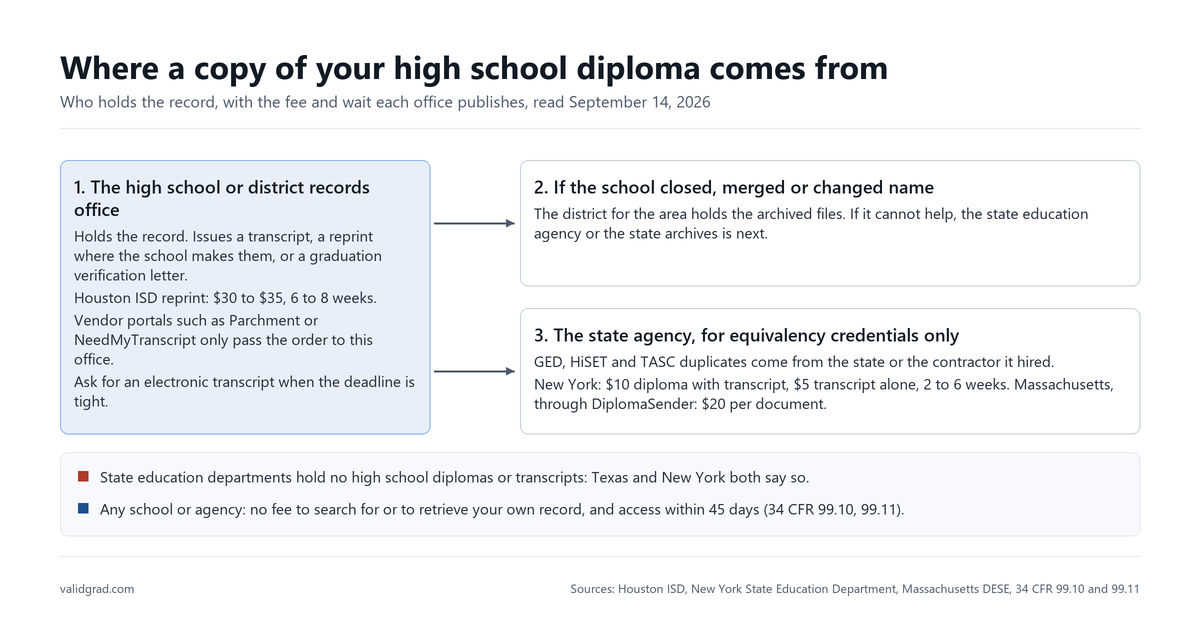
There is no public database where a former student can look up a high school diploma and download it. The district that issued the diploma holds the record, and every legitimate online request routes back to that district or to a records vendor the district pays. The National Student Clearinghouse, which runs transcript ordering for thousands of schools, states the arrangement in one line on its student page: “Your school owns the transcript and determines delivery options and cost.”
This guide covers where the record actually sits, what a copy costs, how long it takes, which parts are free, and what to do when the school has closed or changed its name. Every figure below comes from a state agency, a district records office or the federal student privacy rules, and the sources are listed at the end.
Can You Look Up Your High School Diploma Online?
Ordering online is normal. Viewing an existing diploma online is a different thing, and it is almost never available. Districts publish request forms, and many hand the work to a vendor such as Parchment, NeedMyTranscript or the National Student Clearinghouse. Those systems take an order and pass it to the school office that keeps the file. The Clearinghouse says as much on the same page: “The Clearinghouse does not create, retain, or edit your transcript.”
Before ordering anything, check which document is wanted. Houston Independent School District tells former students that “A diploma is not considered an official document. Diplomas are considered commemorative items, whose function is primarily ceremonial.” The transcript is the record a college, an employer or a licensing board will accept. The differences between the two documents are set out in the diploma and transcript comparison.
Old records also survive longer than most people expect. The New York State Archives schedule keeps the cumulative achievement record, the permanent record card, permanently. Washington keeps the Official Student Record, which includes the standardized high school transcript, for 100 years after a student graduates or withdraws, while the separate cumulative folder can be destroyed after three years. A graduation from the 1970s sits well inside both windows.
Step 1: Contact Your High School
The school that issued the diploma is the first stop, and for most graduates it is also the last one. The school office keeps the academic record and can usually issue a transcript, a reprinted diploma or a letter confirming that you graduated.
1.1 Start on the School or District Records Page
Look for a page named Records, Transcripts, Alumni or Former Students. A useful page tells you five things.
- The form or vendor link used for transcript requests
- Whether the school reprints diplomas at all, and which office handles it
- The fee and the payment methods accepted
- The current processing time
- Where the finished document is sent, and whether an electronic copy is an option
1.2 Call or Email the Registrar’s Office
When the website is thin or out of date, phone the registrar. Have this ready before you call.
- The full legal name used in high school, plus any later name change
- Date of birth
- Year of graduation and the last year attended
- Student ID number, if it is known
- A government-issued photo ID for the identity check
- A mailing address and a phone number the office can use for questions
Federal rules set the outer limit for how long an office may take. Under 34 CFR 99.10, a school, a district or a state education agency must comply with a request to inspect and review a student’s education records “within a reasonable period of time, but not more than 45 days after it has received the request.”
1.3 What to Do If Your High School Has Closed
Closed schools do not take their files with them. The records move to the district, and in some states onward to the state education agency or archives. Start with the district for the area where the school stood, then the state. The full route is in the guide to closed schools. Closed private and for-profit schools are harder, because the custodian of records is named at closure and differs case by case.
Step 2: What the State Department of Education Can and Cannot Do
A common piece of advice sends people to the state education department for a copy of a diploma. For a standard high school diploma that advice is wrong in most states. State agencies collect summary data about graduates. They do not hold the documents.
2.1 What a State Agency Actually Holds
The Texas Education Agency keeps High School Graduation Information from 1990-91 to the present and course information from 1992-93 onward, and its public information page states “TEA DOES NOT have diplomas” and “TEA DOES NOT have transcripts.” Requests go to the school or district instead.
New York is blunter still. Its high school equivalency office writes: “The New York State Education Department DOES NOT have any high school records or high school transcripts. To obtain a copy of your HIGH SCHOOL TRANSCRIPT, contact the school district from which you graduated.”
A few states do run a central archive for very old records or for districts that no longer exist, so read the state agency’s records page before assuming either way. Keep the district as the main route.
2.2 When the State Is the Right Office
There is one category of record the state does own, and that is high school equivalency. GED, HiSET and TASC credentials are awarded by the state, so duplicates come from the state agency or from the contractor it hired. How equivalency credentials work covers what that document is.
States differ in how they run it. New York sells duplicates itself, charging “$5.00 for a copy of a transcript” and “$10 for a copy of a diploma (transcript included)”, with a turnaround of “two to six weeks from the time of receipt of the request form.” Massachusetts contracts the whole job out, and its education department says “A third-party vendor, DiplomaSender, now has access to all Massachusetts GED® and HiSET® records back to 1968 and issues all High School Equivalency credentials, transcripts, and other verification documents for the Commonwealth.” GED Testing Service sends holders to a state-by-state transcript page for the same reason, since there is no single national process.
What a Replacement Diploma Costs and How Long It Takes
Published figures from three record holders, read on September 14, 2026. Every district sets its own fee, so check the school’s page for the number that applies to you.
| Document and source | Fee | Wait |
|---|---|---|
| Replacement high school diploma, Houston ISD high schools | $30 to $35 at most schools | 6 to 8 weeks |
| Duplicate equivalency diploma, New York State (transcript included) | $10 | 2 to 6 weeks |
| Equivalency transcript, New York State | $5 | 2 to 6 weeks |
| Verification letter or transcript for an earlier credential, Massachusetts via DiplomaSender | $20 per document | Not published |
| Inspecting your own education record, any school or agency under FERPA | No search or retrieval fee | Up to 45 days |
Charging for a copy is allowed. Under 34 CFR 99.11 a school “may charge a fee for a copy of an education record”, and the same section adds that it “may not charge a fee to search for or to retrieve the education records of a student.” A fee large enough to prevent access is not permitted at all. Typical waits across districts are collected in the replacement diploma wait times guide.
Step 3: The Online Services That Handle Diploma and Transcript Requests
For those who want a faster route than a phone call, several companies run the request process for schools. They are order desks, and their reach stops where the school’s contract stops.
3.1 Who the District Hired
- DiplomaSender: equivalency records for the states that contracted with it. In Massachusetts it holds GED and HiSET records back to 1968 and issues the credentials, transcripts and verification letters.
- Parchment: transcripts and other documents for schools that subscribe. A school that does not use Parchment cannot be ordered from there. Parchment is now sold inside Instructure’s product line, and Scribbles Software, a separate district records vendor, redirects its old web address to Parchment.
- NeedMyTranscript: high school transcripts, graduation verifications and immunization records. The company says it distributes “100% of the document fees collected back to the high school or district” and it does not handle GED requests.
- National Student Clearinghouse: transcript ordering, weighted heavily toward colleges. Orders are placed through the school site or the Clearinghouse site and then sent to the school for processing.
None of these companies stores a diploma for you. Each one collects an order, takes payment and hands the request to the school that owns the record. Paying a site that is not connected to your school buys nothing.
3.2 How to Show You Graduated When the Diploma Is Gone
Employers and admissions offices rarely want the diploma itself. A sealed or electronic transcript from the district answers the question, and many districts also issue a graduation verification letter. For an equivalency credential, the state contractor issues verification letters on the state’s behalf, as DiplomaSender does for Massachusetts. What verifiers accept is covered in the verification guide and in what employers ask for at hiring.
Step 4: How to Find My High School Diploma Online for Homeschool Graduates
Homeschool records sit outside the district system in most states. The diploma is issued by the parent, an umbrella school or the curriculum provider, so a copy comes from whoever issued it. Online programs and umbrella schools often keep digital records and can reprint.
Where a state requires a notice of intent or annual assessment, the district or the state may hold those filings, although a filing will not substitute for a diploma. The homeschool diploma guide covers what the document should contain.
Common Situations That Make Diploma Recovery Harder
- You moved to another state after graduating. The district where you graduated still holds the file, so contact that office directly.
- Your high school merged or changed names. The successor school or the district office inherits the records.
- You changed your name after marriage or for legal reasons. Offices normally reissue in the name on the original record and ask for legal documentation before adding a new one. Name changes on a diploma covers the paperwork.
- You graduated decades ago. The transcript usually survives, given retention schedules that run to permanent in New York and 100 years in Washington, but archived files take longer to pull.
- The school declines to reprint the diploma. Some districts issue transcripts only, and what to do when a school will not reissue lists the options.
Step 5: If You Only Need Something for the Wall
A picture frame does not need the original document. ValidGrad sells replica high school diplomas as novelty items for display and personal keepsakes. A replica carries no academic standing. It must never be used to claim a credential, to apply for a job or a course, or to answer a verification request, and our terms say so. The copy from the district stays the document that counts.
Your Best Options for Finding Your High School Diploma Online
Five moves, in the order worth trying them.
- Ask the high school or district records office for a transcript, and for a reprint if the school issues one.
- If the school has closed, ask the district that covers the area, then the state archives.
- For a GED, HiSET or TASC, go to the state equivalency office or the contractor it names.
- Use a vendor portal only when the school points you to it.
- Budget for a fee and a wait in weeks, and ask for an electronic transcript when the deadline is tight.
Frequently Asked Questions
How do you get a copy of your high school diploma online?
Start on the website of the high school or its district and look for records, transcripts or alumni services. Follow the form published there, or the vendor link the school provides. The request reaches the same school office either way, and a worked example of the request shows what to write.
How can you get a copy of your high school diploma online for free?
The diploma itself is rarely free. Districts charge for a reprint, and Houston ISD puts the usual range at $30 to $35. Federal rules do make two things free. Inspecting and reviewing your own education record costs nothing, and an office may not charge to search for or to retrieve it. Many districts also send a graduation verification straight to an employer at no charge, which is what most people needed in the first place.
What is the fastest way to get a copy of a high school diploma?
An electronic transcript is the quickest document, often a few business days when the district uses an online vendor. A reprinted diploma is slower, because it has to be printed, signed and mailed. Houston ISD quotes 6 to 8 weeks for one. Ask the registrar whether a rush option exists and whether an emailed transcript will satisfy whoever is asking, since it usually will.
What if your high school closed or changed names?
The local district normally holds the archived records. Contact the district for the area where the school stood and ask for the office that keeps closed-school files. If the district cannot help, the state education agency or the state archives is the next call, and the lost diploma walkthrough covers what to do when nobody answers.
Can you buy your high school diploma online?
A real diploma comes only from the school, district or state that awarded it. The Federal Trade Commission warns that sites promising a diploma with no coursework and a one-day turnaround are scams, and that “Employers, colleges, or the military may reject a diploma from a scam program.” A site that sells a diploma without checking your school record is selling a novelty document.
Sources
- 34 CFR 99.10, the federal student privacy rules. The 45-day limit on records access. Checked September 14, 2026.
- 34 CFR 99.11. Fees for copies, and the ban on charging to search or retrieve. Checked September 14, 2026.
- Texas Education Agency, public information requests. What the state keeps, and that it holds no diplomas or transcripts there. Checked September 14, 2026.
- New York State Education Department, equivalency duplicates. Fees, turnaround, and the department holding no high school records. Checked September 14, 2026.
- Massachusetts Department of Elementary and Secondary Education. The DiplomaSender contract, records back to 1968, and the $20 fee. Checked September 14, 2026.
- Houston Independent School District, student record FAQs. Reprint fees and waits, and the diploma as a ceremonial item. Checked September 14, 2026.
- Washington State Archives, official student records. The 100-year retention period for the official student record. Checked September 14, 2026.
- New York State Archives, local government schedule. Permanent retention of the cumulative achievement record. Checked September 14, 2026.
- National Student Clearinghouse, students and learners. Who owns the transcript, who sets the cost, and how ordering runs. Checked September 14, 2026.
- NeedMyTranscript. What the service covers and how its fees pass back to schools. Checked September 14, 2026.
- Federal Trade Commission, high school diploma scams. Warning signs, and what happens when a fake is used. Checked September 14, 2026.
- GED Testing Service, transcripts. State-by-state ordering for equivalency records. Checked September 14, 2026.