
Look, here’s the thing nobody tells you about IT salaries—most people have no clue what engineers actually make or why salaries vary so wildly. I’ve seen fresh bootcamp grads land $75k jobs while seasoned developers with years of experience struggle to break $90k. The difference? They didn’t understand the game.
According to the U.S. Bureau of Labor Statistics, engineers had a median annual wage of $91,420 in May 2023, which was significantly higher than the median annual wage for all occupations of $48,060. But that’s just the starting point. Experience level, specialization, location, and industry sector create a complex matrix where understanding these dynamics becomes crucial for maximizing your earning potential.
Table of Contents
-
Understanding What Actually Drives Your Paycheck
-
Breaking Down Real Salary Numbers by Experience Level
-
Why Your Location Still Matters (Even in Remote Work)
-
The Specializations That Actually Pay Premium Wages
-
Industry Secrets: Where the Money Really Is
-
How to Negotiate Without Shooting Yourself in the Foot
-
Building Skills That Translate to Bigger Paychecks
-
The Hidden Value in Benefits You’re Probably Ignoring
-
Market Intelligence: Staying Ahead of Salary Trends
TL;DR
-
Entry-level engineers start around $60K-$85K, but specialization can push you to $200K+ within 8 years
-
Geographic location creates 30-50% salary differences, though remote work is changing this dynamic
-
Cloud engineering, cybersecurity, and data engineering command the highest premiums right now
-
FAANG companies offer $130K-$300K+ total compensation, but traditional industries provide stability
-
Total compensation often represents 25-40% more value than base salary alone
-
Negotiation timing around performance reviews and project completions maximizes success
-
Technical leadership paths can reach $280K+ without managing people
-
Certifications like AWS Solutions Architect can boost salary by 15-25%
Understanding What Actually Drives Your Paycheck

Every company needs tech help, and they’re finally willing to pay for it. Digital transformation isn’t just a buzzword—it’s driving serious money into IT roles across every industry. Companies are throwing budgets at technology initiatives, and that translates directly to competitive packages for professionals who can deliver results.
I’ve watched the market evolve over the past few years, and the demand for skilled IT engineers has created a seller’s market. You’re competing in a global talent pool where companies will pay premium rates for the right skills. The landscape has shifted dramatically, with remote work opening doors that didn’t exist five years ago.
The Real Market Forces Behind IT Salaries
Market forces go deeper than simple supply and demand. Enterprise cloud migrations are creating massive demand for engineers who understand both legacy systems and modern architectures. Every company I’ve worked with is dealing with technical debt while trying to modernize their infrastructure simultaneously.
Cybersecurity threats are driving unprecedented investment in security engineering roles. When a single breach can cost millions, companies don’t hesitate to pay premium salaries for engineers who can prevent disasters. The regulatory compliance requirements in healthcare, finance, and government create specialized knowledge that commands significant premiums.
What Experience Actually Means in Dollar Terms
Experience levels create distinct salary tiers, but it’s about the complexity of problems you can solve rather than years on the job. The value you bring and your ability to work independently matter more than your tenure at any single company when determining your earning potential.
Entry-Level Reality Check (0-2 years): $60,000-$85,000
Fresh graduates typically land at the lower end, while bootcamp grads might start slightly lower but often advance faster. Any internship experience can bump your starting offer by 10-15%. I’ve seen candidates with strong portfolios and internship experience negotiate starting salaries at the higher end of this range.
Mid-Level Sweet Spot (3-7 years): $85,000-$120,000
The 3-5 year mark often brings significant jumps because you’re handling complex projects independently. This is where specialization starts paying real dividends. Companies start viewing you as someone who can mentor junior developers while still contributing individual work.
Senior-Level Territory (8+ years): $120,000-$200,000+
Leadership responsibilities become part of the package, whether you’re managing people or technical architecture. You’re making decisions that impact entire organizations, and companies pay premium rates for professionals who can see the big picture and guide technical direction.
Understanding the true value of your educational credentials becomes essential when negotiating these salary ranges, especially when replacing a lost diploma becomes necessary during career transitions.
Breaking Down Real Salary Numbers by Experience Level
Look, here’s the thing nobody tells you about IT salaries—the jumps aren’t gradual. You’ll coast along for a while, then suddenly boom—a $20k increase because you finally figured out what companies actually value.
Entry-Level: Your First Real Paycheck
Starting out, you’re looking at $60k-$85k if you play your cards right. I know it doesn’t sound like much when you’re drowning in student loans, but here’s what matters: this is just your launching pad.
Bootcamp grads often start a bit lower than computer science majors, but here’s the secret—they catch up fast. Sometimes within 18 months. Why? Because they’re hungry and focused on practical skills instead of theoretical knowledge that doesn’t translate to real work.
Your GitHub portfolio matters way more than your GPA at this stage. I’ve seen hiring managers completely ignore transcripts if your personal projects show you can actually build things that work.
Sarah started at $68,000 straight out of college. Felt pretty good until she realized her rent was eating half her paycheck. But she got smart—earned two AWS certifications while working and led a cloud migration project. Eighteen months later? $95,000. That’s a 40% jump because she proved she could solve real business problems.
Mid-Level: Where Things Get Interesting
The 3-7 year range is where your career really starts making sense. You’re looking at $85k-$120k, but more importantly, this is where specialization starts paying real dividends.
Around year three, something clicks. You stop being the person who just implements what others design and start making architectural decisions. Companies notice this shift, and your paycheck reflects it.
This is decision time. Do you want to go deep into cloud architecture or focus on security? These choices will shape your earning potential for the next decade, so don’t just drift into whatever project lands on your desk.
Many professionals at this stage benefit from having proper documentation of their educational achievements, and services for how to get a college diploma replacement can ensure career transitions proceed smoothly.
Senior-Level: The Big Leagues
Senior engineers earning $120k-$200k+ aren’t just writing better code—they’re the ones everyone calls when things break at 2 AM. You’re making decisions that affect entire organizations, and that responsibility comes with serious compensation.
At this level, you’re not just solving technical problems. You’re thinking about business impact, mentoring junior developers, and often being the bridge between technical teams and executives who speak entirely different languages.
|
Experience Level |
Realistic Range |
What You’re Really Doing |
The Catch |
|---|---|---|---|
|
Entry (0-2 years) |
$60k-$85k |
Learning not to break things |
Everything is overwhelming |
|
Mid (3-7 years) |
$85k-$120k |
Actually solving problems |
Imposter syndrome peaks |
|
Senior (8+ years) |
$120k-$200k+ |
Keeping the lights on |
You’re always on call |
Why Your Location Still Matters (Even in Remote Work)

Despite all the remote work hype, geography still plays a huge role in your paycheck. And honestly, the math isn’t always what you’d expect.
Geographic location continues to significantly impact compensation levels, with high-cost tech hubs offering 30-50% premiums over national averages. However, the rise of remote work is creating new opportunities in mid-tier markets and emerging locations.
High-Cost Tech Hubs: The Premium Markets
San Francisco and Seattle still pay the most—30-50% above national averages. But before you start packing, let me tell you about my friend who moved to SF for a $150k job. After rent, taxes, and $20 salads, he had less spending money than when he was making $100k in Austin.
A $150,000 salary in San Francisco might leave you with less disposable income than $100,000 in Austin. The housing costs alone can eat up that premium, and don’t get me started on parking fees and daily expenses.
That said, these markets offer something you can’t get anywhere else: career acceleration. The problems you’ll solve and the people you’ll meet can set up your entire career. Just don’t expect to get rich in year one.
Mid-Tier Markets: The Sweet Spot
Austin, Denver, Atlanta—these are where smart engineers are heading. You get solid salaries with reasonable cost of living, plus growing tech scenes that offer real opportunities.
I’ve watched the Austin market explode over the past five years. Major tech companies are setting up shop, startups are thriving, and you can still afford a house without selling a kidney.
These markets are attracting major tech companies and startups alike. The quality of life tends to be higher, and your salary goes much further. Plus, you’re dealing with less intense competition and burnout culture that sometimes plagues the major tech hubs.
Remote Work: Changing the Game
Some companies are paying San Francisco wages regardless of where you live. Others adjust based on your location. The trick is finding the ones that pay for value, not geography.
Remote-first companies are increasingly offering location-independent salaries, which creates interesting arbitrage opportunities. You can earn San Francisco wages while living in a lower-cost area, though not all companies follow this model.
The best remote opportunities come from companies that built their culture around distributed teams from day one, not those that grudgingly allow it because of the pandemic.
The Specializations That Actually Pay Premium Wages
Not all tech skills are created equal. Some will get you steady work, others will make you rich. Here’s the breakdown nobody wants to admit.
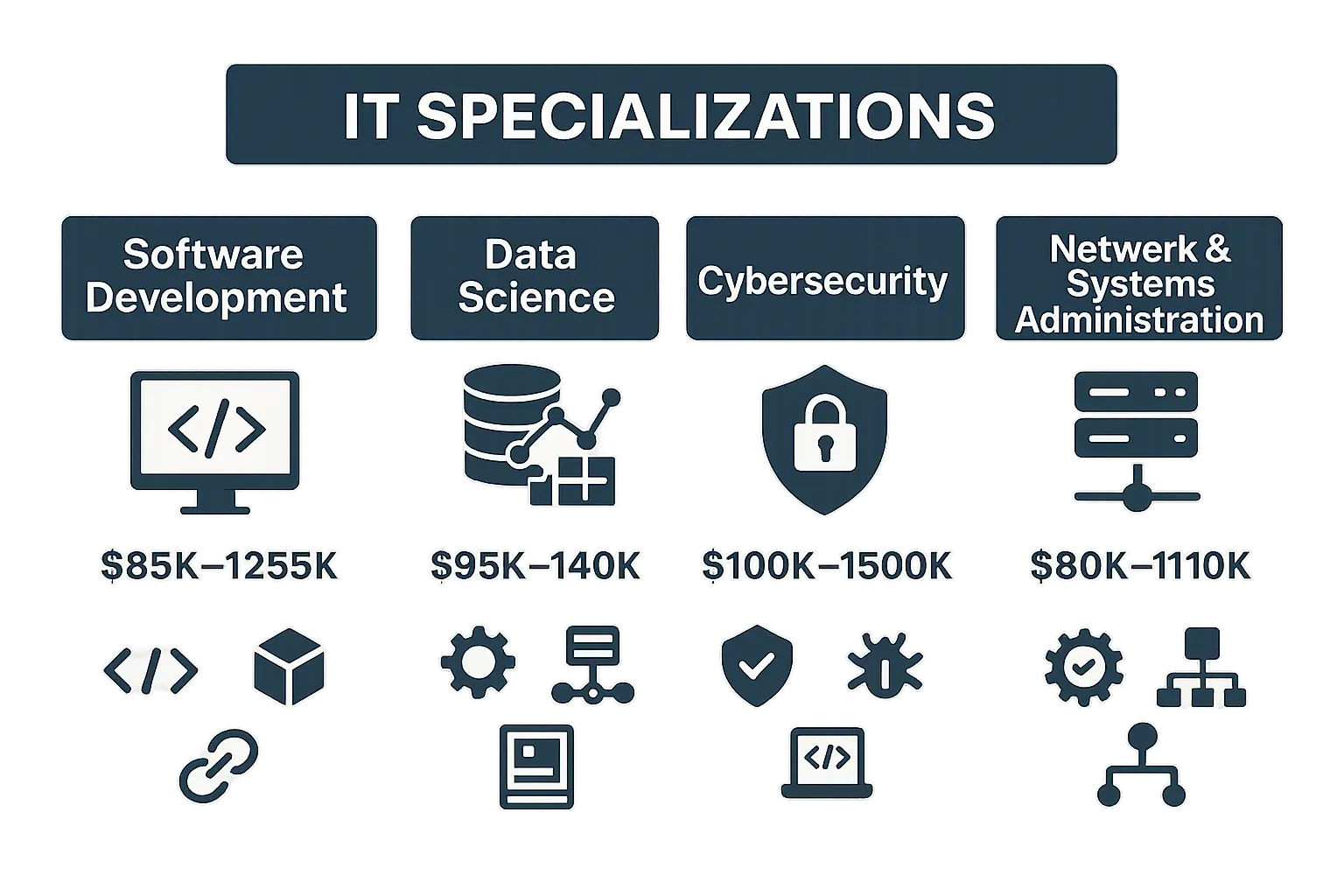
Different IT engineering specializations command varying salary premiums, with emerging technologies typically offering the highest compensation potential. Cloud engineering, cybersecurity, and data engineering lead the high-demand categories with salaries ranging from $90K-$185K.
The job market in the AI sector is characterized by strong demand for qualified professionals, especially in industries where AI is revolutionizing business processes. In the United States, by 2024, the average salary for an AI engineer is estimated at $120,000 to $150,000 annually, according to DataScientest research by companies that specialize in technology recruitment.
High-Demand Specializations: Where the Money Is
Cloud Engineering: $95,000-$180,000
Cloud isn’t just trendy—it’s essential. Every company is either migrating to the cloud or wishing they already had. AWS, Azure, GCP certifications can boost your salary by 15-25%, especially when you combine them with DevOps skills.
The sweet spot is understanding both the technical implementation and the business case. Companies want engineers who can build cloud solutions that actually save money, not just ones that look impressive on architecture diagrams.
The integration of DevOps methodologies makes you even more valuable. Companies want engineers who can build, deploy, and maintain applications in cloud environments. Infrastructure as Code expertise with tools like Terraform and CloudFormation is becoming a requirement rather than a nice-to-have skill.
Cybersecurity Engineering: $90,000-$175,000
The cybersecurity talent shortage is real, and it’s driving up salaries across the board. Every week there’s another breach in the news, and executives are finally taking security seriously.
If you understand compliance requirements like SOX or HIPAA from a technical perspective, you become incredibly valuable. The combination of security skills and regulatory knowledge is rare and highly compensated.
Compliance expertise adds significant value here. If you understand SOX, HIPAA, or PCI DSS requirements from a technical implementation perspective, you become incredibly valuable to organizations in regulated industries.
Data Engineering: $100,000-$185,000
Companies are drowning in data but can’t figure out how to use it. That’s where data engineers come in. If you can build systems that turn raw data into business insights, you’re solving million-dollar problems.
Real-time processing is particularly valuable. Stream processing with Kafka and Spark isn’t just cool technology—it’s what powers fraud detection, recommendation engines, and all the systems that directly impact revenue.
Michael made this transition perfectly. He went from general software development to data engineering by learning Spark and Kafka. Two years later, he jumped from $85k to $135k at a fintech company because he could build real-time fraud detection systems that saved the company millions annually.
Traditional but Stable Specializations
Network Engineering: $75,000-$140,000
Network engineering isn’t going anywhere, but it’s evolving fast. The old “configure routers manually” approach is dying. Now it’s all about software-defined networking and infrastructure as code.
If you can script network configurations and automate deployments, you’ll command higher salaries. The fundamentals of networking remain the same, but the tools and approaches are completely different.
Software-defined networking and network automation are becoming standard expectations. Traditional “configure routers manually” approaches are being replaced by infrastructure as code methodologies.
Systems Administration: $65,000-$120,000
Systems administration is transforming into DevOps and infrastructure as code. Traditional “click and configure” approaches won’t cut it anymore.
Configuration management with Ansible, Puppet, or Chef is becoming essential. The ability to manage infrastructure programmatically separates high earners from those stuck in lower-paying roles.
For professionals transitioning between specializations, maintaining proper educational documentation becomes crucial, and understanding what does a college diploma look like helps ensure your credentials are properly represented throughout your career journey.
Industry Secrets: Where the Money Really Is

Industry choice matters more than most people realize. Same skills, different industry, completely different paycheck.
Industry sector choice significantly impacts compensation, with technology companies, financial services, healthcare, and government each offering distinct compensation structures and career paths. FAANG and tier-1 tech companies provide the highest total compensation ($130K-$300K+) but require extremely competitive hiring processes.
Despite having two decades of experience and a computer science degree, some experienced engineers are finding the current job market challenging. According to Fortune, one software engineer who previously earned $150,000 has sent out 800 applications with fewer than 10 interviews, highlighting how AI’s revolution of the tech industry is creating new market dynamics.
Technology Companies: The Gold Standard
FAANG and Tier-1 Tech: $130,000-$300,000+
These companies don’t just pay high salaries—the stock options and bonuses can double your total compensation. But the hiring process is brutal, and the work environment can be intense.
You’re expected to perform at an extremely high level consistently, and the performance review processes can be stressful. The technology exposure you get at these companies is unmatched. You’re working on systems that serve millions of users, which creates incredible learning opportunities and resume value for future roles.
The real value is the experience and resume boost. Working at scale with millions of users teaches you things you can’t learn anywhere else.
Established Software Companies: $100,000-$200,000
Companies like Adobe, Salesforce, and Microsoft offer excellent pay with better work-life balance than the hyper-growth startups. The technology is mature, and you’re not constantly worried about running out of funding.
These roles often provide stability and predictable career progression paths. You’re working with cutting-edge technology without dealing with the uncertainty of startup life. The benefits packages are typically comprehensive, and the professional development opportunities are substantial.
Financial Services: High Stakes, High Rewards
Investment Banking/Trading: $120,000-$250,000
Financial services technology comes with serious pressure but substantial bonuses. When systems go down, millions of dollars are at stake. The compensation reflects this responsibility, with performance bonuses that can exceed your base salary in good years.
Regulatory compliance knowledge is hugely valuable here. If you understand the technical side of financial regulations, you become indispensable to these organizations. The combination of technical expertise and regulatory knowledge is rare and commands premium compensation.
Traditional Banking: $85,000-$150,000
More conservative compensation but excellent stability and benefits. The technology adoption is slower, but pension plans and comprehensive healthcare add significant value to the total compensation package.
Healthcare and Government: Stability and Purpose
Healthcare Technology: $80,000-$140,000
HIPAA compliance expertise is highly valued in healthcare technology roles. The growing telemedicine and digital health sectors are creating new opportunities with competitive compensation. Electronic health record systems and medical device integration require specialized knowledge that commands premium rates.
Government/Defense: $75,000-$130,000
Security clearances can add 15-25% to your salary, and the benefits packages are often excellent. Pension plans and job security are significant advantages, though the technology can sometimes lag behind private sector roles. The work often has meaningful impact on national security or public services.
How to Negotiate Without Shooting Yourself in the Foot

Most engineers are terrible at negotiation because they treat it like a technical problem. It’s not. It’s about understanding people and timing.
Effective salary negotiation requires thorough preparation, strategic timing, and understanding of total compensation beyond base salary. Market research from multiple sources, personal value proposition development, and timing negotiations around performance reviews or project completions maximize success rates.
Do Your Homework First
Don’t just check Glassdoor once and call it research. Cross-reference multiple sources—PayScale, Levels.fyi, Robert Half surveys. Each platform has different users and methodologies, so combining data gives you a more accurate picture.
The best intelligence comes from your network. People will share compensation information if you approach them professionally. Professional meetups and LinkedIn connections in similar roles provide real-world insights that salary websites miss.
Document everything before you negotiate. Track your certifications, quantifiable achievements, and project outcomes. Numbers speak louder than general statements about being a “hard worker.” Cost savings you’ve delivered and process improvements you’ve implemented become powerful negotiation tools.
Timing Is Everything
Performance review cycles offer the best opportunities for salary discussions. Companies are already evaluating contributions and planning budgets. Your achievements are fresh in everyone’s mind, and managers have budget allocation conversations happening naturally.
Project completions provide natural leverage. When you’ve just delivered a successful implementation or solved a critical problem, your value is most visible to decision-makers. The impact of your work is immediate and measurable, which strengthens your negotiation position significantly.
Market timing matters too. Understanding industry hiring cycles and your company’s financial performance helps you choose the right moment to initiate salary conversations.
Think Beyond Base Salary
Don’t fixate on base salary alone. Health insurance, retirement matching, professional development budgets, and flexible work arrangements all have real value. A lower base salary with excellent benefits might provide more total value than a higher salary with minimal benefits.
Stock options at growing companies can be worth more than salary increases, but they carry risk. Understanding vesting schedules and tax implications helps you evaluate these benefits accurately. Early-stage company equity carries higher risk but potentially massive upside if the company succeeds.
Salary Negotiation Checklist:
-
Research salary ranges from 3+ sources (Glassdoor, PayScale, Levels.fyi)
-
Document quantifiable achievements and cost savings
-
Identify optimal timing (performance reviews, project completions)
-
Calculate total compensation including benefits and equity
-
Prepare alternative negotiation points (flexible work, professional development)
-
Practice negotiation conversation with trusted mentor
-
Set realistic salary range with minimum acceptable offer
During salary negotiations, having proper documentation of your educational background becomes crucial, and knowing is it worth it to get a college degree helps you articulate the value of your formal education alongside your practical experience.
Building Skills That Translate to Bigger Paychecks

Not all skills are created equal. Some will get you steady work, others will make you indispensable.
Certain technical competencies consistently command salary premiums and should be prioritized for professional development investment. High-ROI skills include cloud platform mastery, security specialization, and infrastructure automation, with certifications like AWS Solutions Architect providing 15-25% salary increases.
Employment of computer hardware engineers is projected to grow 7 percent from 2024 to 2034, much faster than the average for all occupations, according to the U.S. Bureau of Labor Statistics. About 4,700 openings for computer hardware engineers are projected each year, on average, over the decade.
High-ROI Technical Skills
Cloud Platform Mastery
Multi-cloud expertise commands premium salaries because enterprises use multiple providers. AWS Solutions Architect certification can boost your salary 15-25%, but combining it with Azure and GCP makes you even more valuable. Companies want engineers who can make informed decisions about which cloud services to use for specific use cases.
Kubernetes and containerization aren’t nice-to-haves anymore—they’re essential. Infrastructure as Code with Terraform directly translates to higher compensation because you’re solving real business problems. The ability to automate infrastructure deployment and management saves companies significant time and money.
Security and Compliance Specialization
Zero Trust architecture implementation is in massive demand. Identity and access management, network segmentation, incident response—these skills create significant salary premiums. Every company is dealing with increasing security threats, and they need engineers who can implement comprehensive security strategies.
The intersection of technical implementation and regulatory requirements is specialized knowledge that commands premium compensation. Understanding how to implement SOX, HIPAA, or GDPR controls makes you incredibly valuable to organizations in regulated industries.
Jennifer made this transition perfectly. She spent six months learning Kubernetes and Docker, then used that knowledge to lead her company’s microservices migration. Result? Promotion from Systems Admin ($75k) to DevOps Engineer ($105k) and establishing herself as the go-to expert for container orchestration projects.
Soft Skills That Drive Compensation
Business Acumen
Understanding ROI calculations and total cost of ownership helps you communicate value in business terms. This often separates high earners from purely technical contributors. When you can translate technical decisions into business impact, you become more valuable to executives.
Vendor negotiation and contract optimization abilities make you valuable beyond your technical contributions. Companies appreciate engineers who can manage vendor relationships and optimize technology spending. These skills demonstrate business maturity and strategic thinking that executives value highly.
Leadership Without Management
Technical leadership—implementing Agile methodologies, managing code reviews, developing team members—creates pathways to higher compensation without formal management roles. You can earn management-level salaries while remaining in technical roles if you can lead technical initiatives effectively.
Knowledge transfer abilities are undervalued but crucial. Engineers who can create training programs and spread best practices across organizations become indispensable. Your ability to scale your knowledge through others multiplies your impact and value to the organization.
|
Skill Category |
High-Impact Skills |
Salary Boost |
Reality Check |
|---|---|---|---|
|
Cloud |
AWS, Azure, Kubernetes |
15-25% |
Takes 3-6 months to get proficient |
|
Security |
Zero Trust, Compliance |
20-30% |
6-12 months, ongoing learning |
|
Leadership |
Mentoring, Documentation |
15-35% |
Develops over years |
|
Business |
ROI analysis, Communication |
10-20% |
Often overlooked but crucial |
The Hidden Value in Benefits You’re Probably Ignoring

Base salary is just the starting point. Benefits often represent 25-40% of your total compensation, but most people barely glance at them during negotiations.
Modern compensation extends far beyond base salary, with benefits and perquisites often representing 25-40% of total compensation value. Health and wellness benefits, financial security programs, professional development investments, and remote work flexibility create substantial additional value that requires careful evaluation when comparing job offers.
Health and Wellness: More Than Just Insurance
Medical insurance varies dramatically between employers. A company covering 100% of premiums versus 80% can represent $3k-$5k annually. That’s real money that directly impacts your take-home pay.
Mental health programs, gym memberships, and wellness initiatives have genuine value, especially in high-pressure tech roles. Some companies offer on-site fitness facilities and mental health counseling that would cost hundreds monthly if purchased independently.
Health Savings Account contributions and wellness incentive programs can add significant value to your total compensation package. These benefits often provide tax advantages that increase their effective value beyond the dollar amounts contributed.
Financial Security Beyond Salary
401(k) matching creates substantial long-term value. A company matching 6% with immediate vesting provides significantly more value than lower matching with longer vesting periods. Over 30 years, this difference represents hundreds of thousands in retirement savings.
Stock options can dramatically impact total compensation, especially at growing companies. Understanding vesting schedules and tax implications helps you evaluate these benefits accurately. Early-stage company equity carries higher risk but potentially massive upside if the company succeeds.
Professional Development Investment
Tuition reimbursement and certification funding can be worth thousands annually. Companies investing $5k-$10k in your professional development are providing tax-free income for career advancement. Some organizations offer substantial budgets for continuing education, which represents significant value for career growth.
Conference attendance has both immediate and long-term value. The connections you make often lead to better opportunities and higher salaries down the road. Companies that send employees to major conferences are investing in their professional networks and industry knowledge.
Remote Work and Flexibility
Location-independent salaries create incredible value for remote workers. Earning San Francisco wages while living in a lower-cost area can increase your purchasing power by 30-50%. This arbitrage opportunity represents tens of thousands of dollars in additional value annually.
Eliminating daily commutes saves 10+ hours weekly and thousands annually in transportation costs. The time savings alone has monetary value when you consider what you can accomplish with those additional hours.
Flexible schedules accommodate family responsibilities and personal commitments in ways that traditional office jobs simply can’t match. This flexibility has real monetary value when you consider childcare costs and personal time.
Benefits Evaluation Template:
-
Health Insurance: Premium costs, deductible amounts, coverage scope
-
Retirement: 401(k) matching percentage, vesting schedule, investment options
-
Professional Development: Annual budget, conference attendance, certification reimbursement
-
Equity: Stock options, vesting timeline, company growth potential
-
Flexibility: Remote work policy, flexible hours, unlimited PTO
-
Wellness: Gym memberships, mental health programs, HSA contributions
When evaluating comprehensive benefits packages, professionals should ensure their educational credentials are properly documented, and understanding framed college diploma display options helps present achievements professionally in home offices during remote work arrangements.
Market Intelligence: Staying Ahead of Salary Trends

Staying current with compensation trends requires systematic data gathering from multiple sources. The market moves fast, and last year’s salary data might already be outdated.
Staying current with compensation trends requires systematic data gathering from multiple sources including professional surveys, anonymous salary platforms, and competitive intelligence. Economic factors like technology investment cycles, venture capital funding levels, and digital transformation spending significantly impact salary trends and negotiation leverage.
Real-Time Data Collection
Professional surveys from IEEE Computer Society and CompTIA provide industry-wide data. Local tech meetup salary sharing offers more granular regional information that’s immediately actionable for your specific market.
Anonymous platforms like Blind and Levels.fyi provide verified employee discussions about compensation. These platforms offer insights into total compensation packages that traditional salary websites miss. The real-time nature of these discussions gives you current market intelligence rather than outdated survey data.
Building relationships with technical recruiters gives you insider knowledge about market demand and hard-to-fill position premiums. Recruiters understand which skills are commanding premium rates and which markets are most competitive. They’re also aware of upcoming hiring initiatives that might create opportunities.
Economic Factors Affecting Salaries
Venture capital funding levels directly impact startup salary competition. When funding is abundant, startups compete aggressively for talent, driving up compensation across the market. Conversely, when funding tightens, salary growth slows and competition for positions increases.
Enterprise IT budget allocation trends create demand for specific skills. Cloud migration projects, cybersecurity investments, and digital transformation initiatives drive salary premiums for relevant expertise. Following industry spending reports helps you anticipate which skills will be in highest demand.
Interest rates and inflation impact real wage growth. Understanding these factors helps you negotiate cost-of-living adjustments and evaluate long-term career moves. High inflation periods require more aggressive salary negotiations to maintain purchasing power.
Market Intelligence Toolkit:
-
Subscribe to industry salary reports (IEEE, CompTIA, Robert Half)
-
Monitor anonymous salary platforms (Levels.fyi, Blind)
-
Track job posting salary ranges in your specialization
-
Build relationships with 3-5 technical recruiters
-
Follow venture capital funding news in your industry
-
Monitor economic indicators affecting tech spending
Professional documentation of educational achievements becomes increasingly important as engineers advance their careers and maximize earning potential. For comprehensive career documentation, professionals may also need college transcript replacements to support their salary negotiations and career advancement discussions with complete academic records.
Final Thoughts
The IT salary landscape offers incredible opportunities, but only if you understand how to navigate it strategically. Your earning potential isn’t just about technical skills—it’s about positioning yourself in the right specializations, markets, and companies while continuously developing both technical expertise and business acumen.
Geographic location still matters, but remote work is creating new opportunities that didn’t exist five years ago. The key is understanding total compensation rather than fixating on base salary alone, and timing your career moves and negotiations strategically.
Specialization choices you make early compound over time. Cloud engineering, cybersecurity, and data engineering currently offer the highest premiums, but the landscape evolves quickly. Stay informed about market trends and be willing to adapt your skill set as demand shifts.
Remember that salary negotiation improves with practice and preparation. Document your achievements, understand your market value, and don’t be afraid to advocate for yourself. The worst they can say is no, and even that gives you valuable information about your position and future opportunities.