
There is no national standard for the size of a US college diploma, so the first step in any diploma display is a ruler, not a shopping cart. Registrar offices publish sizes that range from 8 × 10 inches at the University of Wisconsin-Madison to 17 × 23 inches at Rice, and several schools issue a different size for doctoral degrees than for bachelor’s degrees. Measure the document, add a mat border of 2 to 3 inches on each side to get the frame size, choose a mat and glazing that will not damage the paper, and hang it where the light will not reach it. If the diploma is irreplaceable, the safest display of all is a copy on the wall and the original flat, dark and dry in a box.
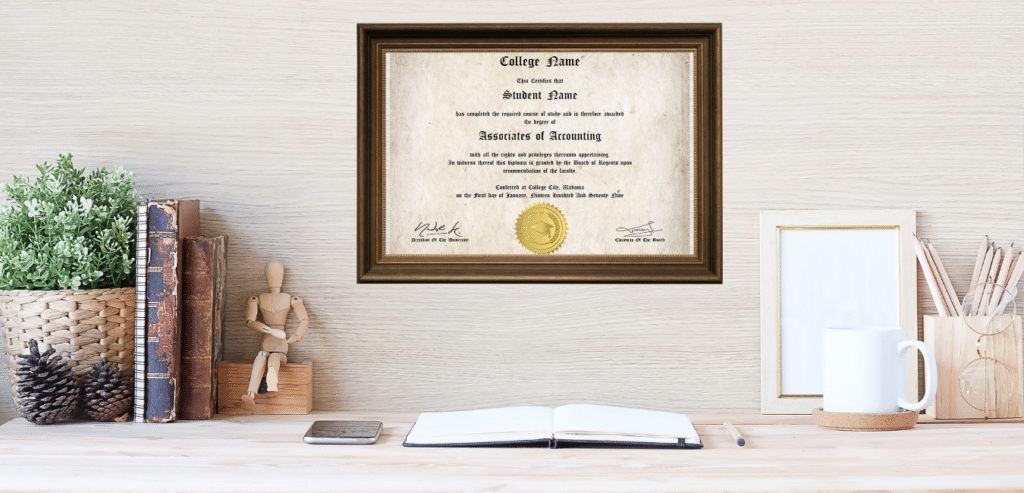
Step 1: measure the diploma, because sizes are not standard
Frame shopping usually starts with “8.5 × 11” because that is the size of a sheet of letter paper. It is a poor assumption for a degree. The table below collects the dimensions that university registrars publish for their own diplomas. Every row is taken from the institution’s own page, and the sizes are quoted as the school states them, so some are given width first and some height first.
| Institution | Diploma size (inches) | Notes |
|---|---|---|
| Wisconsin-Madison | 8 × 10 | “All diplomas, regardless of your degree or when you earned it” |
| Missouri | 8.5 × 11, doctorate 13 × 17 | All printed portrait |
| Indiana University | 8.5 × 11, professional 16 × 20 | Professional degrees are much larger |
| Seattle University | 8.5 × 11, doctoral 11 × 14 | Landscape orientation |
| Chicago | 9 × 12 | Landscape format, 8.5 × 11 before 2011 |
| Boise State | 11 × 8.5, master’s and doctoral 14 × 11 | Associate, bachelor’s and certificates take the smaller size |
| George Mason | 10 × 14, certificates 8.5 × 11 | Diplomas portrait, certificates landscape format |
| Case Western Reserve | 11 × 14 | One size for all diplomas |
| UT Dallas | 11 × 14 | One size |
| Lamar | 11 × 14 | Current size, per the alumni office |
| Richmond | 11 × 14, law 17 × 22 | 11.5 × 14.5 before December 2023 |
| Memphis | 14 × 11, doctoral and law 14 × 17 | Graduate certificates 8.5 × 11 |
| Georgia | 12 × 15 | “All diplomas issued by the University of Georgia” |
| James Madison | 12 × 16 | Landscape format |
| Virginia Tech | 13.5 × 15.5 | No off-the-shelf frame matches this |
| Georgia Tech | 17 × 14 | “Only issues one size diploma for all majors and levels” |
| Rice | 17 × 23 | 18 × 23 before November 1, 2017 |
Three things follow from that table. First, the same school can issue two or three sizes, usually a larger sheet for doctoral, law or professional degrees. Second, sizes change. Chicago moved from 8.5 × 11 to 9 × 12 in 2011, Richmond trimmed its diploma in December 2023, and Rice narrowed its sheet on November 1, 2017 because, as the registrar explains, US diploma vendors could no longer get parts for the larger-format printing machines. A frame bought for a sibling’s diploma from the same university may not fit yours. Third, orientation is not a detail. A James Madison or Georgia Tech diploma is wider than it is tall, and a portrait frame will not hold it.
If your diploma has not arrived yet, the registrar’s website is the place to check. Most publish the dimensions on the same page that explains whether you get the diploma at graduation or in the mail. For what the document itself contains, from the seal and signatures to Latin honors, see what a college diploma looks like and how doctoral diplomas differ.
Step 2: turn the diploma size into a frame size
Picture frames are sold by the size of the artwork or mat they hold, not by their outside moulding dimensions. So the arithmetic is:
Frame size = diploma size + (2 × mat border).
A typical mat border is 2 to 3 inches per side, according to framing supplier Frame Destination, though wider borders are common on large documents. The mat window itself is cut slightly smaller than the document, by about a quarter of an inch on each side, so the mat overlaps the edges and holds the diploma without tape across the face.
| Diploma size | Frame size with a 2 in border | Frame size with a 3 in border | Nearest common off-the-shelf frame |
|---|---|---|---|
| 8 × 10 | 12 × 14 | 14 × 16 | 11 × 14 (1.5 in border) |
| 8.5 × 11 | 12.5 × 15 | 14.5 × 17 | 11 × 14 (1.25 in) or 16 × 20 (wide mat) |
| 9 × 12 | 13 × 16 | 15 × 18 | 16 × 20 with a custom-cut mat |
| 11 × 14 | 15 × 18 | 17 × 20 | 16 × 20 (2.5 in border) |
| 12 × 15 | 16 × 19 | 18 × 21 | 18 × 24, or custom |
| 12 × 16 | 16 × 20 | 18 × 22 | 16 × 20 exactly, at a 2 in border |
| 13.5 × 15.5 | 17.5 × 19.5 | 19.5 × 21.5 | None, custom framing |
| 17 × 14 (landscape) | 21 × 18 | 23 × 20 | 24 × 18 landscape, or custom |
| 17 × 23 | 21 × 27 | 23 × 29 | None, custom framing |
Only the first four rows have a convenient answer at a craft store. That single fact explains most of the diploma-frame market: if your school issues a 12 × 15 or 13.5 × 15.5 sheet, you are buying either a custom frame from a local framer or a made-to-size frame from a campus-licensed vendor.
Step 3: mat, glazing and mounting that will not damage the paper
A diploma is a single sheet of paper that has to survive decades on a wall. The Northeast Document Conservation Center’s leaflet on matting and framing is the standard reference, and three of its rules matter most here:
- Use 100% cotton rag board for the window mat and the backing board. NEDCC specifically warns against foam boards, “archival” paper-faced foam, lignin-containing mat boards, kraft paper and self-adhesive tapes, which are the materials most cheap frames are packed with.
- Keep the paper off the glazing. “Objects should never be in contact with the glazing surface,” the leaflet states. If moisture condenses inside the frame, a document touching the glass can stick to it. The mat provides that gap.
- Filter the light. The National Archives advises acid-free cotton rag or chemically purified pulp mat board and ultraviolet-filtering glazing wherever the display space gets sunlight or fluorescent light.
Two things to avoid outright are lamination and dry mounting. Both bond the diploma permanently to another material and cannot be reversed, and a laminated diploma is usually refused by registrars if you later need it certified. The full hanging procedure, including wall choice, spacing, nail height and grouping several documents, is set out step by step in how to display certificates on a wall rather than repeated here.
Heavier stock also sits flatter under glass, which is part of why schools use it. See what paper diplomas are printed on, and how diploma seals work if yours has a raised or foil seal that a tight mat could crush.
Diploma folders and covers versus frames
The padded folder handed over on stage is not a display device, and at most large universities it is not even holding the diploma. Indiana University tells graduates they will get a diploma cover at the commencement celebration ceremony, “but not the diploma itself”. Wisconsin-Madison hands out covers at the ceremony and at cap-and-gown pickup, and the diploma is mailed weeks later.
Covers are usually sized for a letter-size sheet. The University of Minnesota’s own cover is 8.5 × 11 inches, opening along the right-hand side, so a cover tells you nothing about the size of the diploma that will arrive later. It is also the cheap item in the display category. The same bookstore sells that cover for $7.60 and its licensed diploma frames for $212 to $230 (September 13, 2026).
Used properly, the folder is storage instead of display, and it keeps the document flat, closed and out of the light, which is exactly what a conservator would ask for. The sensible division is a folder or archival box for the original and a frame for whatever goes on the wall.
What a licensed campus diploma frame actually costs
Most universities point graduates at one officially licensed frame vendor. Church Hill Classics, trading as diplomaframe.com, describes its products as “officially licensed custom college diploma frames handcrafted in the USA”. University Frames supplies schools including Lamar, and Jostens and campus bookstores sell their own lines. The frames are made to the school’s diploma size and carry licensed artwork, such as an embossed seal, a campus lithograph or the university wordmark in its official colors.
The prices below were read on September 13, 2026 and will move.
| Seller | Product | Price (13 Sep 2026) |
|---|---|---|
| Reddie Bookstore, Henderson State | Silver Embossed Black Mat Diploma Frame | $99.99 |
| Reddie Bookstore, Henderson State | Tassel Edition Diploma Frame | $141.99 |
| Reddie Bookstore, Henderson State | Presidential Silver Engraved Diploma Frame | $194.99 |
| Reddie Bookstore, Henderson State | Double Diploma Frame | $209.99 |
| U of M Bookstores, Minnesota | Classic Diploma Frame, Legacy Diploma Frame | $212.00, and $214.00 to $230.00 |
| University of Dayton Bookstore | Church Hill Presidential Diploma Frame | $279.99 |
Three things explain the gap from a craft-store frame, and only one of them is the wood. The frame is cut to a non-standard document size and usually includes conservation-grade mats and UV glazing. The artwork is licensed, which means a royalty: UT San Antonio states that “a portion of all Diploma Frame sales are sent back to the UT San Antonio Alumni Association in support of scholarships and programming efforts”. And the frames are sold through a single approved channel per campus, which is not a competitive market.
None of that is an argument against buying one. It is an argument for knowing what you are buying. If your diploma happens to be 8.5 × 11 or 11 × 14, a conservation-quality off-the-shelf frame with an acid-free mat will protect the document just as well for a fraction of the price, minus the seal and the school colors.
Display ideas for home and office
A few arrangements that work, drawn from the constraints above rather than from decorating taste:
- Single frame at eye level. The simplest option, and the only one that suits a very large diploma. Center it at eye height on the wall a visitor faces, not behind your own chair where you will never see it.
- Grouped wall for several credentials. Matching frames and one mat color hold a mismatched set of document sizes together. Lay the group out on the floor first. Spacing and hanging heights are worked through in the certificate display guide.
- Shadow box with the tassel or cap. Deeper than a standard frame, and the usual reason people buy a “double” frame. Keep the memorabilia from resting against the diploma itself.
- Double frame with a campus photograph. The standard licensed product: diploma on one side, a lithograph or photograph of the campus on the other.
- Desk or shelf easel. Useful in a rented office where you cannot drill, and easy to turn away from a sunny window.
- Interior hallway or a wall away from the window. This is the least glamorous advice and the most important. Light does the damage, and a windowless wall keeps ink and paper looking new far longer than a sunlit feature wall.
One caution applies to an office wall. A framed diploma is a statement about your education that clients and colleagues read literally, so it should match what you actually hold. And if an employer asks for documentation, a wall frame is not what they want, as what to do when an employer asks for a copy of your diploma explains.
Display a copy and keep the original safe
The National Archives puts the case in one sentence: “The best protection from light is to display copies of the originals and keep the originals in a box.” Exposure to light, visible and ultraviolet alike, causes fading and darkening that no frame fully prevents, and a diploma hanging in an office for twenty years is on permanent exhibition.
There is a practical argument on top of the preservation one. A damaged or lost diploma is not quick to replace. The request goes back to the registrar, is usually paid for, and takes weeks. Replacing a lost diploma walks through that process, and the degree timeline hub covers how long the original took to arrive.
So the arrangement that gives up the least is the original stored flat, dark and dry in its folder or an archival box, and a display copy in the frame. It is also the only workable answer when several people want one, because parents, a grandparent, a home office and a work office cannot all have the original.
A replica diploma for display
ValidGrad makes novelty replica diplomas built for exactly this use: a document you can frame, hang in daylight and hand to a parent, while the original stays in a box. You choose the wording, the layout and the paper, and the replica is printed to a size that fits a standard frame or the frame you already own. Start with the replica college diploma maker, or the replica bachelor’s degree page if you want a specific degree layout. Current pricing and paper options are on the product pages.
These are novelty and display items. A replica must never be used to claim a credential you did not earn, submitted to an employer or school, or offered in answer to a verification request; that is set out in our terms and conditions.
Frequently asked questions
How do I display my diploma?
Measure the document, buy or order a frame sized to the document plus a 2 to 3 inch mat border on each side, use a cotton rag mat so the paper never touches the glazing, choose UV-filtering glass or acrylic, and hang it on a wall that does not get direct sun. If the diploma is irreplaceable, frame a copy and store the original flat and dark.
What size frame do I need for a college diploma?
It depends entirely on your school. An 8.5 × 11 diploma fits an 11 × 14 frame with a narrow mat or a 16 × 20 frame with a wide one. An 11 × 14 diploma fits a 16 × 20 frame. Sizes such as Georgia’s 12 × 15, Virginia Tech’s 13.5 × 15.5 or Rice’s 17 × 23 have no off-the-shelf equivalent and need custom framing.
Why are diploma frames so expensive?
Licensed campus frames ran from about $100 to $280 in September 2026 because they are cut to a non-standard document size, include conservation mats and UV glazing, carry licensed artwork, and pay a royalty back to the university. UT San Antonio confirms that a portion of every frame sale funds its alumni association.
Can I use an ordinary document frame from a craft store?
Yes, if the size matches and the materials are sound. Replace any paper-faced foam backing and non-archival mat with cotton rag board, check that the glazing is UV-filtering, and make sure the mat holds the document away from the glass. Those swaps cost far less than the price gap to a licensed frame.
Should I frame the original diploma or a copy?
A copy, if the wall gets any daylight. The National Archives recommends displaying copies and boxing the originals, and replacing a damaged diploma means a paid request to the registrar and a wait of several weeks.
Sources
- Northeast Document Conservation Center, Preservation Leaflet 4.10: Matting and Framing for Works on Paper and Photographs
- Northeast Document Conservation Center, Preservation Leaflet 2.4: Protection from Light Damage
- US National Archives, Displaying Family Papers and Photographs
- Frame Destination, What Size Diploma Frame Do I Need? (mat border guidance)
- Church Hill Classics, Diploma Frames for Colleges and Universities
- University of Texas at San Antonio, Alumni Keepsakes
- University of Minnesota Bookstores, University of Minnesota Diploma Cover
- Campus store prices: Reddie Bookstore, Henderson State University and University of Dayton Bookstore
- Diploma dimensions: the registrar and commencement pages linked in the size table above (Wisconsin-Madison, Missouri, Indiana, Seattle University, Chicago, Boise State, George Mason, Case Western Reserve, UT Dallas, Lamar, Richmond, Memphis, Georgia, James Madison, Virginia Tech, Georgia Tech, Rice)
Diploma dimensions and frame prices were read on September 13, 2026. Schools change diploma sizes and vendors change prices without notice, so confirm with your registrar or the seller before ordering a frame.