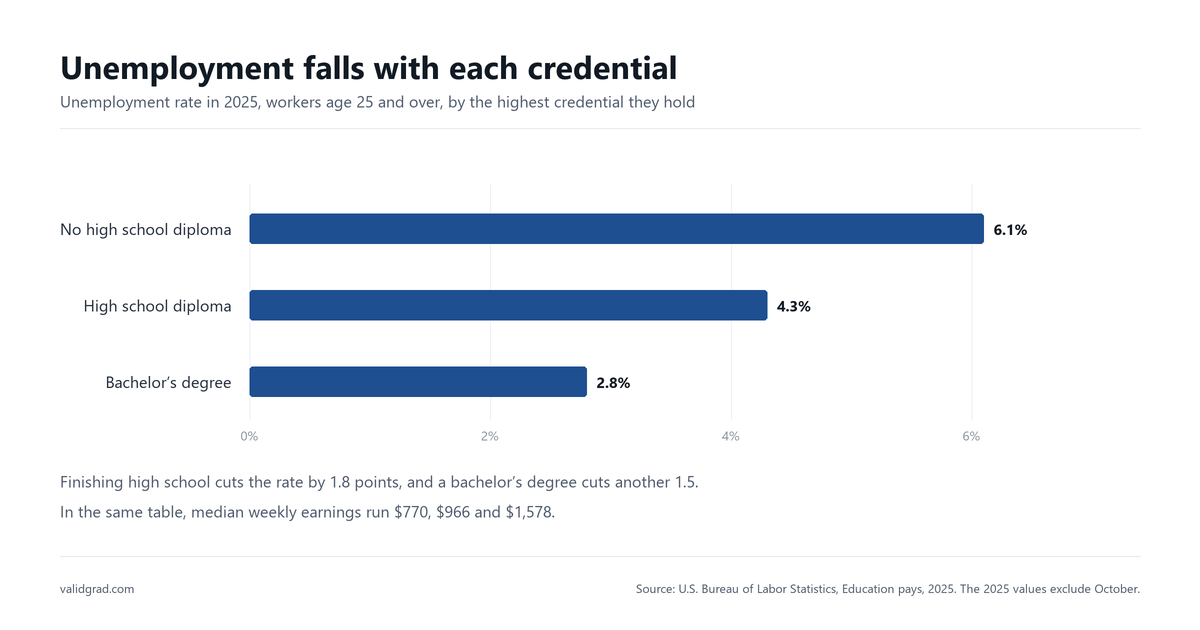
Diplomas still matter in 2026, and the gap they sit on is measurable. In 2025, U.S. workers age 25 and over whose highest credential was a high school diploma had median weekly earnings of $966 and 4.3 percent unemployment. Workers without a diploma earned $770 and faced 6.1 percent. Workers with a bachelor’s degree earned $1,578 and faced 2.8 percent. Those are Bureau of Labor Statistics figures for full-time wage and salary workers, and the full table by level sits in the salary by education level guide.
What has changed is how loudly employers say the credential counts. Since 2020 thousands of companies, several states and the federal government have pulled degree requirements out of job postings. Research published in February 2024 by the Burning Glass Institute and Harvard Business School found the change has barely reached hiring. Dropping a requirement raised the share of hires without a bachelor’s degree by about 3.5 percentage points, but only 3.6 percent of roles dropped one, so the net effect came to 0.14 percentage points, roughly 97,000 workers a year out of 77 million hires.
This post covers what a diploma is worth at each level in 2026, what skills-based hiring actually changed, and what the options are for someone without one. For how employers check education, there is a separate guide on do employers verify degrees.
Do diplomas still matter in 2026 for getting hired?
The answer starts with the posting. Of the roughly 170 million jobs the Bureau of Labor Statistics counted in 2025, a high school diploma or its equivalent is the typical entry requirement for the largest single block, and a bachelor’s degree for about a quarter.
| Typical entry-level education | Jobs in 2025 (millions) | Share of all jobs | Projected change to 2035 |
|---|---|---|---|
| No formal educational credential | 40.2 | 23.6% | +2.3% |
| High school diploma or equivalent | 60.3 | 35.4% | +2.0% |
| Postsecondary nondegree award | 10.7 | 6.3% | +5.7% |
| Some college, no degree | 4.2 | 2.5% | -3.2% |
| Associate degree | 3.6 | 2.1% | +4.9% |
| Bachelor’s degree | 42.9 | 25.2% | +5.6% |
| Master’s degree | 3.9 | 2.3% | +11.0% |
| Doctoral or professional degree | 4.5 | 2.7% | +6.4% |
What skills-based hiring changed
Job advertisements changed a great deal, with an almost fourfold rise between 2014 and 2023 in the number of roles each year from which employers removed a degree requirement, down somewhat from a peak in 2022. A degree filter disqualifies the 62 percent of Americans who do not hold one, and that is why the removals drew attention.
Hiring changed far less. The researchers matched postings against the career histories of 65 million U.S. workers and sorted the firms into three groups:
- About 37 percent of firms drove nearly all of the real change, hiring on average 18 percent more workers without a bachelor’s degree into the affected roles.
- About 45 percent changed the posting and nothing else, with no measurable difference in who was hired.
- About 18 percent made early gains and then slid back to their earlier hiring pattern.
The report’s summary of the net result is that the promised opportunity “was borne out in not even 1 in 700 hires last year.” A posting that no longer names a degree is an invitation to apply, and not yet evidence that the filter is gone.
Where governments dropped degree requirements
- Federal hiring. Executive Order 13932 of June 26, 2020 lets an agency prescribe a minimum educational requirement for the competitive service “only when a minimum educational qualification is legally required to perform the duties of the position.”
- Maryland. The state removed the four-year degree requirement from many state jobs in 2022, a step recorded in the September 2022 minutes of the Maryland Governor’s Workforce Development Board.
- Pennsylvania. On January 18, 2023, Executive Order 2023-03 confirmed that 92 percent of commonwealth jobs, about 65,000 positions, do not require a four-year degree, and directed the Office of Administration to emphasize skills and experience in job postings.
These orders bind only the employers that issued them.
Does a high school diploma still matter?
Yes, and it is the level where the numbers move most sharply. The step from no diploma to a diploma is worth $196 a week at the median and cuts unemployment from 6.1 percent to 4.3 percent, on 2025 Bureau of Labor Statistics data. It also covers 60.3 million jobs.
What a high school diploma means
A high school diploma is the credential a school awards when a student completes the graduation requirements set by the state, so the exact bar differs from state to state. The diploma records completion. The document listing the courses, grades and credits behind it is the transcript, as set out in diploma vs transcript.
An equivalency credential is a different document, issued by a state after a test such as the GED or HiSET. Employers and colleges generally treat it as the equivalent of a diploma while still naming it separately. There are guides on the high school equivalency diploma and on a GED on a resume.
What you can do with a high school diploma
- Apply to the 60.3 million jobs in occupations that take a diploma or equivalent at entry, 35.4 percent of U.S. employment in 2025.
- Enlist without an aptitude-score penalty. Under 10 U.S.C. 520, an applicant who is not a high school graduate may not enlist unless the Armed Forces Qualification Test score is at or above the 31st percentile.
- Qualify for federal student aid. Under 34 CFR 668.32 a student generally must have “a high school diploma or its recognized equivalent,” with narrow alternatives.
- Enter apprenticeships, trade programs and community college, most of which use the same baseline.
Work is available without the credential, in the 40.2 million jobs that need no formal educational credential, listed in jobs without a high school diploma. The pay gap is the cost, and how much a high school diploma costs covers the routes for finishing.
Is a college degree still worth it in 2026?
On pay and employment, the bachelor’s premium held in 2025. Median weekly earnings ran $1,578 against $966 for a high school diploma, about $31,800 over a full year, with unemployment at 2.8 percent against 4.3 percent. Graduate credentials sat higher again. The complete figures by level are in the salary by education level guide.
Those are medians across every field and every age, so they describe the group and no individual program. About 42.9 million jobs typically require a bachelor’s degree to enter, and that block is projected to grow 5.6 percent by 2035 against 2.0 percent for the high school diploma block.
Enrollment points the same way, with a shift toward shorter credentials. National Student Clearinghouse Research Center estimates put total postsecondary enrollment up 3.2 percent in spring 2025, undergraduates at 15.3 million, and undergraduate certificate enrollment up 4.8 percent and about 20 percent above 2020. Longer term, the National Center for Education Statistics recorded a 15 percent fall in undergraduate enrollment between 2010 and 2021 and projects a 9 percent recovery by 2031.
For an individual decision, the wording of the target job advert settles most of it:
- If the postings say “bachelor’s degree required,” the degree is a gate and the other evidence cannot open it.
- If they say “degree preferred” or “or equivalent experience,” skills, certifications and a work record carry real weight.
- If the requirement was dropped recently, check who actually gets hired before treating the change as settled.
Time and format matter to the arithmetic as much as the credential does, which is covered in how long it takes to get a degree and in online degrees.
When diplomas matter more
- The education floor is set by law. Where a state license or a federal rule fixes the qualification, the employer cannot waive it, and Executive Order 13932 keeps that carve-out for federal jobs.
- The requirement was removed on paper only. About 45 percent of the firms studied showed no measurable change in who they hired, so the degree kept working as a filter inside the process.
- The applicant is early in a career. With little work history to read, the credential is most of what a screener has, the role the researchers call “more proxy than direct measure.”
- Federal student aid is the goal, where 34 CFR 668.32 makes the diploma or its recognized equivalent the default condition.
When diplomas matter less
- The employer followed through. The firms the report calls leaders hired 18 percent more workers without a bachelor’s degree into the roles they opened up, among them Koch Industries, Walmart, Apple, General Motors, Target, Cigna, ExxonMobil and Yelp, plus the State of Minnesota and the City of Denver.
- The skill can be tested directly, or a long work record already shows it. A proxy adds least where a work sample, a portfolio or a checkable history gives direct evidence.
- A shorter credential fits the role. Occupations entered with a postsecondary nondegree award cover 10.7 million jobs and are projected to grow 5.7 percent by 2035.
On whether a high school diploma alone is enough for a large tech company or a startup, the evidence cuts both ways. Apple is among the employers whose hiring shifted, while the overall effect stayed under 1 in 700 hires.
What diplomas still signal in 2026
The Burning Glass and Harvard Business School authors describe why the filter spread. Degrees were “perceived as indicators of persistence, of foundational skill, and of general capability,” and were treated as “more proxy than direct measure” of any of them. Executive Order 13932 puts the criticism in the same terms, that an “overreliance on college degrees excludes capable candidates and undermines labor-market efficiencies.”
Both can hold at once. The credential carries information a screener cannot get elsewhere in thirty seconds, and it excludes the 62 percent of American adults without a degree. Employers also keep confirming the details they are given, as covered in do employers verify degrees and the education background check.
How to make your diploma matter more
- Keep the record findable, since employers and schools ask for transcripts years later and the school holds the official copy.
- Add a credential the occupation data rewards. The postsecondary nondegree award block grows faster than the diploma block and covers licensed trades, health support roles and technical fields.
- Show work that can be examined, and collect countable experience through internships, apprenticeships, freelance work and part-time roles.
ValidGrad makes replica diplomas and transcripts as novelty items for display and framing, as in a framed college diploma display. A replica carries no academic standing. It cannot be used to claim a credential or to answer a verification request, as the terms set out. Official copies come from the school.
What if you do not have a diploma yet?
At high school level, the priority is clearing the baseline that federal aid rules, enlistment standards and a third of all job postings share:
- Adult high school programs award the diploma itself, through a district or a state-approved provider.
- A state equivalency test such as the GED or HiSET produces a recognized equivalent, accepted for federal student aid.
- Costs and timelines for both routes are in how much a high school diploma costs.
At college level, the choice is less about whether to enroll than about what to enroll in:
- Check the postings for the target job first. If they name a degree, the degree is the requirement. If they name skills, a shorter credential may reach the same door.
- Weigh a certificate against a degree on time as well as price, using how long it takes to get a certificate.
What it adds up to
- Diplomas still matter in 2026, with the pay and unemployment gaps by education level intact in the 2025 federal data.
- The high school diploma is the largest entry requirement in the labor market, at 35.4 percent of jobs, and the condition for federal student aid and for enlisting without an aptitude-score penalty.
- Degrees gate about a quarter of jobs and carry a median premium of roughly $31,800 a year over a high school diploma, across all fields.
- Skills-based hiring is real in job ads and small in outcomes so far, at about 97,000 additional workers a year out of 77 million hires.
Common questions
Does a high school diploma matter?
Yes. In 2025 the median full-time worker with a high school diploma earned $966 a week against $770 without one, at 4.3 percent unemployment against 6.1 percent. The diploma or its equivalent is the typical entry requirement for 35.4 percent of U.S. jobs and the default condition for federal student aid.
What does a high school diploma mean?
It is the credential a school awards for completing the graduation requirements a state sets. It certifies completion of the program. The transcript, a separate document, is the record of the courses, grades and credits.
Are diplomas worth it?
On the federal data, every step up the education ladder came with higher median earnings and lower unemployment in 2025. The value of a specific program depends on its cost, its length and the jobs it leads to, so compare it against the postings you are aiming at.
Do college degrees still matter in 2026?
They gate about 25.2 percent of U.S. jobs and carry a median premium of roughly $612 a week over a high school diploma. Employers removed degree requirements from many postings since 2020, but the effect on who gets hired has been small so far.
How can you request a copy of your high school diploma?
Requests go to the school or district that issued it, and many districts supply a transcript instead of a replacement diploma. The steps, the fees and the closed-school route are set out in how to find your high school diploma online.
Sources
Checked September 14, 2026.
- U.S. Bureau of Labor Statistics, Education pays, 2025. Weekly earnings and unemployment by attainment, workers 25 and over in full-time wage and salary work. The 2025 values exclude October.
- U.S. Bureau of Labor Statistics, Employment Projections, table 5.2. Employment by typical entry-level education, 2025 and projected 2035, behind every job count here.
- Burning Glass Institute and Harvard Business School, Skills-Based Hiring, The Long Road from Pronouncements to Practice, February 2024. The 11,300 roles, the 3.5 and 0.14 point effects, the firm groups and the named leaders.
- Executive Order 13932 of June 26, 2020. The legally-required-only test for education requirements in the federal competitive service.
- Pennsylvania Office of Administration, January 18, 2023. Executive Order 2023-03 and the 92 percent, 65,000 job figures.
- Maryland Governor’s Workforce Development Board, September 7, 2022. The state’s record of dropping the four-year degree requirement for many state jobs.
- National Student Clearinghouse Research Center, Current Term Enrollment Estimates, spring 2025. Enrollment up 3.2 percent and certificates up 4.8 percent.
- National Center for Education Statistics, undergraduate enrollment. The 2010 to 2021 fall and the projection to 2031.
- 10 U.S.C. 520. The Armed Forces Qualification Test floor for applicants who are not high school graduates.
- 34 CFR 668.32. The diploma or recognized equivalent condition for federal student aid.