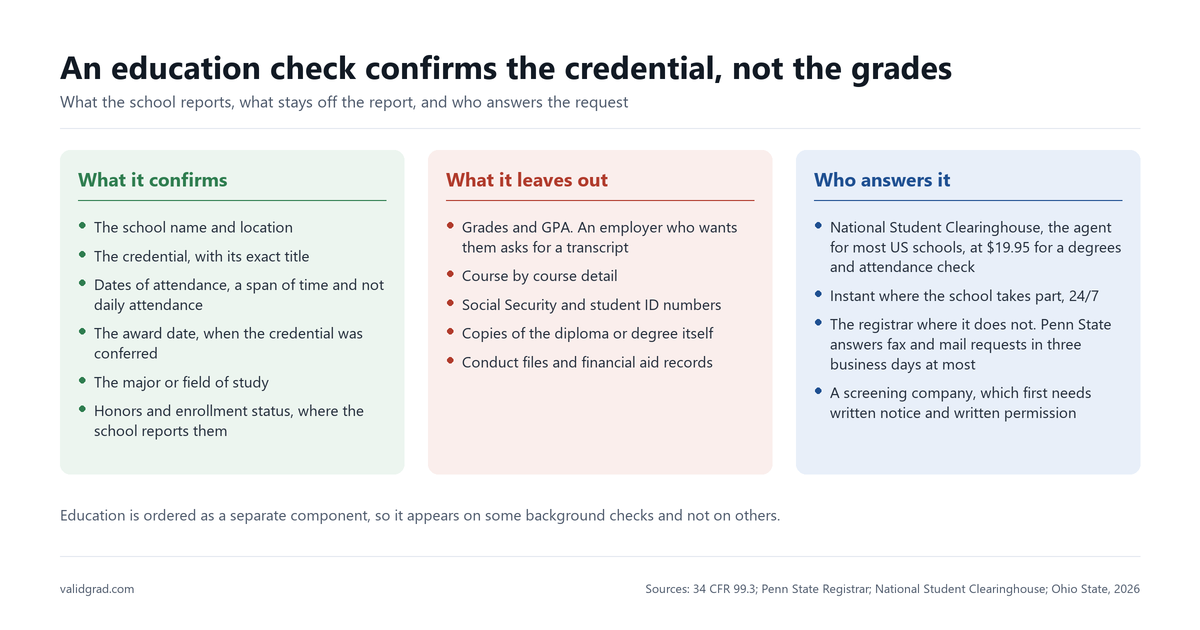
An education background check asks a school to confirm three things about a candidate: the institution attended, the credential awarded, and the dates of attendance. It is one component of a wider pre-employment screening, ordered separately from the criminal and employment components, so education appears on some background checks and is missing from others.
When an employer does order it, the report stays narrow. Penn State’s registrar states that a verification confirms enrollment status, dates of attendance, and degrees conferred, and that verifications do not include the student ID, the Social Security number, specific course information or grades. Grades and course lists sit on the transcript, which an employer has to request as a separate document.
The answer comes from the school or an agent the school appoints. For most United States institutions that agent is the National Student Clearinghouse, which reports coverage of 97% of currently enrolled U.S. postsecondary students and 96% of U.S. four-year postsecondary degrees and says employers can verify academic credentials instantly, 24/7. This guide covers what the check shows, how it is run, what the report wording means, and what to do when a record comes back wrong. For how often employers order education checks at all, see do employers verify degrees.
What is an education background check?
An education background check, also called education verification or degree verification, is the step where an employer confirms the schooling a candidate listed on an application or resume. The employer compares what the candidate wrote against what the school reports, and the gap between those two lines is the point of the exercise.
Screening is common at United States employers. In the 2021 HR.com and Professional Background Screening Association survey, 95% of organizations with at least one U.S. location reported conducting some type of employment background screening, and 73% of them said they typically run screenings after a conditional job offer.
Two sets of rules apply. When an employer hires an outside company to compile the report, the result is a consumer report and the Fair Credit Reporting Act governs notice, permission and disputes. The EEOC adds that asking about a candidate’s background or requiring a background check is not illegal, as long as the same standards apply to everyone regardless of race, national origin, color, sex, religion, disability, genetic information or age.
What shows up on an education background check
The fields a school will confirm line up closely with what federal privacy law calls directory information. Under 34 CFR 99.3, directory information may include the major field of study, grade level, enrollment status, dates of attendance, and degrees, honors and awards received. A typical report carries these items for each school listed.
| Item on the report | What the school confirms |
|---|---|
| Institution | The school name and location as the school’s records carry them |
| Credential | The degree, diploma or certificate awarded, with its exact title |
| Dates of attendance | The period attended, defined in 34 CFR 99.3 as a span of time and not daily attendance |
| Award date | The date the credential was conferred |
| Major or field of study | The program of record, and sometimes minors or concentrations |
| Honors and awards | Reported when the school treats them as directory information |
| Enrollment status | Undergraduate or graduate, full time or part time |
A high school diploma is checked the same way. The Clearinghouse runs a separate diploma service for participating high schools and districts, and the district office answers requests for schools outside it. More detail sits in high school diploma verification.
What does not show up
A verification confirms the items above and stops there.
- Grades and GPA. Penn State states that its verifications do not include specific course information or grades, and grade point average is absent from the directory information list in 34 CFR 99.3, so a school generally needs consent before releasing it. An employer who wants grades asks for a transcript.
- Course by course detail. That level of record lives on the official transcript, described in what a transcript looks like.
- Social Security and student ID numbers. 34 CFR 99.3 excludes both from directory information, and Penn State names them as items its verifications leave out.
- Copies of the credential itself. The National Student Clearinghouse states that copies of degrees and diplomas are not provided by any of its verification services. A replacement document is a separate request to the school, covered in how to find your high school diploma online.
- Conduct files and financial aid records. Those sit with other offices and fall outside the verification.
How an education background check is done, step by step
The sequence is consistent across employers.
- Notice and permission. Before using an outside screening company, the employer has to tell the applicant in writing, in a stand-alone document, that the information may be used for employment decisions, and get written permission for the check.
- The request goes to the school or its agent. Ohio State states that third parties must request verification of enrollment and degree completion through the National Student Clearinghouse, and the University of Illinois has authorized the Clearinghouse for students from Fall 1982 onward.
- Someone pays a fee. The Clearinghouse lists $19.95 for a degrees and attendance verification, plus a possible school surcharge, and $4.95 for current enrollment. Ohio State publishes the combined price its graduates see, $22.95 including a $3.00 service fee.
- Results come back fast, or slowly. Where the school participates, the answer is automated and immediate. Where it does not, a person at the registrar handles it. Illinois routes records from before Fall 1982 to its Transcript Unit, and Penn State promises a maximum three business day response for requests arriving by fax or mail. Older records, closed schools and foreign institutions stretch the timeline. See how long degree verification takes and international degree verification.
- A privacy block can stop the check. Penn State states that verifications are not available for students who asked that their directory information not be released. A candidate who placed that hold may have to lift it or send a transcript.
What the wording on an education verification report means
An education verification report sets the candidate’s own entry beside the school’s answer, one block per institution. The first repeats the school, credential, major and dates from the application, the second carries whatever the registrar or the Clearinghouse returned. Labels vary by screening company, so one outcome can be worded several ways.
- Verified or confirmed. The school reported the same credential and dates the candidate gave.
- Degree claimed. This label usually marks the line the candidate supplied, next to the line the school supplied. A claimed degree with no confirmation beside it means the check is still open or the school did not confirm the award.
- Attendance only. The school confirmed a period of enrollment but no credential. That is the expected result for coursework a candidate started and did not finish.
- No record found. The school or the Clearinghouse has nothing matching the details submitted. A name change since enrollment, a record older than the school’s participation date, a directory hold, or an enrollment that never happened all produce it.
- Discrepancy or unable to verify. Something did not line up, most often the dates or the exact credential title. A degree awarded in January and listed as the previous spring lands here.
None of these labels is a finding against a candidate. They record what the source said, and the employer decides what to do with it.
How far back do education background checks go?
The seven year limit people have heard about comes from 15 U.S.C. 1681c(a), which bars consumer reporting agencies from reporting bankruptcies older than ten years, and civil suits, civil judgments, arrest records, paid tax liens, collection accounts and any other adverse item older than seven years, apart from criminal convictions.
Education appears nowhere in that list. A degree is a fact about a candidate and is not an adverse item, so there is no age limit on verifying it. A credential earned in 1994 can be confirmed in 2026 as readily as one earned last year. The same statute adds at 1681c(b) that even those exclusions fall away when the report is used for employment at an annual salary that equals or may reasonably be expected to equal $75,000 or more.
Scope is the employer’s choice. Some order a check on the single credential the job requires, others on every school listed. An old degree, and an old inaccurate claim, stay checkable either way.
Does an education background check catch a fake degree?
It catches the ordinary cases, because the question goes to the institution that would have awarded the credential. A degree the school never conferred comes back as attendance only or as no record found, whatever the candidate submitted. A school that does not exist has no registrar to answer, so the line stays unverified.
Accreditation is the second filter. An employer or screening firm can look up an institution in the U.S. Department of Education’s Database of Accredited Postsecondary Institutions and Programs. A school absent from that database may still confirm attendance, which carries less weight with employers that require an accredited credential.
The consequences of an invented credential sit outside the report. Several states treat the use of a fraudulent academic document as a criminal offense, and a false statement on a federal form carries its own penalties, as set out in lying about graduating high school.
How to prepare for an education background check
Most disputes trace back to a small mismatch between an application and a registrar’s file.
- Use the school’s wording. The exact institution name, the credential title such as Bachelor of Science in Accounting, and the conferral date the school recorded.
- Account for a name change. Records stay under the name on file at the time of enrollment unless the school updated them, which is the usual cause of a no record result. See changing a name on a transcript.
- Order a transcript for reference. An unofficial copy is enough to check dates and titles against an application, and requesting official transcripts covers the process.
- Fix stale profiles. An online profile claiming a degree that was never finished contradicts an honest application.
How to run an education background check on yourself
There are three routes, in rising order of cost. Ask the registrar what a third party verification would return, which is free. Order a transcript and read the dates and credential title there. Or order a verification through the Clearinghouse at the published $19.95 fee and see what an employer sees.
After an employer has already run a check, there is a fourth route. The FTC states that a candidate has the right to an additional free report from the background reporting company, requested within 60 days of the employer’s decision.
ValidGrad sells novelty replica diplomas and transcripts made for display and personal reference, and its terms of use forbid presenting one as a credential a school awarded. A replica is not an academic record and cannot answer a verification request. The layout is visible on the custom transcript page.
What if you never finished or something is wrong?
An unfinished degree is not a failed check. The school reports attendance without an award, which matches an application that says the same thing. Listing the school, the field of study and the credits completed keeps both lines consistent, and proof of education for employment covers what to send an employer who asks for more.
A wrong result has a defined process behind it. Before turning a candidate down over a report, an employer has to hand over a copy of the report it relied on and a copy of A Summary of Your Rights Under the Fair Credit Reporting Act. After the decision, it has to give the name, address and phone number of the company that sold the report.
The dispute then runs against the screening company. Under 15 U.S.C. 1681i, the company has to reinvestigate free of charge within 30 days, extendable to 45 days if the candidate sends more information during that window, and has to send written results within five business days of finishing. Because the school is the source, correcting the school’s record is what makes the fix stick.
Frequently asked questions about education background checks
Do background checks show education?
Only when the employer orders the education component. The FTC lists education among the things a background report can include, alongside employment history, criminal and other public records, financial history and public social media activity.
Does a college degree show up on a background check?
Yes, when education verification is part of the package. The report shows the institution, the credential and the dates, sourced from the school or the Clearinghouse. It does not reproduce the diploma itself.
Does a high school diploma show up on a background check?
Yes where a diploma is the stated requirement. The Clearinghouse offers a high school diploma verification at the same $19.95 fee as its degree check, and requests for other schools go to the district.
Does an education background check show your GPA?
Standard verifications leave it out. Grade point average is not directory information under 34 CFR 99.3, and Penn State states that its verifications do not include grades. An employer that wants a GPA asks for a transcript.
What does degree claimed mean on a background check?
It marks the line the candidate supplied, as opposed to the line the school confirmed. Wording differs between screening companies, and a claimed entry with no confirmation beside it means the check is unfinished or the school did not confirm that award.
How far back does an education background check go?
There is no cutoff. The seven year limits in 15 U.S.C. 1681c(a) apply to bankruptcies, judgments, liens, collections and other adverse items, and education is absent from that list, so a credential of any age can be confirmed.
The main points
- The check confirms the institution, the credential and the dates, and runs only when the employer orders that component.
- Grades, GPA, course lists and ID numbers stay off the report, and the Clearinghouse does not supply copies of diplomas.
- The Clearinghouse answers for most schools at $19.95 per check, instantly where the school participates and through the registrar where it does not.
- The seven year rule in 15 U.S.C. 1681c(a) covers adverse items, so no age limit applies to verifying a degree.
- A screening company has to reinvestigate a disputed entry within 30 days, and the employer has to hand over the report before turning anyone down over it.
Sources
- National Student Clearinghouse, Education Verifications. Coverage figures and instant verification. Checked September 14, 2026.
- National Student Clearinghouse, Verification Services. Fees, the high school diploma service, and no copies of diplomas. Checked September 14, 2026.
- Penn State Office of the University Registrar, Enrollment Verifications. What a verification confirms and excludes, response time, directory holds. Checked September 14, 2026.
- The Ohio State University Office of the Registrar, Verification Services Summary. Third party requests routed through the Clearinghouse, and the fees. Checked September 14, 2026.
- University of Illinois Office of the Registrar, verification for employers and background screening firms. The Clearinghouse as authorized agent from Fall 1982, registrar for earlier records. Checked September 14, 2026.
- 34 CFR 99.3, FERPA definitions. Directory information, dates of attendance, and the excluded ID numbers. Checked September 14, 2026.
- FTC and EEOC, Background Checks, What Employers Need to Know. Written notice, permission, and the adverse action steps. Checked September 14, 2026.
- EEOC, Background Checks, What Employers Need to Know. The same standards apply to everyone. Checked September 14, 2026.
- FTC Consumer Advice, Employer Background Checks and Your Rights. What a report can include, and the free copy within 60 days. Checked September 14, 2026.
- 15 U.S.C. 1681c. The reporting exclusions and the $75,000 salary exception. Checked September 14, 2026.
- 15 U.S.C. 1681i. The 30 day reinvestigation and the written result. Checked September 14, 2026.
- HR.com and the Professional Background Screening Association, Background Screening, Trends in the U.S. and Abroad, August 2021. The 95% screening rate and 73% conditional offer timing. Checked September 14, 2026.
- U.S. Department of Education, Database of Accredited Postsecondary Institutions and Programs. The accreditation lookup for an institution on a report. Checked September 14, 2026.