
Here’s what surprised me most about Chinese salaries: a software engineer in Beijing can earn 15 times more than a factory worker in rural China. That’s not an exaggeration—it’s the reality of one of the world’s most unequal job markets.
According to the National Bureau of Statistics of China, urban non-private sector workers earned Yuan 114,029 (USD 16,233) annually in 2022, while private sector employees earned Yuan 65,237 (USD 9,279). That’s a staggering 75% pay gap between sectors that most people don’t even know exists.
But here’s the thing – those national averages are practically meaningless. China’s salary landscape contains some of the most extreme regional and industry disparities you’ll find anywhere in the world, and most salary guides completely miss this reality.
Table of Contents
-
Why China’s Salary Data Is More Complicated Than You Think
-
The Shocking Truth About Geographic Pay Differences
-
Industry Salary Hierarchies That Will Surprise You
-
How to Actually Research Reliable Salary Information
-
Economic Forces Reshaping Chinese Wages Right Now
-
Making Smart Career Decisions With Real Data
-
How ValidGrad Supports Your Career Documentation Needs
-
Final Thoughts
TL;DR
-
Beijing, Shanghai, and Shenzhen workers earn 2-3 times more than the national average
-
Tech and finance sectors dominate salary rankings while manufacturing lags behind
-
Rural workers typically earn less than half of what urban employees make
-
Government data often misses informal employment and underreported income
-
Housing costs in major cities force employers to inflate nominal wages significantly
-
Median salaries provide more accurate pictures than averages due to extreme income inequality
-
Post-COVID recovery has created uneven salary growth across different industries
Why China’s Salary Data Is More Complicated Than You Think
Getting accurate information about Chinese salaries feels impossible sometimes. Every source tells a different story, and frankly, they’re all partially right and partially wrong.

The problem starts with how data gets collected. Government agencies focus on formal employment in registered companies. Private surveys target educated professionals in major cities. International consulting firms cherry-pick the highest-paying sectors. Each approach misses huge chunks of the actual workforce.
Three different reports showing Chinese salaries ranging from $400 to $1,200 per month? They were measuring completely different populations using incompatible methods.
Government Numbers vs. Ground Reality
China’s National Bureau of Statistics does solid work, but their data collection faces massive challenges. Try surveying seasonal agricultural workers who move between provinces, or gig economy drivers who work for multiple platforms simultaneously. These employment patterns don’t fit neatly into traditional statistical categories.
Official sources often exclude millions of workers in informal sectors. Cash payments, seasonal work, and small family businesses frequently go unreported. This creates blind spots that can make official figures seem either too high or too low.
Rural income data presents particular headaches. How do you calculate monthly earnings for someone who farms their own land, sells vegetables at local markets, and does construction work during slow seasons? The irregular income patterns and subsistence components make traditional salary calculations nearly meaningless.
Government surveys completely miss entire categories of workers simply because they don’t fit standard employment definitions. Freelancers, informal service providers, and small-scale entrepreneurs often exist in statistical blind spots that official data can’t capture effectively.
Gathering accurate rural income information requires understanding local economic patterns that vary dramatically across China’s vast territory. What works for surveying factory workers in Guangdong province fails completely when applied to herders in Inner Mongolia or fruit farmers in Xinjiang.
Private Survey Problems
Commercial salary surveys love to focus on formal employment in tier-1 cities because that’s where their paying clients operate. This creates sampling bias that dramatically overestimates what typical Chinese workers actually earn.
Most private surveys suffer from what I call “LinkedIn syndrome” – they capture data from educated professionals who are comfortable sharing salary information online, while missing the vast majority of workers who don’t participate in such platforms.
Many salary surveys interview a few hundred people in Beijing and Shanghai, then extrapolate those findings to represent all Chinese workers. A technology salary survey might interview 500 software engineers in Beijing and Shanghai, then claim to represent all Chinese tech workers. However, this misses the reality that most Chinese tech workers actually earn 40-60% less in tier-2 and tier-3 cities.
Cultural factors significantly impact self-reported income data accuracy. Workers may underreport earnings for tax reasons or overreport for social status. The social pressure to appear successful can inflate survey responses, while fear of government attention might suppress them.
The Shocking Truth About Geographic Pay Differences
China’s regional salary variations are so extreme they’re hard to believe until you see the numbers. Companies regularly pay identical positions 300% more in Shanghai than in smaller cities, and that’s before considering cost-of-living differences.
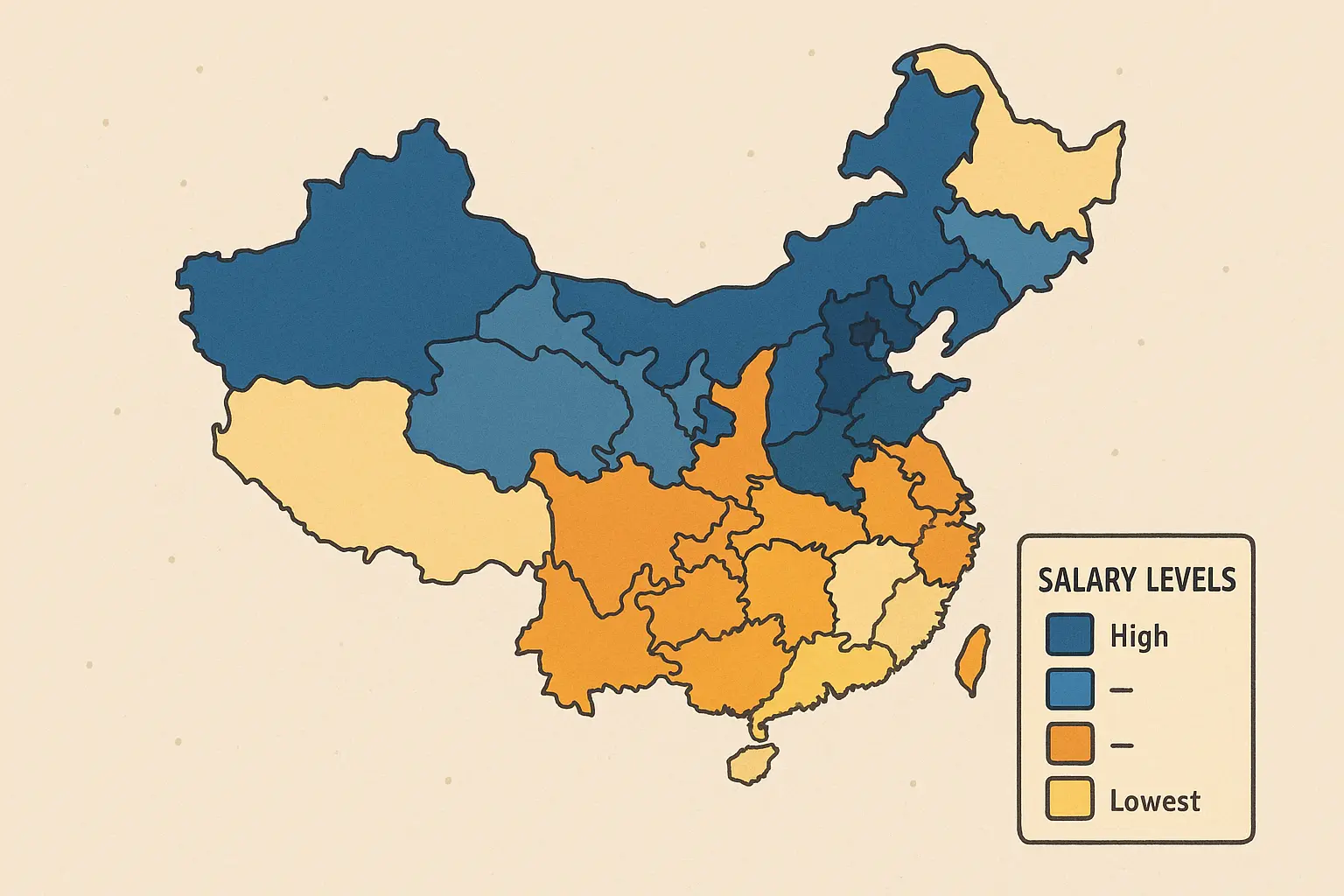
National salary statistics mask these regional disparities completely. When Beijing office workers earn more in a month than rural farmers make in a year, we’re talking about economic conditions that resemble different countries rather than different regions of the same nation.
Tier-1 Cities Are in a Different Universe
Beijing, Shanghai, and Shenzhen operate as economic powerhouses with salary levels that dwarf the rest of the country. These megacities command premium wages due to their concentration of multinational corporations, tech companies, and financial institutions.
They’ve created employment markets that barely resemble the broader Chinese economy, with compensation packages that would be competitive in New York or London.
|
City |
Average Monthly Salary (CNY) |
Average Monthly Salary (USD) |
Cost of Living Index |
|---|---|---|---|
|
Shanghai |
9,000 |
1,243 |
100 |
|
Beijing |
9,417 |
1,301 |
95 |
|
Shenzhen |
8,500 |
1,174 |
90 |
|
Guangzhou |
7,200 |
995 |
75 |
|
Hangzhou |
6,800 |
939 |
70 |
|
National Average |
5,436 |
751 |
60 |
As China’s capital, Beijing attracts government-related industries, state-owned enterprises, and companies seeking political connections. This unique positioning creates salary premiums that extend beyond pure market forces. Professionals in policy-related fields benefit from this political premium effect.
Shanghai’s role as China’s financial capital drives exceptional compensation packages in banking, insurance, and investment sectors. Recent data shows that “24 Banks Had an Average Monthly Salary of Over 30,000 Yuan per Employee in the First Half of the Year” according to Yicai Global, with the banking industry averaging 30,200 yuan monthly.
Shenzhen’s transformation into China’s Silicon Valley has created unprecedented salary growth in technology sectors. Major companies like Tencent and countless startups compete aggressively for talent, pushing compensation levels well above national averages.
Coastal vs. Inland: The Great Divide
Eastern coastal provinces benefit enormously from international trade access and foreign investment, creating salary advantages that inland regions struggle to match. This geographic disparity reflects decades of economic policy favoring coastal development.

The divide continues influencing migration patterns and career decisions. Young professionals consistently move from inland areas to coastal cities, chasing salary opportunities that can double or triple their earning potential.
Provinces like Guangdong and Jiangsu leverage their manufacturing expertise to offer competitive industrial wages, though these may lag behind service sector salaries in financial centers. Export-focused manufacturers typically offer higher wages due to foreign currency earnings and global competition pressures.
Urban workers consistently earn 2.5-3 times more than rural counterparts, representing one of China’s most persistent economic challenges. According to RemotePeople.com, the median monthly income in China is CNY 27,952 ($3,855), while low-paid Chinese workers make about CNY 7,410 ($1,021), demonstrating the extreme income inequality between urban professionals and rural workers.
Understanding these regional disparities becomes especially important when considering international career moves, as professionals need to evaluate not just local salaries but also whether their educational credentials will be properly valued in different markets.
Industry Salary Hierarchies That Will Surprise You
China’s industry salary rankings reveal patterns that don’t always align with global trends. While technology and finance predictably lead compensation charts, the gaps between sectors and the rapid changes in industry fortunes create opportunities many professionals don’t anticipate.
National salary averages vary so dramatically by industry that they become almost meaningless for career planning. Identical job titles can pay 500% more in tech companies compared to traditional manufacturing, even when the actual work responsibilities are nearly identical.
Tech and Finance Rule Everything
Technology and financial services consistently offer China’s most attractive compensation packages, but the reasons go beyond simple market demand. These industries benefit from international competition for talent, stock option programs, and business models that can support premium wages while maintaining profitability.

These sectors have created their own compensation universe. Entry-level positions often pay more than senior management roles in traditional sectors.
Companies like Alibaba, Tencent, and ByteDance engage in aggressive talent competition that drives salaries far above traditional industry standards. These firms often include substantial stock options, performance bonuses, and benefits packages that can double or triple base salary values for top performers.
A senior software engineer at Tencent in Shenzhen might earn a base salary of 400,000 CNY annually, but with stock options, performance bonuses, and benefits, their total compensation package could reach 800,000-1,200,000 CNY, making their effective monthly earnings 66,000-100,000 CNY compared to the national average of 5,436 CNY.
Artificial intelligence and emerging technology sectors command some of China’s highest salaries due to talent scarcity and strategic government support. Government initiatives supporting AI development create additional salary pressure as state-backed companies compete with private firms for the same limited talent pool.
Traditional Manufacturing’s Reality Check
Despite manufacturing’s crucial role in China’s economy, wages in traditional sectors often disappoint compared to service and technology industries. Manufacturing wages reflect global competitive pressures that limit how much companies can pay while remaining cost-competitive.
Companies focused on international markets typically offer higher wages due to foreign currency earnings and global competition pressures. Export-oriented manufacturers often provide better compensation than domestic-focused firms, creating internal industry salary hierarchies based on market orientation.
State-owned enterprises often provide lower base salaries but compensate with superior job security, comprehensive benefits, and social status advantages. These trade-offs appeal to workers prioritizing stability over maximum earnings.
|
Industry Sector |
Average Monthly Salary (CNY) |
Job Security Rating |
Benefits Package |
|---|---|---|---|
|
Information Technology |
18,368 |
Medium |
High |
|
Financial Services |
14,528 |
High |
Very High |
|
Manufacturing (Export) |
6,800 |
Medium |
Medium |
|
Manufacturing (Domestic) |
5,200 |
High |
Medium |
|
State-Owned Enterprises |
10,302 |
Very High |
Very High |
|
Agriculture |
3,500 |
Low |
Low |
Service Economy’s Rising Tide
As China transitions toward service-based economic growth, sectors like healthcare, education, and professional services experience increasing wage growth and talent demand. This shift creates new opportunities for skilled workers while potentially disrupting traditional industry salary hierarchies.
How to Actually Research Reliable Salary Information
Getting accurate salary data in China requires systematic research approaches that account for the country’s complex economic structure and data limitations. Smart professionals use multiple sources and understand the strengths and weaknesses of each data type.

Median wages often provide more realistic expectations than averages, but finding reliable median data requires knowing where to look and how to interpret what you find. Most readily available sources focus on averages that can be misleading due to extreme high earners.
Understanding Chinese salaries requires building comprehensive data intelligence from multiple sources rather than relying on any single report or survey.
Building Your Data Foundation
Effective salary research starts with identifying reliable primary sources and understanding their methodologies. The key is combining official government statistics with real-time market data from job platforms and international consulting reports.
Start with government sources for baseline data, then layer on private sector information to understand current market conditions. This approach helps identify trends and validates findings across different data collection methods.
China’s National Bureau of Statistics provides the most comprehensive official salary data, though it requires careful interpretation. These statistics excel at showing broad trends and regional comparisons but may miss nuances in specific industries or informal employment sectors.
Salary Research Checklist:
-
Check National Bureau of Statistics official reports
-
Cross-reference with at least 3 job platform databases
-
Verify data collection dates and methodologies
-
Account for regional cost of living differences
-
Distinguish between median and average figures
-
Consider industry-specific factors and seasonal variations
-
Factor in benefits and total compensation packages
-
Validate with local professional networks
-
Set realistic timeline expectations for decision-making
Platforms like Zhaopin, 51job, and Boss Zhipin offer real-time salary data that reflects current market conditions. These sources provide valuable insights into what employers actually pay, though they may skew toward formal employment in major cities.
Cross-Referencing for Accuracy
Smart salary research involves comparing data from at least 3-4 different sources to identify consistent patterns and outliers. This approach helps compensate for individual source biases and provides more reliable insights for career planning and salary negotiations.
When different sources show dramatically different results, dig deeper to understand why. Sometimes the discrepancies reveal important market dynamics or methodological issues.
Red flags include surveys with tiny sample sizes, data that’s more than two years old, or sources that don’t explain their collection methodology. These issues can make salary information completely unreliable for practical decision-making.
Always consider purchasing power parity when comparing Chinese salaries to international standards, as cost of living varies dramatically between regions. Exchange rate fluctuations can make USD conversions particularly unreliable for long-term planning.
Understanding Median vs. Average Distinctions
China’s significant income inequality makes the difference between median and average salaries particularly important. Median figures often provide more realistic expectations for typical workers, while averages can be skewed upward by high earners in tech and finance sectors.
China’s wealth concentration means average salaries can be inflated 20-30% above median figures due to extreme high earners. For most professionals, median salaries provide better benchmarks for realistic earning expectations.
Data from MS Advisory shows that in 2025, the average salary in China is ¥22,053 per month (approximately USD 3,050), with state sector employees earning nearly double the private sector average, highlighting the importance of understanding sector-specific compensation patterns.
Economic Forces Reshaping Chinese Wages Right Now
Multiple macroeconomic and policy factors currently influence Chinese salary trends, from government initiatives to global economic conditions. Understanding these forces helps predict future wage movements and identify industries or regions likely to experience significant compensation changes.

Current salary trends reflect broader economic forces more than simple supply and demand dynamics. Government intervention, currency policies, and strategic industry development initiatives all directly impact what people actually earn.
Government Policy’s Direct Impact
Beijing’s economic policies directly shape salary levels through minimum wage adjustments, tax reforms, and industry development strategies. These policy decisions create ripple effects throughout the economy that can dramatically alter compensation patterns in specific sectors or regions.
Salaries respond quickly to policy changes, especially in sectors receiving government support or facing new regulations. Entire industries can see 20-30% salary increases within a year due to favorable policy shifts.
Regular minimum wage increases help lift bottom-tier salaries but also pressure small businesses and affect employment patterns in labor-intensive industries. Small manufacturers sometimes respond to minimum wage increases by reducing headcount or relocating to lower-cost regions.
Government support for strategic industries like renewable energy, semiconductors, and biotechnology creates artificial salary premiums through subsidies and preferential policies. These interventions can rapidly change industry salary rankings and create new high-paying career paths.
Cost of Living’s Salary Pressure
Rising living costs, particularly housing expenses in major cities, force employers to increase nominal wages to attract and retain talent. This dynamic creates inflationary pressure on salaries that may not reflect actual improvements in purchasing power or living standards.
Skyrocketing property prices in tier-1 cities compel employers to offer higher nominal wages just to maintain worker living standards. This housing-driven wage inflation contributes significantly to regional salary disparities and affects career location decisions.
Companies have relocated entire departments to second-tier cities specifically to escape the salary pressure created by housing costs in Shanghai and Beijing. This trend is reshaping China’s economic geography in real time.
Post-COVID Recovery Patterns
The pandemic’s aftermath created uneven salary recovery across different sectors, with some industries exceeding pre-2020 compensation levels while others continue struggling. These recovery patterns are reshaping China’s salary landscape and creating new opportunities and challenges for workers.
COVID-19 accelerated digital transformation and boosted technology sector salaries even higher. Companies in e-commerce, digital services, and remote work solutions experienced exceptional growth that translated into premium compensation packages for tech professionals.
The pandemic essentially fast-forwarded China’s digital economy development by several years, creating massive demand for technical talent that continues driving salary growth in technology sectors.
Hospitality, retail, and other traditional service industries continue facing salary pressures from pandemic impacts. These sectors often struggle to match pre-2020 compensation levels, creating career transition opportunities for workers willing to develop new skills.
Many service sector workers have permanently shifted to other industries, creating ongoing labor shortages that may eventually drive wages higher as businesses compete for remaining workers.
Making Smart Career Decisions With Real Data
Let’s get practical. You’ve got the numbers – now what do you actually do with them?
The truth is, chasing the highest salary isn’t always the smartest move. A marketing manager who turned down a 40% raise in Shanghai because the housing costs would have eaten up the entire increase stayed in Hangzhou, banked more money, and had a better quality of life.

Understanding salary data across different contexts enables strategic career planning that goes beyond chasing immediate compensation increases. Smart professionals analyze industry trajectories, regional development patterns, and skill demand forecasts to position themselves for long-term earning potential.
Think Beyond Base Salary
Chinese companies love to sweeten deals with perks that don’t show up in salary surveys. Housing allowances, meal vouchers, annual bonuses – these can add 20-40% to your actual compensation. A “lower” salary with great benefits often beats a higher base salary with nothing extra.
Quick math check:
-
Job A: 15,000 CNY base + 3,000 housing allowance + 2,000 meal/transport = 20,000 total
-
Job B: 18,000 CNY base, no benefits = 18,000 total
Job A wins, but most people would pick Job B based on the headline number.
Accurate salary data provides crucial leverage in compensation discussions, particularly important in China’s relationship-focused business culture. Successful negotiation requires understanding not just market rates but also company-specific factors and cultural expectations around salary discussions.
Salary Negotiation Preparation Checklist:
-
Research 3+ comparable positions in your city/industry
-
Document total compensation packages, not just base salary
-
Understand company’s financial performance and budget cycles
-
Prepare cultural context for salary discussions
-
Identify non-monetary benefits that add value
-
Practice relationship-building conversation starters
-
Have backup options and alternatives ready
-
Set realistic timeline expectations for decision-making
Chinese business culture values relationship-building and face-saving approaches to negotiation. Aggressive salary demands based on market data can backfire if they’re presented in ways that make managers lose face or feel pressured.
Time Your Industry Jumps
China’s economy moves fast. The manufacturing engineer earning 8,000 CNY today could be making 18,000 in AI/robotics within two years – if they time the transition right. Government initiatives create huge demand spikes that smart career switchers can ride.
A manufacturing engineer earning 8,000 CNY monthly might transition to AI/robotics engineering and see their salary jump to 18,000 CNY within two years, but timing the switch during high demand periods (like government AI initiatives) versus low demand could mean the difference between a 50% or 125% salary increase.
Career transitions often require additional credentials or certifications, making it essential to understand the true cost of obtaining new qualifications versus the potential salary increases they enable.
The key is watching policy announcements. When Beijing says they’re investing heavily in green energy or semiconductors, those sectors see immediate salary bumps.
Geographic Strategy
Here’s a move more people should consider: take a “lower” salary in a tier-2 city where your money goes further. A friend moved from Shanghai to Chengdu, took a 15% pay cut, but cut his living expenses by 40%. He’s saving more money and actually enjoying life.
Understanding regional salary differences creates opportunities for geographic arbitrage, where professionals can maximize earning potential by strategically choosing work locations. This might involve accepting lower absolute salaries in exchange for better cost-of-living ratios or career advancement prospects.
Some professionals find they can maintain similar living standards while building savings by moving from tier-1 to tier-2 cities, especially if they can negotiate remote work arrangements or find companies offering competitive packages outside major metropolitan areas.
Salary decisions should align with broader wealth-building strategies, considering factors like stock options, retirement benefits, and skill development opportunities. The highest immediate salary isn’t always the best long-term financial choice, especially in rapidly changing industries.
For professionals building long-term wealth, maintaining proper documentation of educational achievements becomes crucial, especially when considering professional display of credentials that can enhance career advancement opportunities.

Stock options and equity participation can create wealth-building opportunities that dwarf salary differences, particularly in China’s dynamic startup ecosystem. However, these opportunities require careful evaluation of company prospects and vesting schedules.
How ValidGrad Supports Your Career Documentation Needs
When you’re ready to make your move – whether it’s negotiating a raise or switching companies – having your educational credentials sorted out matters more than you’d think. Chinese employers take documentation seriously, and missing paperwork can kill deals fast.
When pursuing high-paying opportunities in China’s competitive job market, having proper educational credentials readily available becomes crucial for salary negotiations and career advancement. ValidGrad’s diploma replacement services eliminate bureaucratic delays that could cost valuable career opportunities, ensuring professionals can act quickly when lucrative positions become available.
For professionals navigating China’s salary landscape, educational credentials play a significant role in compensation determination. Whether you’re an expatriate who needs backup documentation while working in China, or a Chinese graduate requiring replacement certificates for international opportunities, ValidGrad provides fast, reliable solutions through our user-friendly platform.
ValidGrad helps you get replacement diplomas quickly when you need them. No bureaucratic delays, no missed opportunities. Whether you’re an expat working in China or a Chinese graduate looking at international options, we’ve got you covered.
The ability to quickly obtain professional-quality diploma replicas ensures that missing documentation doesn’t prevent you from capitalizing on career opportunities in China’s fast-paced business environment. When timing often determines salary negotiation success, ValidGrad’s efficient service becomes a valuable career tool.
Understanding the importance of educational credentials in salary negotiations becomes especially relevant when considering essential academic documents that employers typically require during the hiring process.
Ready to secure your educational documentation? Visit ValidGrad today to explore our diploma replacement services and ensure you’re prepared for your next career opportunity.
Final Thoughts
China’s job market is wild. The salary gaps are massive, the regional differences are crazy, and everything changes fast. But that’s also what makes it exciting.
China’s salary landscape is far more complex and nuanced than most people realize. The dramatic differences between regions, industries, and employment types create both opportunities and challenges that require careful navigation. Understanding these patterns isn’t just academic—it’s practical intelligence that can significantly impact your career trajectory and earning potential.
The data tells a story of a country in economic transition, where traditional manufacturing wages compete with explosive tech sector growth, and where geographic location can double or triple your earning potential. These aren’t temporary anomalies but structural features of China’s economy that will likely persist for years to come.

The key takeaway? Don’t just look at average salaries and call it research. Dig deeper. Understand the context. Factor in living costs, career growth, and quality of life. The highest salary isn’t always the best choice.
Smart career planning in this environment requires moving beyond simple salary comparisons to understand the underlying forces shaping compensation trends. Whether you’re considering a move to China, planning an industry transition, or negotiating your current compensation, the insights in this guide provide the foundation for making informed decisions that align with both immediate needs and long-term wealth-building goals.
Most importantly, stay flexible. China’s economy is still evolving rapidly. The industries and cities leading salary growth today might be different in five years. Keep learning, keep networking, and be ready to adapt.
As professionals navigate these complex salary landscapes, having proper educational documentation becomes increasingly important, particularly when understanding how to present education credentials effectively on resumes and during salary negotiations.
The recent announcement that “Putin: Russia to Waive Visa Requirements for Chinese Citizens” according to Jiemian News, creating new opportunities for cross-border professional mobility and potentially affecting salary negotiations for bilingual professionals in both markets.
The opportunities are there – you just need to know where to look and how to evaluate them properly.