Updated September 2026 · Sources listed at the end
A doctoral diploma is the sheet a university issues when it confers a doctorate, and US institutions award three federally distinct kinds. A research doctorate is earned by producing original work and defending it. A professional practice doctorate is earned by completing the training a license requires. A third category exists for everything the first two do not cover. The diploma itself rarely says which kind it is. It names the institution, the graduate, the full title of the degree and the date, and leaves the classification to the transcript and the federal data systems.
That distinction is not academic hair-splitting. It decides whether a dissertation is required, whether the degree leads to a license, and whether the holder is counted in the national doctorate census. At most universities it also decides how big the piece of paper is.
Research, professional practice, and “other”
The US Department of Education classifies every degree an American institution reports through IPEDS. Its glossary defines the doctoral categories in these words:
| IPEDS category | Official definition | Degrees named in the definition |
|---|---|---|
| Doctor’s degree – research/scholarship | “A Ph.D. or other doctor’s degree that requires advanced work beyond the master’s level, including the preparation and defense of a dissertation based on original research, or the planning and execution of an original project demonstrating substantial artistic or scholarly achievement.” | Ph.D., Ed.D., D.M.A., D.B.A., D.Sc., D.A., D.M., plus “and others, as designated by the awarding institution” |
| Doctor’s degree – professional practice | “A doctor’s degree that is conferred upon completion of a program providing the knowledge and skills for the recognition, credential, or license required for professional practice … awarded after a period of study such that the total time to the degree, including both pre-professional and professional preparation, equals at least six full-time equivalent academic years.” | D.C. or D.C.M. (chiropractic), D.D.S. or D.M.D. (dentistry), J.D. (law), M.D. (medicine), O.D. (optometry), D.O. (osteopathic medicine), Pharm.D. (pharmacy), D.P.M., Pod.D. or D.P. (podiatry), D.V.M. (veterinary medicine) |
| Doctor’s degree – other | “A doctor’s degree that does not meet the definition of a doctor’s degree – research/scholarship or a doctor’s degree – professional practice.” | Assigned by the institution |
Two things in that table surprise people. The federal definition explicitly names the Ed.D. and the D.B.A. as research doctorates and not professional ones, even though both are aimed at practitioners. And the deciding test for the professional category is not the subject but the license and the six-year total, which is why the J.D. sits beside the M.D. and the D.V.M.
Classification also depends on the awarding institution. Both definitions end with “as designated by the awarding institution”, so the same abbreviation can be reported differently by two universities. The Psy.D. is the clearest case. The National Science Foundation excludes it from the national research-doctorate census, while individual institutions may report it either way.
The common doctoral degrees, sorted
| Degree | Full title | Type | Culminating work | Leads to a license? |
|---|---|---|---|---|
| Ph.D. | Doctor of Philosophy | Research | Dissertation and oral defense | No |
| Ed.D. | Doctor of Education | Research (per IPEDS) | Dissertation or applied capstone | No, and state administrator licenses are separate |
| D.B.A. | Doctor of Business Administration | Research (per IPEDS) | Applied dissertation | No |
| D.M.A. | Doctor of Musical Arts | Research | Recitals plus a document or original project | No |
| M.D. | Doctor of Medicine | Professional practice | Clinical rotations and licensing examinations | Yes, from the state medical board |
| D.O. | Doctor of Osteopathic Medicine | Professional practice | Clinical rotations and licensing examinations | Yes, from the state medical or osteopathic board |
| J.D. | Juris Doctor | Professional practice | Coursework, with the bar examination after it | Yes, through state bar admission |
| D.D.S. / D.M.D. | Doctor of Dental Surgery / Dental Medicine | Professional practice | Clinical training and board examinations | Yes, from the state dental board |
| Pharm.D. | Doctor of Pharmacy | Professional practice | Advanced pharmacy practice experiences | Yes, from the state board of pharmacy |
| D.V.M. | Doctor of Veterinary Medicine | Professional practice | Clinical rotations and a national examination | Yes, from the state veterinary board |
| O.D. | Doctor of Optometry | Professional practice | Clinical training and board examinations | Yes, from the state optometry board |
| Psy.D. | Doctor of Psychology | Practice-oriented, and outside the federal research-doctorate census | Supervised practica, internship, clinical dissertation | Yes, from the state psychology board |
| D.N.P. | Doctor of Nursing Practice | Practice-oriented | Practice-improvement project | Builds on an existing nursing license |
| Dr.P.H. | Doctor of Public Health | Practice-oriented | Applied dissertation or practicum | No |
Where each of these sits relative to a bachelor’s and a master’s is set out in degrees in order, which also covers whether the master’s step is required first, since that varies by field.
What a doctoral diploma actually says
A doctoral diploma is a single formal sentence dressed up in ceremony. The institution’s governing body states that it has admitted a named person to a named degree and granted the rights that go with it. The University of Pennsylvania, which has printed its diplomas in Latin for more than two centuries, publishes its own translation of the operative clause. The Latin reads “ad gradum DEGREE admisimus eique omnia iura honores privilegia ad hunc gradum pertinentia libenter concessimus”, and in English that is “to the degree of DEGREE and we have freely granted all rights, honors and privileges pertaining to this degree.”
Brown goes further. Its diploma “is produced entirely in Latin (except for name of graduate)”, carries the Seal of the Corporation of Brown University in the lower center, and is signed by the University President and the Secretary of the Corporation. A reader looking for the word “dissertation”, a field of study or a grade will not find any of them.
Whether the diploma names the field at all is decided institution by institution, and registrars disagree flatly:
| Institution | Printed on the diploma | Not printed |
|---|---|---|
| Vanderbilt University | Student’s name, the Vanderbilt school, the degree, the date of graduation, and academic, college or departmental honors if earned | Majors and minors |
| University of Missouri | Name as given on the graduation application, degree earned, major or majors, Latin honors, honors program | Minors and emphasis areas, which are on the transcript only |
| UC Irvine | Degree, plus Latin and Campuswide Honors beneath the University Seal for undergraduates | Minors and specializations |
| University of Pennsylvania | The Latin conferral clause, and honors distinctions | Honors distinctions apply only to undergraduate and law graduates, so a Ph.D. diploma carries none |
So “Doctor of Philosophy” may appear alone, or followed by the field, depending on where it was earned. Neither version is more official than the other, and neither shows a grade point average, because no US registrar prints one on a diploma. The anatomy of the sheet itself, line by line, is covered in what a college diploma looks like, and the embossed mark in diploma seals.
Are doctoral diplomas bigger? Usually, yes
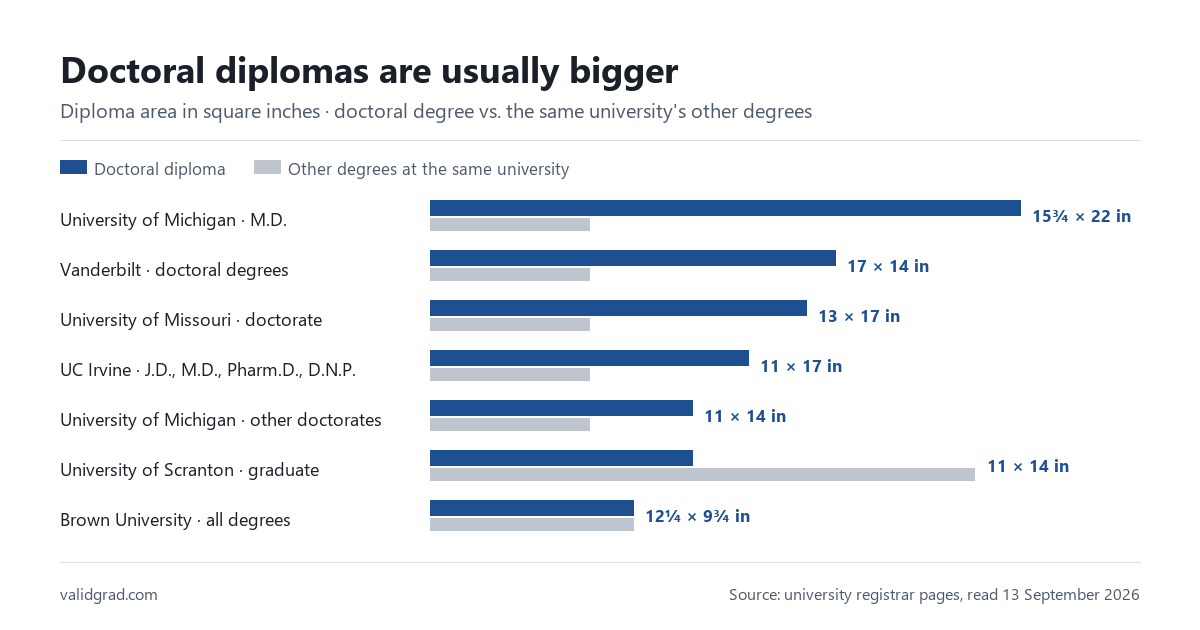
This is the question the search results are full of, and it has a documented answer. Most universities that vary diploma size by level print the doctorate larger, and the gap can be dramatic.
| Institution | Doctoral diploma | Other degrees | Note |
|---|---|---|---|
| Vanderbilt University | 17 × 14 in | 11 × 8.5 in | Roughly 2.5 times the area |
| University of Missouri | 13 × 17 in | 8.5 × 11 in (bachelor’s, master’s, specialist, certificate) | All portrait |
| University of Michigan | 11 × 14 in (doctoral, except M.D.) | 8.5 × 11 in | The M.D. is 15¾ × 22 in, the largest documented here |
| UC Irvine | 11 high × 17 wide in (J.D., LL.M., M.D., Pharm.D., D.N.P.) | 8.5 high × 11 wide in | Wide format, and the larger size follows the professional degrees |
| Brown University | 12.25 × 9.75 in | 12.25 × 9.75 in | One size for every degree |
| University of Scranton | 11 × 14 in (graduate degrees) | 16 × 20 in (baccalaureate, printed in Latin) | The reverse, with the bachelor’s diploma the largest |
Three practical consequences. A frame bought before the diploma arrives is a gamble, because the documented range here runs from 8.5 × 11 to 15¾ × 22 inches. Orientation varies independently of size, so a wide 11 × 17 and an upright 13 × 17 need different frames. And the size follows the institution’s own rule instead of the prestige of the degree, so a Brown Ph.D. and a Brown bachelor’s arrive on identical sheets.
How long a doctorate takes, in one paragraph
Research doctorates are counted every year by the National Science Foundation’s Survey of Earned Doctorates, an annual census run since 1958 of everyone receiving a research doctorate from an accredited US institution. In academic year 2024 it counted 58,131 of them. The Ph.D. accounted for 98.5% and the Ed.D. for 0.9%. Every other research doctorate came in under 0.3% each. Professional doctorates (the M.D., D.D.S., D.V.M., J.D., Pharm.D., D.Min. and Psy.D.) are excluded from that count entirely, which is worth remembering whenever a headline number about “US doctorates” is quoted.
Time to degree varies so much by field that a single figure is misleading. The full comparison, from a certificate through to a doctorate, is in the how long each degree takes hub. The wait that surprises people comes after the defense rather than before it. Missouri, for example, prints and mails diplomas roughly six to eight weeks after commencement, so the degree is conferred and verifiable well before the paper exists.
Who verifies a doctorate, and what they look at
Nobody verifies a degree by looking at a diploma. Verification runs against the institution’s record.
- Employers and background screeners query the National Student Clearinghouse, which covers 96% of US four-year postsecondary degrees and 97% of currently enrolled US postsecondary students, and returns an immediate automated response. What the check actually covers, and what happens when it comes back mismatched, is in do employers really verify your degree.
- State licensing boards go further and use primary source verification. The Medical Board of California, for instance, accepts a Certificate of Medical Education verified through the Federation Credentials Verification Service, though it notes that “the Board does not mandate the use of FCVS and it is not a requirement for filing a Physician’s and Surgeon’s application”. Either way, the medical school confirms the education, not the applicant.
- Foreign doctorates go through a credential evaluation before either of the above will accept them, and the process is set out in how employers verify international degrees.
If an employer has asked for “a copy of your diploma” and you are not sure what to send, that request has its own answer: an official transcript or a verification letter is what satisfies it.
Replacing a lost doctoral diploma
Registrars reissue doctoral diplomas as a routine service, at very different prices, and the reissue is usually marked as one.
| Institution | Fee | Process and what the reissue shows |
|---|---|---|
| UC Irvine | 22 dollars, plus 25 dollars mailing | Four to six weeks. A reissue date is printed at the bottom, and it carries the signatures of current state and University officials |
| Vanderbilt University | 100 dollars, plus shipping | Ordered through Paradigm, and it takes approximately four to six weeks, with expedited shipping available |
| Brown University | Not available | Brown “does not provide for duplicate printed copies of diplomas” |
Brown’s policy is the one to plan around, because a replacement is not guaranteed to exist. Where the institution will not reissue, or has closed, the alternatives are the official transcript, the degree verification letter and the state archive of a closed school’s records, all set out in replacing a lost diploma.
Replica doctorate diplomas for display
Once the real record is in hand, there are ordinary reasons to want a second sheet to hang: the original is in a safe deposit box or a parent’s house, it was damaged in a move, the institution will not reissue it, or a prop is needed for a photograph, a film set or a stage production. ValidGrad’s replica doctorate diploma maker produces novelty documents for display and commemoration, using generic seals and signature styles rather than any institution’s marks. Current pricing, sizes and turnaround are on that page.
A replica is not an official document and proves nothing. It must never be used to claim a credential that was not earned, and never sent in answer to a verification request from an employer, a school, a licensing board or a government agency. The Terms and Conditions forbid it. The answer to a verification request is always a record that comes from the institution.
Frequently asked questions
Is a doctoral degree the same as a PhD?
No. The Ph.D. is one doctoral degree among many. It accounted for 98.5% of US research doctorates in 2024, but research doctorates are only part of the picture. The M.D., J.D., D.D.S., Pharm.D., D.V.M., O.D., D.O. and D.P.M. are doctoral degrees classified as professional practice, and they are not counted in the national research-doctorate census at all.
Are PhD diplomas bigger than other diplomas?
At most universities that vary the size, yes. Vanderbilt prints doctoral diplomas at 17 × 14 inches against 11 × 8.5 for everything else, Missouri at 13 × 17 against 8.5 × 11, and Michigan at 11 × 14 against 8.5 × 11, with the M.D. at 15¾ × 22 inches. But it is a house rule, not a convention: Brown prints every degree at 12.25 × 9.75 inches, and the University of Scranton’s baccalaureate diploma, at 16 × 20 inches, is larger than its graduate one.
Does a doctoral diploma say what the degree is in?
Sometimes. Missouri prints the major or majors on the diploma. Vanderbilt prints the school and the degree but not the major or minor, and UC Irvine omits minors and specializations. Where the field is not on the diploma it is always on the transcript, which is the document that actually records what was studied. The difference is laid out in diploma vs transcript.
Can you call yourself a doctor with a doctorate degree?
By academic custom, any earned doctorate carries the courtesy title. What the diploma does not do is authorize practice: a license to practice medicine, dentistry, optometry, pharmacy, psychology or law comes from a state board or bar, after it has verified the education directly with the school. A doctorate and a license are separate things, and only one of them is printed on a diploma.
What is the difference between an EdD and a PhD in education?
Federally, none of the kind people expect: IPEDS classifies both as research doctorates, and the NSF counts the Ed.D. among research doctorates. In practice, programs differ. An Ed.D. is usually aimed at working administrators and may end in an applied capstone rather than a traditional dissertation, but the difference is set by the program, not by the classification, and the diplomas look the same.
Sources
- National Center for Education Statistics, IPEDS Glossary, 2024–25 survey materials, with definitions of “Doctor’s degree – research/scholarship”, “- professional practice” and “- other”.
- National Science Foundation, National Center for Science and Engineering Statistics, Survey of Earned Doctorates, and Doctorate Recipients from U.S. Universities: 2024.
- Vanderbilt University, University Registrar, Diplomas.
- University of Missouri, Office of the University Registrar, Diplomas.
- University of Michigan, Office of the Registrar, Diploma Sizes.
- UC Irvine, Office of the Registrar, Diplomas.
- Brown University, Office of the Registrar, Diplomas.
- University of Pennsylvania, Office of the University Secretary, Diploma Translation.
- University of Scranton, Office of the Registrar, Diploma Information.
- National Student Clearinghouse, Education Verifications.
- Medical Board of California, Third Party Services.
Registrar pages, dimensions and fees were read on September 13, 2026. Institutions change diploma designs, sizes and fees without notice, so confirm with the issuing registrar before relying on a detail.