Updated September 2026 · Figures from the U.S. Bureau of Labor Statistics and the other sources listed at the end
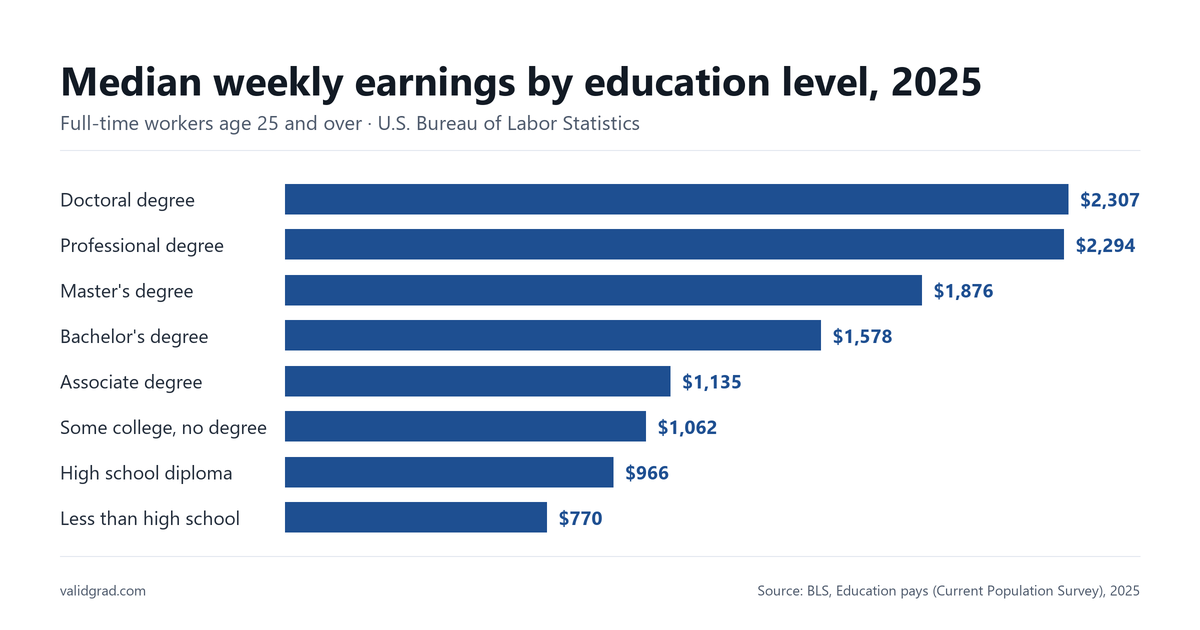
The more education you finish, the more you tend to earn. In 2025, full-time workers whose highest credential was a bachelor’s degree earned a median of $1,578 a week, about $82,000 a year. Workers with a high school diploma earned $966 a week, about $50,000. According to the U.S. Bureau of Labor Statistics (BLS), that is a 63% gap.
This guide breaks the numbers down by education level, shows what the gap adds up to over a career, and lists what more than 50 jobs require and pay. It also covers the part people forget until they need it, namely the diploma, transcript or license that proves your education, and what to do if yours is lost.
- Median weekly earnings in 2025 ranged from $770 for workers without a high school diploma to $2,307 for those with a doctorate.
- A bachelor’s degree paid 63% more than a high school diploma, and a master’s paid 19% more than a bachelor’s.
- Unemployment fell as education rose: 6.1% without a diploma, 2.8% with a bachelor’s degree, 1.8% with a doctorate.
- Over a career, men with a bachelor’s degree earn about $900,000 more than high school graduates, and women about $630,000 more (Social Security Administration research).
- “Some college, no degree” paid only 10% more than a high school diploma. Finishing the credential is what moves pay.
Average salary by education level (2025)
| Highest level of education | Median weekly earnings | About per year | Unemployment rate |
|---|---|---|---|
| Doctoral degree | $2,307 | $120,000 | 1.8% |
| Professional degree (law, medicine, etc.) | $2,294 | $119,300 | 1.9% |
| Master’s degree | $1,876 | $97,600 | 2.6% |
| Bachelor’s degree | $1,578 | $82,100 | 2.8% |
| Associate degree | $1,135 | $59,000 | 3.0% |
| Some college, no degree | $1,062 | $55,200 | 3.8% |
| High school diploma (or GED) | $966 | $50,200 | 4.3% |
| Less than a high school diploma | $770 | $40,000 | 6.1% |
| All workers | $1,268 | $65,900 | 3.4% |
Source: BLS, Education pays, 2025 (Current Population Survey). Covers full-time wage and salary workers age 25 and over. “High school diploma” includes equivalents such as the GED. The 2025 figures average 11 months, because October 2025 data weren’t collected during the federal government shutdown. The yearly column is the weekly median × 52, rounded. It is an estimate, not an official BLS annual median.
Two patterns stand out. First, each completed level pays more than the one below it up to the master’s degree. Doctoral and professional degrees (law, medicine, dentistry) pay about the same as each other. Second, unemployment moves the opposite way. Workers without a diploma were more than twice as likely to be unemployed as bachelor’s degree holders.
Medians hide a wide range. The median is the middle worker, so half earn more and half earn less. Your field, job, location and experience often matter as much as the degree itself, which is why the job tables below are more useful for planning than the averages.
Lifetime earnings by education level
Weekly gaps add up over a 40- to 50-year career. Researchers at the Social Security Administration used earnings records tracked over two decades to estimate median lifetime earnings between ages 20 and 69:
| Extra lifetime earnings compared with a high school diploma | Men | Women |
|---|---|---|
| Bachelor’s degree | +$900,000 | +$630,000 |
| Graduate degree | +$1.5 million | +$1.1 million |
Source: Tamborini, Kim and Sakamoto, “Education and Lifetime Earnings in the United States,” Demography (2015), as summarized by the Social Security Administration.
The study also controlled for background factors that affect both earnings and the chance of finishing college. The bachelor’s premium shrank but stayed large, at about $655,000 for men and $450,000 for women. Georgetown University’s Center on Education and the Workforce puts the lifetime value of a bachelor’s degree at $2.8 million on average, 84% more than someone whose highest credential is a high school diploma.
Why finishing pays and the sheepskin effect
Economists call the jump in pay that comes with the credential itself the sheepskin effect, after the sheepskin parchment diplomas were once printed on. People who complete a degree tend to earn noticeably more than people with nearly the same years of schooling who didn’t finish. One explanation is signaling, because a diploma tells employers you completed a program from start to finish.
The 2025 BLS figures show it clearly:
- Some college, no degree: $1,062 a week, 10% more than a high school diploma.
- Associate degree: $1,135 a week, 17% more.
- Bachelor’s degree: $1,578 a week, 63% more.
Someone who left college after three years may have taken nearly as many classes as a graduate, but for hiring purposes they sit much closer to the high school group. The research behind the term goes back decades. A well-known study is Jaeger and Page’s “Degrees Matter” (Review of Economics and Statistics, 1996).
It’s also why the diploma and transcript matter long after graduation. They are the proof that employers, licensing boards and graduate schools ask for. See do diplomas still matter? and how employers check your education below.
GED vs. high school diploma pay
The BLS figures above count GED holders with high school graduates, so the $966 median covers both. Research that separates the two tells a different story. Economists James Heckman, John Eric Humphries and Nicholas Mader studied the GED over many years (NBER, 2010). They found that GED recipients’ earnings and employment look more like those of dropouts than those of traditional graduates. The main reason was differences in persistence and other skills a test doesn’t measure.
In practice:
- Most employers and colleges accept the GED as a high school credential. Read more about high school equivalency diplomas.
- The military is stricter. The armed forces limit how many GED holders they enlist and usually require higher test scores from them. See do you need a GED to join the Army?
- The GED is a solid base, and it qualifies you for most jobs, training programs and colleges that ask for a high school credential. Here’s how to list a GED on a resume.
Jobs by education level, what they require and what they pay
The tables below group jobs by the education BLS says is typically needed to enter them. Pay is the U.S. median annual wage for May 2025. For comparison, the median for all U.S. workers was $50,980.
Here is how to read them. Pay is for the closest official BLS job category (Occupational Employment and Wage Statistics, May 2025). “What you need” combines the BLS typical entry-level education with the licenses or certificates the job usually requires. Where BLS has no category for a job, we say so rather than guess.
Jobs you can get with a high school diploma or GED
Several of these pay above the all-worker median without a college degree, mostly through apprenticeships or on-the-job training. The diploma or GED still matters, because it’s usually the minimum to get into the apprenticeship or training program.
| Job | What you need | Median pay (May 2025) |
|---|---|---|
| Electrical power-line installer (lineman) | High school diploma or GED, then long-term on-the-job training or an apprenticeship. Many employers also require a commercial driver’s license. | $95,320 |
| Crane operator (mobile and tower cranes) | High school diploma or GED and experience in a related job. OSHA rules require construction crane operators to be certified, for example through NCCCO. | $68,080 |
| Oil rig worker | No formal credential to start as a roustabout, and pay rises with rig experience. Offshore jobs add safety training such as helicopter underwater escape training (HUET). | $46,960 (roustabout) to $67,890 (rotary drill operator) |
| Electrician | High school diploma or GED, a 4- to 5-year apprenticeship, and a license in most states. | $63,190 |
| Heavy equipment operator | High school diploma or GED, then on-the-job training or an apprenticeship. | $59,850 |
| Welder (TIG, pipeline and oil rig welders) | High school diploma or GED plus technical-school or on-the-job training. Many employers want a welding certification, such as one from the American Welding Society. Pay varies widely by industry. | $53,750 |
| Pharmacy technician | High school diploma or GED and on-the-job training. Most states regulate pharmacy technicians, and many require certification (for example, from PTCB). | $45,750 |
More options: jobs you can get without a high school diploma, and why so many jobs ask for one anyway. Adults who never finished can still get a high school diploma.
Jobs that need a certificate, license or training program
These jobs don’t require a degree, but they do require a specific credential: a pilot certificate, a Coast Guard credential, a state license or a completed training program. BLS calls this a “postsecondary nondegree award.” Keep the certificate or license somewhere safe, because employers and regulators will ask to see it. For timelines, see how long it takes to get a certificate.
| Job | What you need | Median pay (May 2025) |
|---|---|---|
| Commercial pilot (corporate and charter pilots, flight instructors) | Flight training and an FAA commercial pilot certificate. Flight instructors also hold a flight instructor (CFI) certificate. Some employers prefer a degree. Many pilots instruct for a while to build the flight hours airlines require. | $123,220 |
| Merchant mariner (merchant navy) | A Merchant Mariner Credential from the U.S. Coast Guard and a TSA worker ID (TWIC). Entry-level sailors need no formal education. Officers complete Coast Guard-approved training, and many hold a bachelor’s degree from a maritime academy. | $51,520 for sailors, $92,460 for captains and mates, $109,530 for ship engineers |
| Aircraft mechanic | An FAA-approved aviation maintenance program. Most mechanics work under an FAA mechanic certificate with airframe and powerplant (A&P) ratings. | $79,870 |
| Commercial diver (saturation divers, underwater and deep-sea welders) | Commercial diving school, then on-the-job training. Underwater welders also need welding certification. Saturation diving, where divers live under pressure for weeks at a time, is the most specialized end of the field, and pay depends on day rates and time in saturation. | $72,990 |
| Truck driver (tractor-trailer) | A commercial driver’s license (CDL), usually through a truck-driving school. | $58,640 |
| Medical records specialist (RHIT) | A certificate program in health information, or an associate degree. The RHIT credential from AHIMA requires an associate degree from an accredited program. | $51,140 |
| Lash technician (skincare specialist) | A state-approved esthetics or cosmetology program and a state license. Some states license eyelash extensions separately. In Missouri, check the State Board of Cosmetology and Barber Examiners. | $45,330 (all skincare specialists) |
| Phlebotomist | A phlebotomy certificate program, often under a year. Most employers want certification (for example, from NHA or ASCP), and a few states, including California, require a state license or certificate. | $45,230 |
| CPR instructor | A current CPR provider card plus an instructor course from the American Heart Association or the American Red Cross. Many instructors teach part-time. | No BLS category |
| Trichologist (hair and scalp specialist) | There’s no U.S. license, and practitioners train through private certification bodies such as the Institute of Trichologists or the World Trichology Society. Trichologists aren’t physicians, and medical hair-loss treatment is a dermatologist’s job. | No BLS category |
| ROV pilot (remotely operated underwater vehicles) | Usually a technical background in electronics, electrical or mechanical systems (often from the military or a technical college), followed by offshore training and industry competence schemes such as IMCA’s. | No BLS category |
Jobs that need an associate degree
An associate degree takes about two years of full-time study. In 2025 it paid a median $1,135 a week, 17% more than a high school diploma. If you are unsure whether to write associate’s or associates, here’s the answer.
| Job | What you need | Median pay (May 2025) |
|---|---|---|
| Ultrasound technician (diagnostic medical sonographer) | An associate degree or a postsecondary certificate in sonography. Many employers require certification (for example, from ARDMS), and some states require a license. | $96,590 |
| Paralegal | An associate degree in paralegal studies, or a bachelor’s degree in another subject plus a paralegal certificate. | $62,890 |
Jobs that need a bachelor’s degree
A bachelor’s degree paid a median $1,578 a week in 2025, and it’s the entry requirement for every job in this table. Many also require a license or professional exams on top of the degree. Employers who check a degree usually confirm it with the school or through the National Student Clearinghouse. See do employers verify degrees?
| Job | What you need | Median pay (May 2025) |
|---|---|---|
| Airline and cargo pilot (UPS, FedEx and passenger airlines) | A bachelor’s degree in any field is typical, plus experience as a commercial or military pilot and an FAA airline transport pilot (ATP) certificate, which generally requires 1,500 flight hours. Senior cargo captains earn far more than the median. Simple Flying estimated in May 2026 that UPS captains make close to $34,000 a month, and that first officers at UPS and FedEx earn roughly $90,000 to $140,000 a year. |
$232,140 |
| Portfolio manager (including hedge funds) | A bachelor’s degree in finance, economics or a related field, plus 5+ years of experience. The CFA charter is common. BLS counts portfolio managers as financial managers. At hedge funds, a large share of pay usually comes as performance bonuses. | $166,570 (financial managers) |
| Software developer or engineer (including Amazon, Google, Java, AI and DevOps roles) | A bachelor’s degree in computer science or a related field is typical, and skills and portfolios count heavily. Large tech companies pay well above the median, with much of the difference paid in stock. | $135,980 |
| Cloud or network architect | A bachelor’s degree plus usually 5+ years of experience. Cloud certifications (AWS, Azure, Google Cloud) are common. | $134,050 (computer network architects) |
| Nuclear engineer | A bachelor’s degree in nuclear engineering or a related field. | $133,970 |
| Actuary | A bachelor’s degree in math, statistics or actuarial science, plus a series of professional exams from the Society of Actuaries or the Casualty Actuarial Society, usually passed over several years on the job. | $130,000 |
| Chemical engineer | A bachelor’s degree in chemical engineering. | $125,040 |
| Electrical engineer | A bachelor’s degree in electrical engineering. | $120,630 |
| Business manager (general and operations manager) | A bachelor’s degree, often in business, plus 5+ years of experience. | $105,770 |
| Mechanical engineer | A bachelor’s degree in mechanical engineering. | $104,110 |
| Video game designer | A bachelor’s degree in game design, computer science or a related field, plus a portfolio. BLS groups game designers with web and digital interface designers. | $104,000 |
| Industrial or manufacturing engineer | A bachelor’s degree in industrial, manufacturing or mechanical engineering. The closest BLS category is industrial engineers. | $102,440 |
| Licensed professional engineer (PE) | An engineering degree (usually ABET-accredited), the Fundamentals of Engineering (FE) exam, about four years of supervised experience, then the PE exam from NCEES. A PE license allows you to sign off on plans and offer engineering services to the public. | Varies by field (see the engineer rows) |
| Architect | A professional architecture degree (usually a 5-year bachelor’s), a paid internship and the Architect Registration Examination, which leads to a state license. | $99,280 |
| Bioinformatics scientist | BLS lists a bachelor’s degree for entry, but many bioinformatics jobs ask for a master’s or PhD in biology, statistics or computer science. | $98,920 |
| Chemist | A bachelor’s degree in chemistry. Research jobs usually require a PhD. | $91,240 |
| Safety officer (occupational health and safety specialist) | A bachelor’s degree in occupational health and safety or a related field. Certifications such as the CSP are common. | $90,150 |
| Industrial designer | A bachelor’s degree in industrial design, architecture or engineering, plus a portfolio. | $83,910 |
| Fashion designer | A bachelor’s degree in fashion design or merchandising, plus a portfolio. | $80,960 |
| Dietitian | BLS still lists a bachelor’s degree, but since January 2024 new registered dietitians need a graduate degree to take the credentialing exam, plus supervised practice. Most states license dietitians. | $76,400 |
| Game warden or conservation officer | A bachelor’s degree (often in wildlife, biology or criminal justice), then law-enforcement academy training. | $74,060 (fish and game wardens) |
| Teacher (including PE and gym teachers, and Chicago Public Schools) | A bachelor’s degree and a state teaching license. PE teachers need certification in physical education. Large districts such as Chicago Public Schools publish salary schedules that pay more for each extra degree and year of experience. | $72,040 for high school, $63,970 for elementary |
| Medical laboratory scientist (MLS, ASCP) | A bachelor’s degree in medical laboratory science or a life science. ASCP’s MLS certification is the common credential, and some states license lab staff. | $62,930 (lab technologists and technicians) |
| Patent agent | A science or engineering background that qualifies you for the USPTO registration exam (the “patent bar”), then passing it. Unlike patent attorneys, patent agents don’t need a law degree. | No BLS category |
Jobs that need a master’s degree
A master’s degree paid a median $1,876 a week in 2025, 19% more than a bachelor’s. For the jobs below it’s the standard entry credential, often combined with a state license. Licensing boards usually want official transcripts sent by your school’s registrar, not a copy you print yourself. See how to request official transcripts.
| Job | What you need | Median pay (May 2025) |
|---|---|---|
| Psychologist with a master’s degree | A master’s degree is enough for school psychologists (with an internship and state certification) and for industrial-organizational psychologists. Clinical and counseling psychologists need a doctorate and a license. | $95,990 for school, $193,950 for industrial-organizational, $100,580 for clinical and counseling |
| Research scientist (including Meta and other AI labs, and computer science PhDs) | Usually a master’s degree in computer science or a related field. Many employers, especially AI labs, prefer a PhD. Research scientists in medicine and biology are counted separately as medical scientists, where a doctorate is typical and the median is $103,410. Fortune reported in July 2025 that research scientists at Meta earn base pay of about $305,000 a year at mid-level and up to $581,000 at senior level, and that some AI recruits were offered packages worth up to $300 million over four years. |
$140,300 (computer and information research scientists) |
| Statistician | A master’s degree in statistics, mathematics or a related field. Some entry-level jobs accept a bachelor’s. | $105,650 |
| Librarian (including school librarians) | A master’s degree in library science (MLS or MLIS), usually from an ALA-accredited program. School librarians often need a teaching certificate as well. | $68,270 |
| Clinical social worker (MSW) | A master’s degree in social work, supervised clinical experience and a state license (such as the LCSW). Non-clinical social work jobs can start with a bachelor’s degree. | $67,880 for healthcare, $60,280 for mental health, $59,550 for child, family and school |
| School or career counselor | A master’s degree in school counseling or a related field. Public school counselors also need a state credential. | $64,330 |
| Quantum engineer | BLS has no category for this job yet. Most roles ask for a master’s or PhD in physics, electrical engineering or computer science. The closest BLS figures are physicists ($172,250) and electrical engineers ($120,630). | No BLS category |
Jobs that need a doctoral or professional degree
Doctoral and professional degrees (such as a PhD, JD or MD) paid the most in 2025, about $2,300 a week. They also take the longest to earn, at three years of law school after a bachelor’s degree, typically five or more years for a PhD, and for physicians, four years of medical school followed by residency. See how long it takes to get each degree.
| Job | What you need | Median pay (May 2025) |
|---|---|---|
| Radiologist (including neuroradiologists) | A medical degree (MD or DO), a radiology residency and a state medical license. Neuroradiologists add a fellowship after residency. | $420,860 |
| Physicist (including quantum physicists) | A PhD in physics for most research jobs. Some government and industry jobs hire people with a bachelor’s or master’s. | $172,250 |
| Lawyer (including BigLaw associates) | A law degree (JD), usually three years after college, and passing your state’s bar exam. The largest firms now pay first-year associates a base salary of $235,000, after Milbank raised the market scale effective July 1, 2026 (Biglaw Investor). |
$159,670 |
Salaries outside the United States
Countries measure pay differently (monthly or yearly, before or after tax), so these figures aren’t directly comparable with the U.S. tables. Each row gives the most recent official figure we could verify, plus the U.S. median for the related job where there is one.
| Place | Latest official figure | U.S. comparison |
|---|---|---|
| Norway | Average monthly earnings of NOK 62,070 before tax in 2025 (men NOK 65,610, women NOK 57,690). Source: Statistics Norway. | None |
| Serbia | Average net salary of RSD 120,401 a month in June 2026 (gross RSD 166,123). Half of employees earned RSD 94,281 net or less. Source: Statistical Office of the Republic of Serbia. | None |
| Jamaica | The national minimum wage rose to J$17,000 per 40-hour week on July 1, 2026, up from J$16,000. Source: Jamaica Information Service. | None |
| Saudi Arabia (drivers and safety officers) | The statistics authority (GASTAT) publishes employment figures every quarter, but we couldn’t find a current official wage figure for drivers or safety officers. Job offers usually combine a basic salary with housing and transport allowances. | U.S. truck drivers $58,640, safety specialists $90,150 |
| United Arab Emirates (electricians in Dubai) | We couldn’t find an official, current wage survey for electricians in Dubai. Pay depends heavily on the employer and on certification, and offers usually list basic salary and allowances separately. | U.S. electricians $63,190 |
| New York City (workers around age 30) | Wages in the New York metro area averaged $41.50 an hour in May 2025, about 24% above the U.S. average of $33.54 (BLS). Nationally, full-time workers aged 25 to 34 earned a median $1,160 a week in the second quarter of 2026, about $60,300 a year. | None |
Working across borders usually means a diploma from one country needs a credential evaluation in another. See whether foreign diplomas are accepted in the US and how international degree verification works.
How employers check your education
Salary tables assume you can prove the credential. This is what’s usually asked for at each level:
| Credential | What you’re usually asked for | How it’s checked |
|---|---|---|
| High school diploma or GED | A yes/no question on the application, and sometimes a copy of the diploma or a transcript. | With the school or district, or with the state or GED Testing Service for equivalency credentials. Many employers hand this to a background-check company. |
| College degree | The degree, major and graduation date on your resume. | Through the National Student Clearinghouse or the school’s registrar, often via a background-check company. |
| Transcript | Official transcripts for licensing boards, teaching jobs, graduate school and some government jobs. | Sent directly by the registrar, often electronically (for example, through Parchment or the National Student Clearinghouse). |
| License or certificate | The license or certificate number. | Online lookups run by state boards and certifying bodies, such as the FAA, the Coast Guard, and state nursing and cosmetology boards. |
More detail:
- What an education background check covers
- How high school diplomas are verified
- Proof of education for employment
- Diploma vs. transcript
- Using a transcript instead of a diploma
Claiming a credential you don’t have can cost you the job, and in some situations it’s illegal. See can you go to jail for lying about graduating?
Lost your diploma or transcript?
Diplomas get lost in moves, damaged in basements, or never picked up. Getting the official record back is usually straightforward:
- Official transcript: order it from the registrar of the school you attended, online in most cases. It’s the document that counts when someone verifies your education.
- Replacement diploma: most schools reissue diplomas for a fee. For a high school diploma, start with the school district. See how to find your high school diploma online and replacing a lost diploma.
- Closed school: records usually move to the state education agency or another school. See how to get a diploma from a closed school.
- GED: order copies of your GED diploma and transcript through GED.com or your state’s high school equivalency office. See how to get a GED certificate.
If you just want a copy to frame (because the original was damaged, or you never had one framed), ValidGrad makes replacement high school diplomas, college diplomas, GED diplomas and transcripts for display. They are novelty documents. They don’t replace your school’s official records, and they must never be used to claim a credential you haven’t earned. Employers verify education with the school, not with the paper on your wall. For ideas, see displaying a framed diploma.
Frequently asked questions
Which education level earns the most?
Doctoral and professional degrees, with medians of $2,307 and $2,294 a week in 2025, or about $120,000 a year. The biggest single jump is from a high school diploma ($966 a week) to a bachelor’s degree ($1,578).
How much more does a bachelor’s degree earn than a high school diploma?
About $612 more a week at the median in 2025, or 63%. That’s roughly $31,800 a year. Over a career, Social Security Administration research puts the gap at about $900,000 for men and $630,000 for women.
Does a GED pay as much as a high school diploma?
Official BLS averages can’t answer this, because they count GED holders and graduates together. Research that separates them finds GED holders earn less on average than traditional graduates. Still, the GED opens the door to most jobs, training programs and colleges that ask for a high school credential.
What are the highest-paying jobs with a high school diploma?
In the tables above:
- Electrical power-line installers: $95,320
- Crane operators: $68,080
- Rotary drill operators on oil rigs: $67,890
- Electricians: $63,190
All of them need substantial training or experience after high school.
Do employers actually check whether you have a diploma?
Many do, especially for jobs that require a degree or a license. They usually confirm it with the school or through a background-check company. See do employers verify degrees?
Sources
- U.S. Bureau of Labor Statistics, Unemployment rates and earnings by educational attainment, 2025 (Education pays).
- BLS, Occupational projections and worker characteristics (May 2025 median wages and typical entry-level education), and the Occupational Outlook Handbook.
- O*NET OnLine, Bioinformatics Scientists and Video Game Designers (BLS May 2025 wages).
- BLS, Usual weekly earnings, second quarter 2026, Table 3.
- BLS, Occupational Employment and Wages in New York-Newark-Jersey City, May 2025.
- Social Security Administration, Research Summary: Education and Lifetime Earnings (2015), based on Tamborini, Kim and Sakamoto, Demography 52 (2015).
- Georgetown University Center on Education and the Workforce, The College Payoff.
- Jaeger, D. A., and Page, M. E. (1996). “Degrees Matter: New Evidence on Sheepskin Effects in the Returns to Education.” Review of Economics and Statistics 78(4).
- Heckman, J. J., Humphries, J. E., and Mader, N. S. (2010). “The GED.” NBER Working Paper 16064.
- Fortune, “Mark Zuckerberg is determined to build an AI superteam” (July 11, 2025).
- Simple Flying, “A Look At The Salaries Of Widebody Cargo Pilots In 2026” (May 3, 2026).
- Biglaw Investor, Biglaw salary scale.
- Statistics Norway, Earnings; Statistical Office of the Republic of Serbia, Earnings; Jamaica Information Service, “Minimum Wage Moves to $17,000 on July 1”.