
I’ll be honest – when I first looked into getting my real estate license, I felt completely overwhelmed. The internet was full of contradictory information, and everyone seemed to have a different opinion on the “right” way to do it.
After stumbling through the process myself (and making a few costly mistakes along the way), I figured I’d share what actually worked – and what didn’t. Here’s the real story of how I went from knowing absolutely nothing about real estate to holding my license and closing my first deals. The median annual wage for real estate sales agents was $56,320 in May 2024 according to the Bureau of Labor Statistics, which honestly looked pretty good compared to my previous job.
Step 1: Don’t Make My First Mistake with Education Requirements
I almost screwed this up right from the start. I was living in Wisconsin and got excited about this online course I found – great reviews, reasonable price, the whole nine yards. Thank God I double-checked with the state before paying, because it turns out that course wasn’t even approved for Wisconsin residents. Would’ve been $500 down the drain.
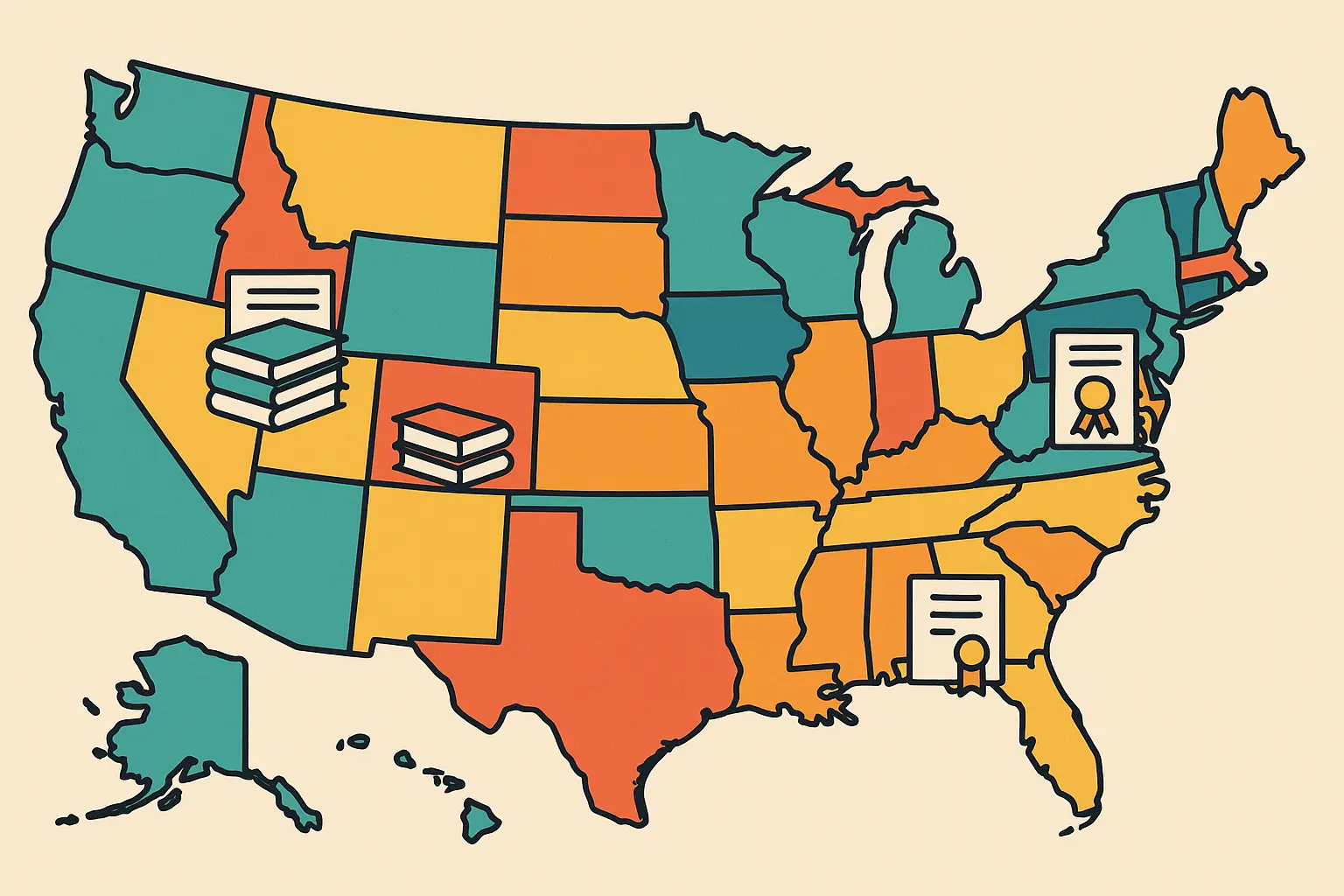
Every state has different rules, and they’re not messing around. Wisconsin wanted 72 hours of coursework. My friend in Texas? She needed 180 hours. That’s more than double! The lesson here is simple: check your state’s website first, not Google ads.
The real estate licensing landscape keeps changing too. “In the first quarter (Q1) of 2025, 4,000 new real estate agents and 760 new brokers received licenses from the California Department of Real Estate (DRE)” according to firsttuesday journal, though this represents a 31% decline in newly-licensed agents compared to the previous year. That actually made me feel better about my timing – less competition!
For those who need to obtain their high school diploma first, understanding high school diploma requirements is essential before pursuing real estate education.
What Those Hours Actually Cover
The coursework isn’t just busy work – though some of it feels like it. You’ll dive deep into real estate law, which honestly made my head spin at first. Property management principles, financing options, contract basics, and fair housing regulations round out most programs. The ethics training is mandatory everywhere, and looking back, it was probably the most useful stuff I learned.
|
State Example |
Pre-License Hours Required |
Additional Requirements |
|---|---|---|
|
Wisconsin |
72 hours |
Background check, high school diploma |
|
California |
135 hours |
Background check, fingerprinting |
|
Florida |
63 hours |
Post-license education required |
|
Texas |
180 hours |
Additional SAE courses |
|
New York |
77 hours |
Sponsoring broker required |
Wisconsin specifically requires agents to “Complete the Board-approved 72-hour pre-license program for Salespersons within four years before submitting the application for licensure” according to the Wisconsin Department of Safety and Professional Services. Four years sounds generous, but trust me, you don’t want to drag this out.
In Wisconsin’s 72-hour program, I spent about 20 hours drowning in real estate law, 15 hours learning property valuation (which actually came in handy later), 12 hours on financing that made me appreciate my mortgage broker, 10 hours on contracts that scared the hell out of me, 8 hours on fair housing and ethics, and 7 hours on property management. It sounds like a lot, but it goes by faster than you think.
Step 2: Picking a School That Won’t Leave You High and Dry
Choosing the right school can make or break your experience. I looked at everything – accreditation, course formats, costs, and most importantly, their students’ pass rates on the licensing exam. The cheapest option definitely isn’t always the best if you end up failing the exam twice.
The importance of a good school became crystal clear when I learned that “The passing rate for the Wisconsin Real Estate Salesperson Exam is 75%, meaning that a quarter of the people who take it do not pass” according to The Close. I did not want to be in that 25%.
Online vs. Sitting in a Classroom
I went with online because I was working full-time and couldn’t make it to evening classes. Being able to study at 2 AM in my pajamas was a lifesaver. But I’ll admit, there were times I missed being able to raise my hand and ask “Wait, what the hell does that mean?” to a real person.
Some of my classmates swore by traditional classroom learning. They liked the face-to-face interaction and said it kept them more accountable. “You can take courses entirely online and you can start immediately” according to the California Association of Realtors, which is exactly what sold me on the online route.
Actually Finishing the Coursework Without Losing Your Mind
The material is dense. Like, really dense. I’m talking complex legal concepts that made me question my career choice more than once. I developed a system that worked for me – short study sessions instead of marathon cramming, practice tests after every module, and flashcards for all those terms that sound like they were made up by lawyers (because they were).
If you need assistance with protecting or replacing your educational certificates later, learning about replacement diplomas can help you maintain proper documentation throughout your career.
Here’s what actually helped me get through it:
-
Set up a dedicated study space (my kitchen table became real estate central)
-
Created a weekly schedule with specific goals (and actually stuck to it)
-
Took practice quizzes religiously – they showed me where I was weak
-
Joined an online study group that kept me motivated
-
Did regular review sessions so I didn’t forget everything from week one
Step 3: The Exam That Almost Broke Me
Let me tell you about exam day – I was a nervous wreck. I’d been studying for weeks, taking practice tests until I could recite property law in my sleep. But sitting in that testing center, staring at the first question about easements, my mind went completely blank.
The exam is actually two separate tests: a national portion covering general real estate principles and a state-specific section focusing on local laws. Here’s what saved me: I’d practiced enough timed tests that my hands knew what to do even when my brain was panicking.
What’s Actually on These Tests
The national portion covers stuff you’ll use everywhere – property ownership rights, land use controls, valuation methods, financing options. I spent extra time on property valuation and financing because they seemed to show up in every practice test.
The state section is where things got tricky. Wisconsin threw me some curveballs about local disclosure requirements that I wasn’t expecting. This is why you can’t just focus on the national content and hope for the best.
Most exams are 80-150 multiple-choice questions with time limits that feel way too short. A typical question might be: “A buyer is purchasing a $300,000 home with a 10% down payment. If the lender charges 2 points on the loan, how much will the buyer pay in points?” The answer is $5,400 (90% of $300,000 = $270,000 loan amount × 2% = $5,400). Math was never my strong suit, so I practiced these calculations until I could do them in my sleep.
How I Actually Prepared (And What I Wish I’d Done Differently)
I used official practice tests from the state testing provider – those are worth their weight in gold. I also bought study guides, made flashcards, and found some decent online resources. Taking practice exams under timed conditions was crucial because it showed me I knew the material but was too slow at applying it.
My test-taking strategy was simple: read each question twice, eliminate the obviously wrong answers, and don’t overthink it. I had a bad habit of changing correct answers to wrong ones because I second-guessed myself.
Step 4: The Paperwork Marathon
Passing the exam felt amazing, but then reality hit – I still had a mountain of paperwork to complete. The license application process involves background checks, fingerprinting, fees, and enough forms to kill a small forest. Being organized here saved me weeks of delays.
Understanding proper academic documents management becomes crucial during this phase because you’ll need to present various educational credentials.
What You Actually Need to Submit
I gathered everything before starting the application to avoid delays. You’ll need proof of education completion, exam passage confirmation, identification documents, and completed state forms. I made copies of everything and kept digital backups because some of this stuff is a pain to replace.
Here’s what I needed in Wisconsin:
-
Certificate of pre-licensing education completion
-
Exam passage confirmation
-
Driver’s license and Social Security card
-
Completed state application form
-
Background check authorization
-
Fingerprinting appointment confirmation
-
$60 application fee plus $68 for the background check
The background check and fingerprinting process was straightforward but felt weird. I scheduled an appointment at an approved location and got results within a few days. Having a speeding ticket from college didn’t disqualify me, thankfully.
Processing times vary, but I waited about three weeks for approval in Wisconsin. Some states are faster, others slower. The key is submitting everything as soon as possible after passing the exam.
|
State |
Application Fee |
Processing Time |
Background Check Fee |
|---|---|---|---|
|
Wisconsin |
$60 |
2-4 weeks |
$68 |
|
California |
$245 |
4-6 weeks |
$49 |
|
Florida |
$83.75 |
2-3 weeks |
$42 |
|
Texas |
$185 |
3-5 weeks |
$38.25 |
|
New York |
$150 |
4-8 weeks |
$94.50 |
Step 5: Finding a Broker (AKA Real Estate Dating)
New agents must affiliate with a licensed broker to activate their license. This decision basically determines whether your first year will be successful or miserable, so I spent a lot of time researching potential brokerages.
Finding a broker felt like online dating – lots of promises, but you don’t know what you’re really getting until you’re in the relationship. I visited five different offices, and the differences were huge.
What I Learned About Broker Relationships
Brokers provide supervision, training, and legal oversight while taking a cut of your commission income. Some offer extensive support and training, others basically hand you business cards and say “good luck.”
One place offered a 50/50 commission split but wanted $300 a month in fees, whether I sold anything or not. Another offered 70/30 in my favor but basically said “good luck” when I asked about training. The place I ultimately chose wasn’t the highest commission split, but they had a mentorship program that made all the difference in my first year.
When I evaluated brokerages, I made a simple comparison: Brokerage A offered 50/50 split with great training but $200/month in fees. Brokerage B provided 70/30 in my favor with minimal fees but no support. Brokerage C offered a graduated split starting at 60/40 and improving to 80/20 after $50,000 in gross commission income, plus comprehensive training and marketing support. That systematic approach helped me choose what actually supported my long-term goals.
Understanding potential earnings helped too, especially knowing that “Overall employment of real estate brokers and sales agents is projected to grow 3 percent from 2024 to 2034, about as fast as the average for all occupations” according to the Bureau of Labor Statistics. Steady growth meant I wasn’t jumping into a dying industry.
Step 6: Staying Licensed and Actually Building a Career
Getting licensed is just the beginning. Most states require continuing education to renew your license, and building a successful career demands way more learning than I expected.

Nobody warned me that getting licensed was
Nobody warned me that getting licensed was just the beginning. Two years later, I got a letter saying my license was up for renewal – and I needed 18 hours of continuing education courses. Cue the panic.
I put it off until the last minute (don’t do this) and ended up taking a mind-numbing online course about fair housing laws at 11 PM the night before my deadline. The instructor had the most monotone voice imaginable, and I’m pretty sure I fell asleep during the section on disability accommodations.
Now I’m smarter about it. I spread the courses throughout the renewal period and actually pick topics that help my business. Last year I took a course on luxury home marketing that directly led to a $800,000 listing.
The Continuing Education Reality
License renewal periods typically range from 1-4 years, with continuing education requirements varying from 10-30 hours per renewal cycle. I keep track of my renewal date and required hours in a simple spreadsheet to avoid last-minute panic.
For professionals who need to maintain multiple certifications, understanding replacement certifications processes can help ensure you never lose important credentials.
My tracking system looks like this:
-
License expiration date: March 15, 2026
-
Required CE hours: 18
-
Hours completed to date: 12
-
Remaining hours needed: 6
-
Renewal fee due: $75
-
Renewal submission deadline: February 15, 2026
Getting Additional Certifications (And Whether They’re Worth It)
After my first year, I realized I was drowning in a sea of other agents who all seemed to know something I didn’t. That’s when my broker suggested getting some additional certifications.
The GRI designation sounded impressive, but it meant three more weeks of classes and another $600. I almost talked myself out of it – who has time for more studying? But honestly, it was worth every penny. Not because clients care about letters after your name, but because I finally understood things like comparative market analysis and investment property evaluation that I’d been faking my way through.
Understanding business certification requirements can help real estate professionals expand their expertise beyond basic licensing.
Industry organizations offer specialized designations including GRI (Graduate Realtor Institute), CRS (Certified Residential Specialist), and ABR (Accredited Buyer’s Representative). These require additional education and experience, but they provide credibility and knowledge that actually helps you serve clients better.
The Real Talk About Building a Career
Look, I’m not going to sugarcoat this – real estate is tough. Getting licensed is the easy part . Building a business where you can actually pay your bills? That takes time, patience, and a lot of rejection.
But if you’re willing to put in the work, it’s also incredibly rewarding. There’s nothing quite like handing someone the keys to their first home or helping a family sell the house where they raised their kids.
Career success requires developing marketing skills, building client relationships, understanding local markets, and maintaining professional networks. I’ve learned that the technical knowledge from licensing education is just the foundation – business development skills determine whether you’ll actually make money in this industry.
My first year was humbling. I thought having a license meant clients would just appear. Wrong. I spent months learning how to generate leads, follow up with prospects, and actually close deals. The education prepared me to understand contracts and regulations, but it didn’t teach me how to convince someone to trust me with the biggest financial decision of their life.
During your licensing journey, you’ll accumulate important documents including education certificates and exam results. If you ever need backup copies of these credentials for display purposes or safekeeping, ValidGrad’s diploma replacement services can help you create high-quality replicas while keeping your originals secure. Professional presentation matters in real estate, and having proper documentation readily available demonstrates your commitment to the profession.
For those looking to properly showcase their achievements, learning about how to display certificates on wall can help create a professional office environment that builds client confidence.
My Advice After Three Years in the Business
Don’t overthink the licensing process. Pick a decent school that’s approved by your state, study consistently instead of cramming, and find a broker who actually cares about helping new agents succeed. The rest you’ll figure out as you go.
Focus on getting through the requirements efficiently rather than perfectly. I spent way too much time researching the “best” school when any approved program would have gotten me to the same place. The real learning happens after you get your license and start working with actual clients.
Most importantly, be prepared for the business side of real estate to be completely different from the licensing education. The courses teach you about property law and regulations, but they don’t teach you how to prospect for clients, handle difficult negotiations, or manage your finances when commission checks are unpredictable.
The licensing process took me about four months from start to finish – two months for the coursework, one month of exam prep, and one month for the application processing. Your timeline might be different depending on your state’s requirements and how quickly you move through each step.
Start by checking your state’s real estate commission website for specific requirements, find an approved school that fits your schedule and learning style, and don’t let the exam intimidate you. Thousands of people pass these tests every year, and with proper preparation, you can too.