Updated September 2026 · Sources listed at the end
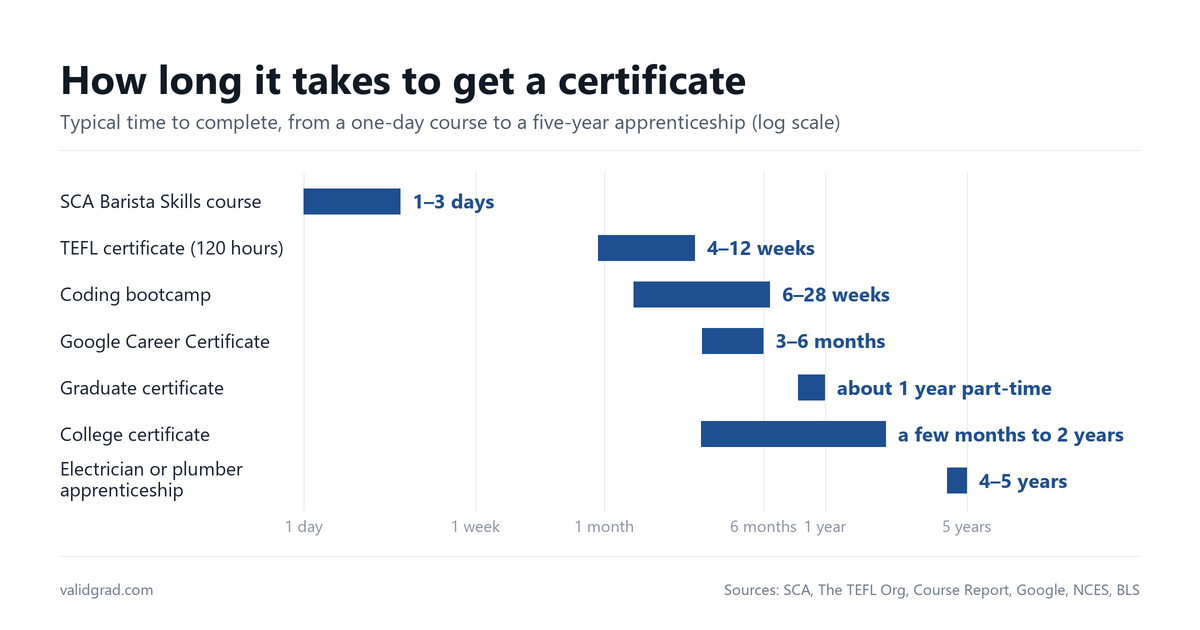
Anywhere from a day to several years:
- One level of a barista course takes a single day.
- A Google Career Certificate takes 3 to 6 months of part-time study.
- College certificates take a few months to two years.
- Trade credentials built on an apprenticeship take four to five years.
Below are typical timelines by type, followed by nearly 20 specific certificates people ask about.
- Federal education statistics sort college certificates into three lengths: under one academic year, one to two years, and two to four years.
- Under the federal definition, a graduate certificate requires at least 18 credit hours beyond a bachelor’s degree, or about six graduate courses.
- Google says its Career Certificates take 3 to 6 months at under 10 hours of study a week.
- Most electricians and plumbers train through a 4- or 5-year apprenticeship, with about 2,000 hours of paid on-the-job training each year (BLS).
- Some documents called certificates are really registrations or score reports: a DBA, a Pennsylvania short certificate, TOEFL scores. Their timeline is processing time, not study time.
How long each type of certificate takes
| Type | Typical time | What decides it |
|---|---|---|
| Skills course certificate (barista, first aid, workplace safety) | A day to a few weeks | Course hours. Many courses issue the certificate as soon as you finish or pass the final exam. |
| Online career certificate (Google, Coursera and similar) | A few weeks to about 6 months | Mostly self-paced, so it depends on how many hours a week you put in. |
| College certificate (community or technical college) | A few months to 2 years | The number of credits. Federal statistics group these programs as under 1 year, 1 to 2 years, or 2 to 4 years. |
| Graduate certificate | About a year part-time, often less full-time | At least 18 credit hours beyond the bachelor’s degree (federal definition). |
| Professional certification (exam-based) | Weeks to several years | Exam preparation plus any experience requirement. CISSP, for example, requires five years of paid work in the field. |
| Trade license (electrician, plumber) | 4 to 5 years | Apprenticeship hours, then a state or local license in most places. |
| Teaching certificate (state license) | About 4 years through a bachelor’s degree, or less if you already have one | A teacher-preparation program, student teaching and the state’s requirements. |
| Registrations and score reports (DBA, short certificate, TOEFL) | Days to weeks | Processing time at the office that issues them. |
Timelines for specific certificates
| Certificate | How long | What’s involved |
|---|---|---|
| DBA (“doing business as”) or business certificate | Depends on the state, often days and sometimes weeks | It is not an education credential. It registers a business name that differs from the owner’s legal name. Depending on the state, you file with the county clerk or the secretary of state. Some states, including California, also require you to publish a notice in a local newspaper for several weeks. In New York, sole proprietors file a “business certificate” with the county clerk. |
| Barista certificate (SCA Barista Skills) | 1 to 3 days per level | The Specialty Coffee Association’s Barista Skills course has three levels: Foundation (1 day), Intermediate (2 days) and Professional (3 days). Each level has a written and a practical exam and earns points toward the SCA Coffee Skills Diploma. |
| TOEFL score report | About 3 days after the test | ETS doesn’t issue a certificate. Scores appear in your ETS account 3 days after the test, the PDF score report 24 to 48 hours later, and scores stay valid for 2 years. |
| Short certificate (Pennsylvania estates) | Depends on the county | A sealed document from the county Register of Wills that names the person authorized to act for an estate, for example to close bank accounts. You get it after filing to open the estate and being granted letters. Timing and the per-copy fee vary by county. |
| CNC machining certificate | Under 2 years | Community colleges and technical schools offer 2-year degrees and shorter certificate programs that cover CNC programming and machine operation. Many machinists also learn on the job or through apprenticeships (BLS). |
| Google Career Certificate | 3 to 6 months part-time | Google says under 10 hours of flexible study a week, with no experience needed. The courses run on Coursera, and you get a digital badge (Credly) when you finish. |
| Trade school certificate | A few months to 2 years | Depends on the trade and the credits required. Licensed trades such as electrician and plumber add a multi-year apprenticeship. See the next two rows. |
| Electrician (apprenticeship and license) | 4 to 5 years | Most electricians learn in a 4- or 5-year apprenticeship with about 2,000 hours of paid on-the-job training a year, plus technical instruction. Technical-school graduates usually get credit toward the apprenticeship. Most states require electricians to be licensed. |
| Plumber (apprenticeship and license) | 4 to 5 years | Most plumbers train through a 4- or 5-year apprenticeship with about 2,000 hours of paid on-the-job training a year, and some take a vocational-technical program first. Most states and some localities require plumbers to be licensed. |
| Technical certificate (community or technical college) | A few months to 2 years | Set by the number of credits. Many colleges design these certificates so the credits also count toward an associate degree. |
| Teaching certificate (state license) | About 4 years through a bachelor’s degree | Public school teachers need a state-issued certificate or license, which usually means a bachelor’s degree that includes a teacher-preparation program and student teaching. Some states later require a master’s degree (BLS). People with a degree in another field can often use an alternative-route program. |
| Graduate certificate | About 1 year part-time | At least 18 credit hours beyond the bachelor’s degree under the federal definition, which is about six courses. At many schools the credits can later count toward a master’s degree. |
| Certificate of completion | Immediately to a few weeks | Issued when you finish a course or program, often instantly for online courses and after final grades for school programs. It shows you finished, but it isn’t an accredited credential. See how to make a certificate of completion. |
| Coding bootcamp certificate | About 3 months full-time | Course Report puts the average bootcamp at about 14 weeks (the range is 6 to 28 weeks), and full-time programs at about 12 weeks. College programming certificates follow the college timelines above. |
| Cybersecurity certification | Weeks to years | For entry-level exams such as CompTIA Security+, the main factor is study time. Advanced credentials add experience requirements: CISSP requires five years of paid work experience in the field. |
| CBT (cognitive behavioral therapy) certification | At least a year after licensure | Open to licensed mental-health professionals. The Academy of Cognitive and Behavioral Therapies requires a terminal degree and a license, at least 40 hours of CBT training, a year of clinical CBT experience, and review of a case or work sample. |
| Coaching certificate (youth and school sports) | Hours to months | The entry certifications leagues and schools require are often short online courses. Higher coaching levels add clinics and experience. Requirements depend on the sport and the organization. |
| CAD certificate | A few months for a course; 1 to 2 years of practice for Autodesk’s professional exam | College drafting certificates are shorter than the associate degree most drafters hold (BLS). Autodesk recommends 400 to 1,200 hours of hands-on AutoCAD experience before its professional certification exam. |
| TEFL certificate | 4 to 12 weeks | The standard is a 120-hour course. The TEFL Org says online students take 10 to 12 weeks on average. Intensive in-person courses take about 4 weeks. |
Certificate or degree?
A certificate trains you for a specific job or skill. A degree is broader and takes longer. Many certificate jobs pay well. In May 2025, aircraft mechanics earned a median $79,870 and commercial pilots $123,220 (see jobs that need a certificate). For the difference and when each makes sense, see is a certificate a degree? Degree timelines are in how long it takes to get a degree.
Getting, proving and replacing a certificate after you finish
- How it’s issued: many programs send a digital badge or PDF first, and some mail a paper certificate later.
- How employers check it: with the issuer, or through public lookups for licenses (state licensing boards) and many certifications. Keep your certificate or license number handy.
- If you lose it: ask the issuer for a replacement. State boards reissue license cards, and schools reissue certificates, usually for a fee.
- If it expires: many professional certifications must be renewed. CompTIA’s, for example, last three years.
For framing ideas, see how to display certificates on a wall. If you run a course, workshop or team program, you can design certificates of completion and achievement for your participants with ValidGrad’s certificate maker. See the certificate of completion template guide and why achievement certificates matter. ValidGrad certificates are novelty documents, and you must never use one to claim a credential you haven’t earned.
Frequently asked questions
How long is a certificate program?
Most college certificate programs take under two years. Federal statistics group them as under 1 year, 1 to 2 years, or 2 to 4 years. Graduate certificates require at least 18 credit hours, usually about a year of part-time study.
What’s the quickest certificate to get?
Skills certificates, such as the SCA’s one-day Barista Skills Foundation course. For hiring, industry-recognized certificates and licenses usually carry more weight than short courses.
How long does it take for a DBA to be approved?
It depends on the state and county. Some filings are processed quickly. Some states, including California, also require a newspaper notice that runs for several weeks.
Do certificates expire?
College certificates and certificates of completion don’t. Many professional certifications must be renewed (CompTIA’s every three years), and TOEFL scores are valid for two years.
Can certificate credits count toward a degree?
Often, yes. Many community-college certificates are designed to stack into an associate degree, and graduate certificate credits frequently transfer into a master’s at the same school. Check with the school before you enroll.
Sources
- National Center for Education Statistics, IPEDS glossary (certificate award levels; postbaccalaureate certificate).
- U.S. Bureau of Labor Statistics, Occupational Outlook Handbook: Electricians, Plumbers, Machinists, Drafters, High school teachers.
- Google, Google Career Certificates.
- ETS, Getting your TOEFL iBT scores.
- Specialty Coffee Association, SCA courses.
- Course Report, Coding bootcamps guide.
- ISC2, CISSP experience requirements.
- Academy of Cognitive and Behavioral Therapies, Certification criteria.
- Autodesk, Certified Professional in AutoCAD for Design and Drafting.
- The TEFL Org, How long does it take to complete a TEFL course?
- Lancaster County, Pennsylvania, What is a short certificate?