Updated September 2026 · State credential names, federal rules and record-request procedures are sourced at the end
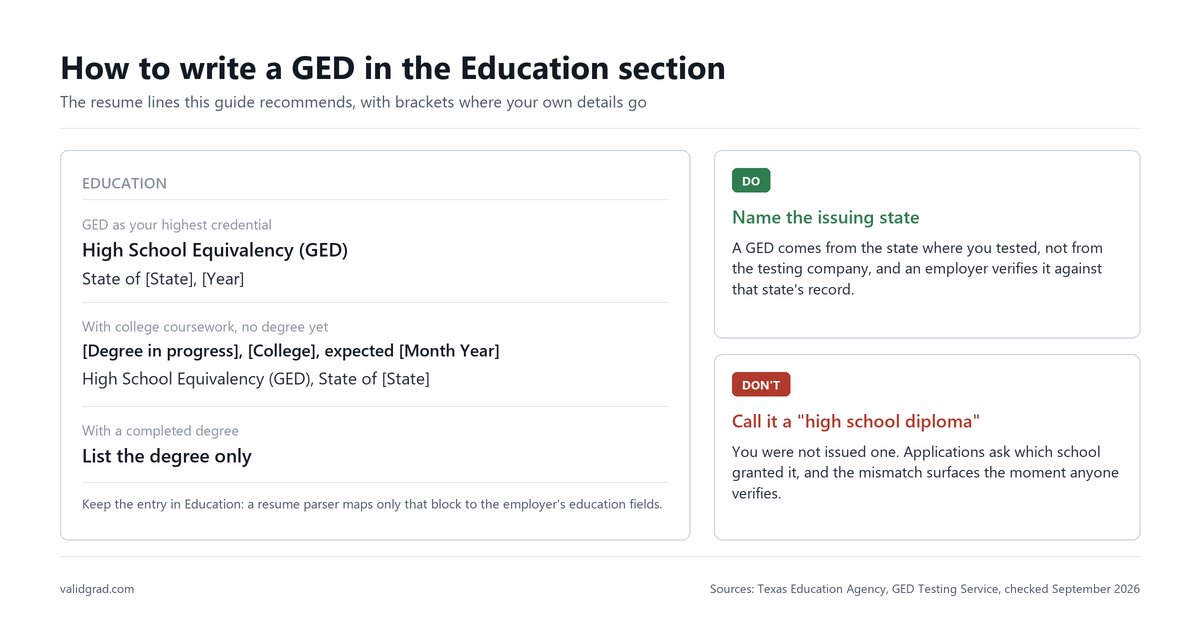
Put your GED in the Education section, write the official name of the credential your state issued, add the state and the year, and stop there. One line does the job, for example High School Equivalency (GED), State of Ohio, 2021. A hiring manager checking whether you meet a “high school diploma or equivalent” requirement needs to see that line and nothing else. There is no need to explain why you took the test, to apologize, or to add an extra section.
The part most advice leaves out is what that line has to match. A GED is not issued by the testing company. It comes from the state or jurisdiction where you tested, under a name that state chooses, and an employer who verifies your education is looking up that state’s record. Write the line so it matches the record, and the check is a formality.
- The state issues the credential, and the names differ. Texas calls it the Texas Certificate of High School Equivalency, California the California High School Equivalency Certificate, New York a High School Equivalency Diploma.
- Federal rules treat it as a diploma equivalent for student aid (34 C.F.R. § 600.2) and for federal civil service jobs (OPM).
- Military enlistment is the one common gate that treats the paperwork differently (32 C.F.R. § 66.6).
- Verification is a record lookup. Nobody inspects the document. In Texas anyone with your details can pull a verification letter online for free.
- Official copies come from the state or through GED.com, usually for a small fee and usually within days.
Where a GED goes on a resume
In the Education section, formatted like any other credential, at the bottom of it if you also have college coursework. Keep it out of “Certifications” and “Awards”, which are read as licences and recognitions, and a résumé parser maps only the Education block to the employer’s education fields, so a GED filed elsewhere can be missed entirely. It does not belong in the summary or the cover letter as a story either, because the credential is a fact, and how you earned it belongs in an interview, if anywhere.
If you have finished a college degree you can drop the GED, because the degree already answers the high-school question. Keep it while you are still studying, or when a posting names the diploma requirement explicitly.
The exact lines to use
Six situations cover almost every resume. Replace the bracketed parts with your own details and keep the whole entry to one or two lines.
| Your situation | What to write in Education | Why |
|---|---|---|
| GED only, earned in the last few years | High School Equivalency (GED) |
Names the credential the way the state issued it, in the form a recruiter recognizes. The year shows recency and fills the gap after school. |
| GED only, earned long ago, with a solid work history | High School Equivalency (GED) |
The year is optional on a resume once experience carries the application. The date is still on the official record, so never state a year you did not earn. |
| GED plus college courses, no degree yet | [Degree in progress], [College], expected [Month Year] |
Most recent or most advanced education first, with the GED below it as the entry credential. |
| GED plus a completed degree or diploma-level program | List the degree only | The degree supersedes it. Adding the GED is not wrong, only redundant. |
| Currently testing | High School Equivalency (GED), State of [State], in progress, expected [Month Year] |
Only worth including when the job requires a diploma or equivalent. “In progress” must be literally true, meaning you are registered and testing. |
| The posting says “high school diploma or GED” | Mirror the posting’s phrase, e.g. High school equivalency (GED), State of [State], [Year] |
Screening software and screening humans both match against the posting’s own wording. |
“GED” or “high school equivalency”? Write both
They are not competing labels. GED is the test, and the phrase recruiters and résumé parsers search for. High school equivalency is the category, and some version of it is what your state printed on the certificate. High School Equivalency (GED) carries both in four words.
What not to write is “high school diploma.” You were not issued one, applications ask which school granted it, and the mismatch surfaces the moment anyone verifies. It is also unnecessary, because the equivalency satisfies “diploma or equivalent” on its own.
If you passed a different equivalency test, name that one. Texas accepts the GED, HiSET and TASC toward the same state certificate, and California authorizes the GED and HiSET providers. Your record says which test you passed, so your resume should too. Our guide to the high school equivalency diploma covers how they differ.
| State | Official name of the credential | Suggested resume line |
|---|---|---|
| Texas | Texas Certificate of High School Equivalency (TxCHSE), issued by the Texas Education Agency after the GED, HiSET or TASC | Texas Certificate of High School Equivalency (GED), [Year] |
| California | California High School Equivalency Certificate, issued through the GED or HiSET provider authorized by the California Department of Education | California High School Equivalency Certificate (GED), [Year] |
| New York | New York State High School Equivalency (HSE) Diploma. New York has used the GED test as its primary route since January 2022 | New York State High School Equivalency Diploma (GED), [Year] |
| Most other states | Some combination of “high school equivalency” with “diploma” or “certificate,” issued by the state education agency | High School Equivalency (GED), State of [State], [Year] |
Sources: Texas Education Agency, California Department of Education, NYSED Adult Career and Continuing Education Services (linked at the end). If you are not sure what your own certificate says, what a GED diploma looks like shows which lines on the document carry the credential name, the state and the issue date.
When to include the year, and when to leave it off
Include it when you earned it recently, when it explains a gap between school and your first job, or when the application asks for a completion date. Leave it off when it is decades old and your work history is the stronger part of the application, the same judgment people apply to an old degree. A resume is a summary and may omit a date. An application is a declaration and may not. Never move the year forward, and never enter one that does not match the state’s record.
Should you name the state?
Yes, whenever you know it. The credential is a state document, verification goes through that state, and naming it saves a screener a round of questions. It is printed on your certificate and on your transcript. If you tested in one state and now live in another, list the state that issued the credential, not the one you live in.
How to answer the education questions on an online application
A resume gives you a free-text line. An application form does not, and the fields are where people talk themselves into trouble.
- “Highest level of education” dropdown. Choose High school diploma or equivalent if that is the only option. Choose GED or High school equivalency when the list separates them. Both are accurate.
- “Did you graduate?” Yes. You hold a state-issued completion credential. What you must not do is name a high school as the institution that granted it, or give a graduation year for a diploma you were never issued.
- School or institution name. Enter the issuing body, which is your state’s department of education or its equivalency program. If the form forces you to name a school, name the high school you attended and make the credential field say GED or high school equivalency.
- Education verification consent. Signing it is routine. The screener asks the state or the testing service to confirm the record, so the name you tested under (including a former surname), the state and the year should match what you entered.

What an employer actually sees when they check
Education checks look up a record. They do not inspect your certificate. For a high school equivalency that record sits with the issuing state or with GED Testing Service, and the lookup is usually cheap and fast. Texas, for example, runs a public certificate search where a verification letter can be downloaded free and an official PDF containing both the certificate and the score transcript costs $5. The agency stopped sending records by mail, fax or email altogether (checked September 2026).
Two consequences follow. An inaccurate entry does not slip through. A name or year that does not match comes back unverified, a far worse outcome than the GED itself would ever have been. And when an employer asks for proof, send the official transcript or certificate rather than a photo of the paper in your drawer. Our guides to how employers verify degrees, proof of education for employment and sending a transcript instead of a diploma cover what screeners accept.
How a GED compares with a diploma, gate by gate
“A GED is exactly the same as a diploma” and “a GED holds you back” are both too simple. In the rules that are written down, the equivalency is treated as a diploma almost everywhere. The exceptions are specific and worth knowing.
| Gate | How a GED is treated | Source |
|---|---|---|
| Federal student aid (FAFSA) and eligibility to enroll | Counted as a “recognized equivalent of a high school diploma,” alongside a state equivalency certificate and a transcript showing two years of credit toward a bachelor’s degree | 34 C.F.R. § 600.2 |
| Federal civil service jobs (General Schedule) | “High school graduation or equivalent” means a diploma, “General Education Development (GED) equivalency certificate, or proficiency certificate from a State or territorial-level Board or Department of Education” | OPM, General Schedule qualification policies |
| Private employers requiring “a diploma or equivalent” | The phrase is written to include an equivalency credential, and the employer verifies it against the state record like any other credential | Posting language and the verification route above |
| Military enlistment | Treated differently. Applicants who are not high school graduates need an AFQT score at or above the 31st percentile, and holders of “an alternative credential (e.g., General Educational Development certificates …)” may be given lower enlistment priority based on first-term attrition rates | 32 C.F.R. § 66.6 |
| Community colleges and open-admission programs | A state equivalency credential meets the entry requirement, and the college asks for the official score transcript, not the certificate | Institutional policy and the federal aid definition above |
| Selective four-year admission | Each institution sets its own policy. Many ask GED applicants for the score transcript plus something that stands in for a school record: test scores, college credits, or a personal statement | Institutional policy, so check the admissions page |
| Federal statistics | Counted separately. The American Community Survey asks people to distinguish a “regular high school diploma” from a “GED or alternative credential” | U.S. Census Bureau, educational attainment |
For the enlistment route specifically, the tier rules and score thresholds each branch applies are covered in do I need a GED to join the Army. If you are weighing what the credential is worth over a career rather than at one gate, the earnings figures by credential are collected in our salary by education level hub.
A GED and college admission
Almost all colleges accept one, none are required to, and the federal aid definition above makes an outright refusal uncommon at an accredited institution. What varies is what else they ask for. Community colleges and open-admission programs take the state equivalency credential as the entry requirement, often with placement rather than admissions testing. Public universities generally accept it and then apply their usual standards, sometimes asking applicants without a school record for transferable college credits. Selective private institutions set their own rules and read the application as a whole.
In every case the document they want is the official transcript of your test scores, sent from the state or the testing service, not a copy of the certificate. Search the admissions page for “high school equivalency” instead of “GED”. That is the phrase most institutions write their policy in.
Where to get official copies
Requests go to the state that issued the credential, or through the grads-and-transcripts route on GED.com, which works with a records partner to deliver transcripts and printed diplomas for most jurisdictions. Some states run their own system. Texas uses its own online certificate search, California points graduates to the GED or HiSET provider it authorizes, and New York handles equivalency records through the state education department.
- What you need: your legal name at the time you tested (including a former surname), date of birth, the approximate year, and the testing state.
- Fees are small and set by the state or the records partner, and the current amount appears before you pay. Texas charges nothing for a verification letter and $5 for the official PDF (checked September 2026).
- Timing is days instead of weeks for digital copies, and printed documents add mailing time. How to get a GED certificate walks through the request, and what a GED diploma looks like shows what arrives.
If you never finished the test, the alternatives are an adult high school diploma program or another equivalency test. How to get a high school diploma as an adult compares the routes.
Replica GED documents for display
ValidGrad makes replica diplomas, transcripts and certificates as novelty documents for display and personal use. We are not a school, a testing service or a state agency: we confer no credentials, create no records, and nothing we print can make an unearned credential verifiable. What we produce is a reproduction to the layout you specify, for framing or as a display copy of a credential you already hold while the original stays filed away.
- Replica GED diploma, the certificate layout in a size that fits a frame.
- Replica GED transcript, a matching score-record layout to display alongside it.
What these are not for. A replica must never be used to claim a credential you do not hold, and never to answer a verification request from an employer, a school, a licensing board or a government agency. That use is prohibited by our Terms and Conditions. When an employer or a college asks for proof, the answer is the official transcript or certificate from the state that issued it.
Frequently asked questions
Should I write “GED” or “high school diploma” on my resume?
Write the GED, using your state’s name for it, for example “High School Equivalency (GED), State of Texas.” Do not write “high school diploma”: you were not issued one, forms ask which school granted it, and the discrepancy appears as soon as your education is verified.
Can I say I graduated if I have a GED?
On an application that asks whether you completed your education, yes. You hold a completion credential issued by a state. What you cannot say is that you graduated from a particular high school, or give a graduation year for a diploma you did not receive. Name the credential, the issuing state and the year.
How do employers see that I have a GED?
Through a record check with the issuing state or GED Testing Service, not by looking at your certificate. Some states publish the lookup. Texas offers a free verification letter and a $5 official PDF through its certificate search (checked September 2026). That is why your resume and application entries should match the record exactly.
Does a GED look bad to employers?
The written rules do not treat it as lesser. OPM’s qualification policy puts a GED equivalency certificate alongside a diploma for federal jobs, and federal student aid regulations count it as a recognized equivalent. Enlistment is the common exception. For most jobs what separates candidates at this level is work history, reliability and the skills the role needs. See what a high school equivalency diploma covers.
What if I lost my GED certificate?
Order a replacement from the state that issued it, or through the grads-and-transcripts route on GED.com. You will need your name at the time of testing, your date of birth and the testing state. How to get a GED certificate covers the request step by step.
Sources
- 34 C.F.R. § 600.2, definition of “recognized equivalent of a high school diploma” (GED certificate, State certificate, two-year transcript, documented academic excellence). law.cornell.edu/cfr/text/34/600.2
- U.S. Office of Personnel Management, General Schedule qualification policies, with “high school graduation or equivalent” defined as a diploma, GED equivalency certificate or State proficiency certificate. opm.gov
- 32 C.F.R. § 66.6, qualification standards for enlistment, with an AFQT 31st-percentile floor for non-graduates and lower enlistment priority for alternative credentials. law.cornell.edu/cfr/text/32/66.6
- Texas Education Agency, Texas Certificate of High School Equivalency (GED), covering accepted tests, the free verification letter, the $5 official PDF and online-only issuance (checked September 2026). tea.texas.gov
- California Department of Education, High School Equivalency Tests, covering the California High School Equivalency Certificate and the authorized GED and HiSET providers. cde.ca.gov/ta/tg/gd
- New York State Education Department, ACCES High School Equivalency, covering the New York State HSE Diploma and the move to the GED test in January 2022. acces.nysed.gov/hse
- GED Testing Service, transcripts and credentials. ged.com/transcripts
- U.S. Census Bureau, educational attainment, with “regular high school diploma” and “GED or alternative credential” as separate categories. census.gov