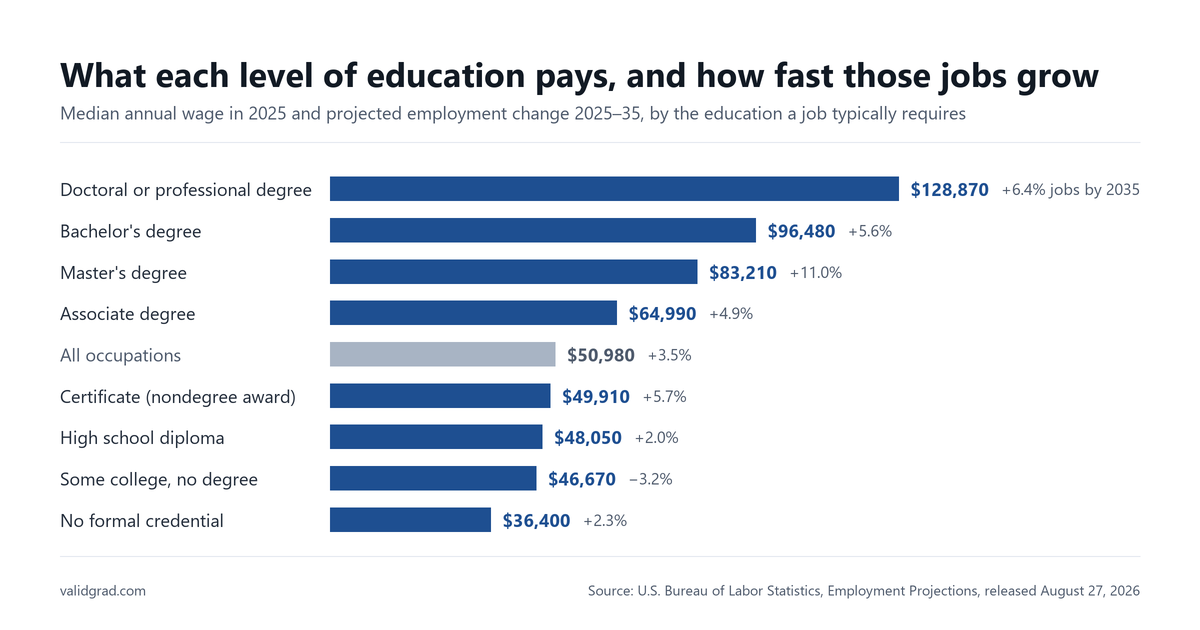
On the federal projections published on August 27, 2026, the degrees with the strongest combination of pay and hiring over the next decade sit in health care and computing. Nurse practitioner, a master’s-level occupation, is the fastest-growing job in the country at 41.0 percent through 2035, with a median wage of $132,300. Data scientist, a bachelor’s-level occupation, grows 34.6 percent at a median of $120,230. Medical and health services manager, also bachelor’s-level, adds 24.2 percent and about 62,300 openings a year. But the same table carries a warning that most “best degrees” lists leave out. The level of the degree predicts pay far less well than the field. Jobs that typically require a master’s degree pay a median of $83,210 a year, less than the $96,480 median for jobs that typically require a bachelor’s.
This page sets out what the U.S. Bureau of Labor Statistics projects for 2025-35: median pay, projected growth and yearly openings for each level of degree, the occupations that pay and grow the most within each level, and what the most common majors actually lead to.
Where these numbers come from, and what they do not say
Everything below comes from one dataset, the BLS Employment Projections program, whose 2025-35 projections were released on August 27, 2026. Three columns matter here.
- Median annual wage, 2025. The midpoint for everyone working in the occupation, from the Occupational Employment and Wage Statistics survey. Half earn more, half earn less. It is not a starting salary, and the survey excludes the self-employed.
- Projected employment change, 2025-35. How much bigger or smaller the occupation is expected to be in ten years. Across all occupations, employment is projected to grow 3.5 percent, from 170.3 million to 176.2 million jobs, well below the 10.9 percent recorded over 2015-25.
- Occupational openings, annual average. Growth plus replacement needs, meaning everyone who retires or leaves the occupation. All occupations together are expected to average about 17.5 million openings a year. This column matters more than growth rate for anyone job-hunting, because a large, slow-growing occupation can offer far more openings than a small, fast-growing one.
“Typical education needed for entry” is the BLS assignment of what most workers need to get into the occupation. It is a description of the labor market in 2025 and not a rule, and BLS does not project how requirements will change. Nothing here predicts what any individual will earn, and none of it varies by which school you attend.
Pay and projected growth by degree level
This is the whole labor force sorted by the education each job typically requires.
| Typical education needed for entry | Jobs, 2025 | Projected change, 2025-35 | Median annual wage, 2025 |
|---|---|---|---|
| Doctoral or professional degree | 4.5 million | +6.4% | $128,870 |
| Bachelor’s degree | 42.9 million | +5.6% | $96,480 |
| Master’s degree | 3.9 million | +11.0% | $83,210 |
| Associate degree | 3.6 million | +4.9% | $64,990 |
| Postsecondary nondegree award (certificate) | 10.7 million | +5.7% | $49,910 |
| High school diploma or equivalent | 60.3 million | +2.0% | $48,050 |
| Some college, no degree | 4.2 million | −3.2% | $46,670 |
| No formal educational credential | 40.2 million | +2.3% | $36,400 |
| All occupations | 170.3 million | +3.5% | $50,980 |
Three things stand out.
A master’s degree is not a pay grade above a bachelor’s. The master’s-entry group pays a lower median because of what is in it: counselors, therapists, librarians, social workers and school psychologists. The bachelor’s group contains pilots, chief executives, engineers and every kind of manager. The master’s group does grow faster than any other education group, at 11.0 percent, but the growth is concentrated in the same health occupations that lift the top of the table. Whether a specific master’s degree pays is a question about the occupation it leads to and not about the level. Should you get a master’s degree? goes through the trade-off.
“Some college, no degree” is the only category projected to shrink. It falls 3.2 percent over the decade, and it pays less than the high school group. The occupations BLS assigns to it (computer user support specialists, bookkeeping clerks, teaching assistants, tutors, order clerks) are exactly the ones most exposed to automation. Starting a degree and stopping is the one outcome the data treats worse than not starting.
Degree-level jobs are a minority of the labor market. Bachelor’s-entry occupations are 25 percent of all jobs; master’s, doctoral and associate-entry occupations together are under 8 percent. Most work in the United States is still done in occupations that ask for a high school diploma or no credential at all, which is why the median across all occupations, $50,980, sits so close to the high school figure.
The fastest-growing occupations, by the degree they require
These are the occupations with at least 50,000 workers growing fastest through 2035.
| Occupation | Typical entry-level education | Growth, 2025-35 | Median annual wage | Openings per year |
|---|---|---|---|---|
| Nurse practitioners | Master’s degree | +41.0% | $132,300 | 29,400 |
| Data scientists | Bachelor’s degree | +34.6% | $120,230 | 24,800 |
| Medical and health services managers | Bachelor’s degree | +24.2% | $123,860 | 62,300 |
| Physical therapist assistants | Associate degree | +23.0% | $68,380 | 18,500 |
| Psychiatric technicians | Certificate | +22.3% | $45,130 | 17,000 |
| Computer and information research scientists | Master’s degree | +21.8% | $140,300 | 2,900 |
| Occupational therapy assistants | Associate degree | +21.5% | $72,300 | 8,100 |
| Physician assistants | Master’s degree | +21.1% | $135,880 | 11,500 |
| Information security analysts | Bachelor’s degree | +21.0% | $129,180 | 14,100 |
| Health specialties teachers, postsecondary | Doctoral or professional degree | +17.9% | $107,310 | 24,900 |
Health care and computing take every row. That is not a coincidence of this particular cut. BLS projects healthcare support occupations to grow 13.3 percent and healthcare practitioner and technical occupations 8.0 percent, and expects those two groups alone to account for almost a third of all new jobs created through 2035.
Notice the openings column. Computer and information research scientists grow 21.8 percent but produce only about 2,900 openings a year nationally, because the occupation is small. Medical and health services managers grow at a similar rate and produce 62,300. Growth rate alone is a poor guide to how easy a job is to find.
The highest-paying occupations at each degree level
| Degree level | Best-paid occupations (median annual wage, 2025) |
|---|---|
| Doctoral or professional | Anesthesiologists $391,490 · emergency medicine physicians $335,550 · psychiatrists $281,870 · lawyers $159,670 · pharmacists $140,910 |
| Master’s | Nurse anesthetists $236,590 · computer and information research scientists $140,300 · physician assistants $135,880 · nurse practitioners $132,300 |
| Bachelor’s | Airline pilots and flight engineers $232,140 · chief executives $213,990 · computer and information systems managers $175,140 · financial managers $166,570 · software developers $135,980 |
| Associate | Dental hygienists $98,100 · diagnostic medical sonographers $96,590 · MRI technologists $95,480 · respiratory therapists $82,280 · radiologic technologists $80,110 |
| Certificate (nondegree award) | Commercial pilots $123,220 · first-line supervisors of firefighting and prevention workers $93,530 · captains and mates of water vessels $92,460 · aircraft mechanics $79,870 |
| High school diploma | Elevator and escalator installers $109,910 · transportation, storage and distribution managers $107,230 · first-line supervisors of police $106,040 · electrical power-line installers $95,320 |
The top of each row usually carries a license, a residency, a certification or years of required experience on top of the degree. Chief executives and transportation managers are promotions and not entry points, and the pilot jobs require flight hours and Federal Aviation Administration certificates. The degree is the entry ticket and not the whole requirement. For how these levels stack up against each other as credentials, see degrees in order, from associate to doctorate.
What common majors actually lead to
Majors and occupations are not the same thing, and BLS projects occupations. This table pairs the most common undergraduate fields with the occupations graduates most often enter.
| Field of study | Where graduates typically land | Median wage | Growth | Openings per year |
|---|---|---|---|---|
| Nursing | Registered nurses | $97,550 | +5.6% | 180,800 |
| Computer science | Software developers | $135,980 | +10.2% | 95,300 |
| Computer science / statistics | Data scientists | $120,230 | +34.6% | 24,800 |
| Cybersecurity / information systems | Information security analysts | $129,180 | +21.0% | 14,100 |
| Engineering (mechanical) | Mechanical engineers | $104,110 | +11.2% | 17,800 |
| Engineering (industrial) | Industrial engineers | $102,440 | +12.4% | 23,100 |
| Engineering (civil) | Civil engineers | $100,840 | +6.4% | 22,700 |
| Business / management | Management analysts | $101,860 | +10.1% | 94,100 |
| Supply chain / logistics | Logisticians | $82,320 | +17.6% | 26,600 |
| Health administration | Medical and health services managers | $123,860 | +24.2% | 62,300 |
| Accounting | Accountants and auditors | $83,680 | +5.0% | 115,300 |
| Human resources | Human resources specialists | $75,940 | +6.4% | 73,700 |
| Marketing / communications | Market research analysts | $78,760 | +7.0% | 82,000 |
| Public relations | Public relations specialists | $74,750 | +1.8% | 23,000 |
| Education | Elementary school teachers | $63,970 | −0.4% | 87,500 |
| Graphic design | Graphic designers | $62,960 | −1.7% | 16,000 |
| Psychology / counseling (master’s) | Substance abuse, behavioral disorder and mental health counselors | $59,350 | +18.4% | 50,500 |
Read the openings column next to the growth column again. Registered nursing grows a modest 5.6 percent, but it is one of the largest occupations in the country, so it turns over about 180,800 jobs a year, more than software developers, data scientists and information security analysts combined, which come to 134,200. Accounting is the same story at a smaller scale: 5.0 percent growth, 115,300 openings a year. Meanwhile the two fields here that are projected to shrink, elementary teaching and graphic design, still post 87,500 and 16,000 openings a year respectively, because replacement demand does not stop when an occupation stops growing.
One caveat the table cannot show is that teacher pay is set by district salary schedules rather than by a national market, so a single median hides a wide spread between states and districts.
What the degree costs you in time
The projections say nothing about how long any of this takes, and that is the other half of the decision. An associate degree at full-time pace is about two years and a bachelor’s about four, but the median student takes longer, and graduate programs vary from one year to a decade of residency. How long it takes to get a degree breaks this down by level with completion data, and how long it takes to get a certificate covers the nondegree awards in the table above, the fastest route into several of the fastest-growing occupations on this page. For what the credential is worth over a working life rather than in a single year, see salary by education level, which covers earnings by attainment and lifetime totals.
Cost belongs in the same calculation: a degree that pays $20,000 a year more is a different proposition at $8,000 of tuition than at $200,000. The true cost of a college diploma covers the price side.
Check the program’s accreditation before you enroll
None of the wages above attach to a degree from an institution nobody recognizes. Accreditation, not the format or the marketing, is what makes a degree transferable, acceptable to licensing boards and usable as proof of education with an employer. It takes two minutes to check, and it pays to do it before the application, not after.
- Look the institution up in DAPIP. The Department of Education’s Database of Accredited Postsecondary Institutions and Programs lists roughly 6,900 institutions and programs, each accredited by an agency the Secretary of Education recognizes as a reliable authority on the quality of postsecondary education. If the school is not in it, that is the answer. The Department notes that the data is reported by the agencies themselves and is not audited, so treat it as a starting point for anything unusual.
- Check the accrediting agency, not just the claim. A school can name an accrediting body that no one recognizes. The Council for Higher Education Accreditation maintains its own databases and directories of institutions accredited by CHEA-recognized organizations.
- Check programmatic accreditation separately. For anything that leads to a license, such as nursing, teaching, engineering, accounting, physical therapy or counseling, the program itself usually needs accreditation from a specialty body, and state licensing boards publish which ones they accept. An institution can be accredited while a specific program is not.
- Confirm what the state board requires. Licensure rules are state-level. Confirm that a program is accepted in the state where you intend to work, especially for online programs enrolling students nationwide.
Online degrees: how they work and how employers see them goes through accreditation checking in more detail, including the signals that mark a diploma mill and why the old “regional versus national” distinction no longer means what people think.
Frequently asked questions
What degree is the highest paying?
By level, it is a doctoral or professional degree. Jobs that typically require one pay a median of $128,870, against $96,480 for bachelor’s-level jobs. By specific occupation, medicine sits at the top, with anesthesiologists at a median of $391,490, emergency medicine physicians at $335,550 and psychiatrists at $281,870. Outside medicine, the highest-paying doctoral or professional occupations are law at $159,670 and pharmacy at $140,910.
Which degrees lead to the fastest-growing jobs?
Master’s-level nursing (nurse practitioners, +41.0 percent), computer science and statistics (data scientists, +34.6 percent; information security analysts, +21.0 percent), health administration (+24.2 percent), and the two-year allied health degrees, physical therapist assistant (+23.0 percent) and occupational therapy assistant (+21.5 percent).
Is a master’s degree worth more than a bachelor’s?
Not automatically. Jobs that typically require a master’s pay a median of $83,210, below the $96,480 median for bachelor’s-level jobs, because the master’s group is weighted toward counseling, therapy, social work and library occupations. Where the master’s is the license to practice, as it is for nurse practitioner, physician assistant and nurse anesthetist, it pays well above the bachelor’s median. The question is which occupation the degree leads to.
How can I earn $100,000 a year without a college degree?
Four occupations whose typical entry-level education is a high school diploma have a median at or above $100,000: elevator and escalator installers and repairers ($109,910), transportation, storage and distribution managers ($107,230), first-line supervisors of police and detectives ($106,040) and power plant operators ($102,040). Each requires something else instead of a degree, such as a four-year apprenticeship, years of experience, or promotion from within. Two of them are projected to shrink. Electrical power-line installers at $95,320 and a projected 10.3 percent growth are the steadier version of the same idea.
Do employers check which degree you have?
Many do, usually through the National Student Clearinghouse or the school’s registrar, often via a background-check company. Do employers really verify your degree? covers what is checked, by whom and how long it takes.
Replica diplomas and degrees from ValidGrad
ValidGrad prints replica diplomas, degrees and transcripts as novelty items for display. They are produced from the details you supply on the order form, on the paper stock and sheet size you choose, with a layout proof before printing. The products that match this page are the replica bachelor’s degree, the replica college diploma and the replica master’s degree. Current pricing and production time are on each product page.
A replica is not a credential and is not a substitute for one. It must never be used to claim a degree, to support an application, or to answer a verification request from an employer, a school or a licensing body, none of which would return a record, because no institution awarded anything. If you earned a degree and need a replacement of the physical document, order it from the registrar of the school that conferred it. Our Terms of Service set out the display-only condition of sale.
Sources
- U.S. Bureau of Labor Statistics, Table 1.2 Occupational projections, 2025-35, and worker characteristics, 2025 (median annual wages, May 2025; projected employment change and annual openings, 2025-35). Checked September 13, 2026.
- BLS, Table 5.2 Employment, wages, and projected change in employment by typical entry-level education, 2025 and projected 2035. Checked September 13, 2026.
- BLS, Employment Projections: 2025-2035 Summary, news release, August 27, 2026.
- BLS, Table 1.3 Fastest growing occupations, 2025 and projected 2035.
- BLS, Occupational Outlook Handbook, for the entry requirements behind each occupation.
- U.S. Department of Education, Database of Accredited Postsecondary Institutions and Programs (DAPIP), Office of Postsecondary Education.
- U.S. Department of Education, Accreditation of postsecondary educational institutions.
- Council for Higher Education Accreditation, Browse databases and directories.
Wage data are from the Occupational Employment and Wage Statistics program and cover non-farm wage and salary workers; they exclude the self-employed, owners and partners in unincorporated firms, and household workers. Typical entry-level education reflects 2025 requirements, and BLS does not project educational requirements.