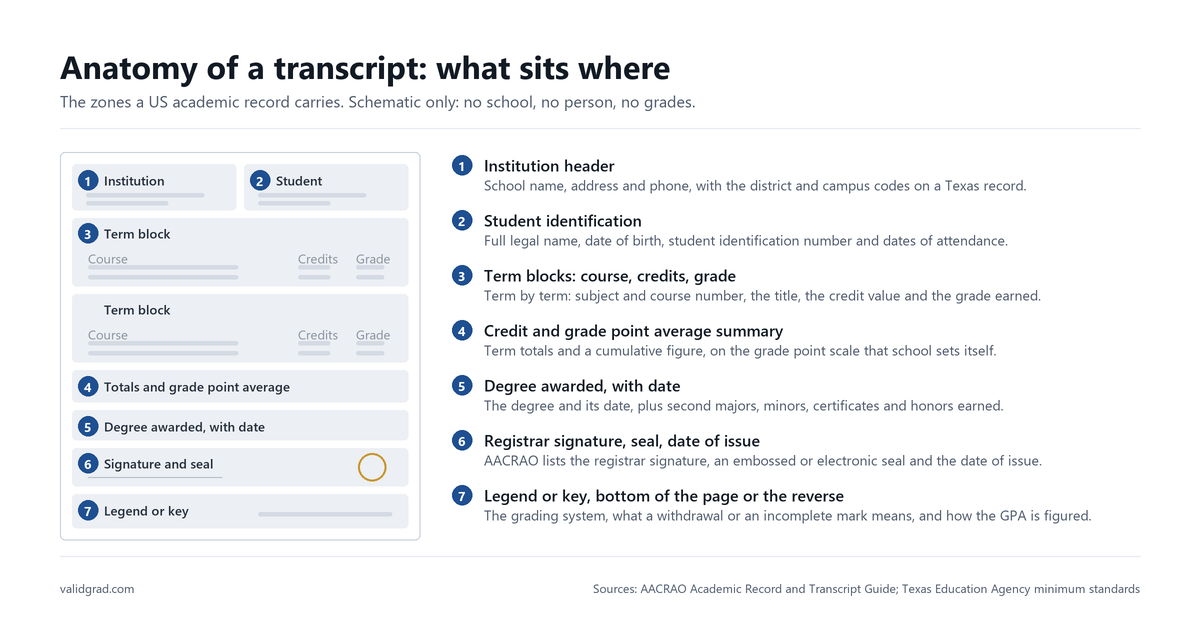
A transcript looks like one document with three bands of information. The school name and address sit at the top beside the student’s name and identifying details, a term by term table of courses fills the middle, and the totals, the grade point average and a printed key sit at the bottom or on the reverse of a paper copy.
Schools treat that document as their own record of coursework. The registrar at Washington University in St. Louis describes the transcript as the academic record of all coursework completed at the university and any degrees earned. The Texas Education Agency uses the words academic achievement record and transcript interchangeably and calls the result an “official and permanent record” of a student’s high school performance.
An official copy carries more than the coursework. On paper it is “printed on security sensitive paper” with the institution seal and the registrar’s signature, and the electronic version is a PDF locked by a digital certificate, as the Penn State registrar sets out. The sections below show how that plays out on a high school, college and trade school record.
What does a transcript look like? Quick overview
The top of the page identifies the school and the student. The Texas minimum standards for a high school transcript call for the school name, address and phone number, the district and campus code, the student’s full legal name, date of birth and student identification number, the parent or guardian name, and the signature and title of a school official. A college header block holds the same kind of information, with the student identification number and the terms attended.
The middle of the page is a table of courses. Each row names a course by its subject or department, its number and its title, and the columns give the credit hours attempted and the final grade earned. Washington University notes that transfer credit, test credit and notations about changes in student status also appear on the record.
The bottom of the page, or the reverse of a printed copy, holds the summary and the key. The AACRAO Academic Record and Transcript Guide treats seven items as essential contents of that key, among them the institution information, the calendar system, the grading system, the way the grade point average is calculated, the course numbering scheme, the security of the record and a FERPA redisclosure statement. Without the key a reader cannot tell what a withdrawal mark or an incomplete mark is worth at that school.
What does a transcript show? Key parts of the record
Formats differ by school, and most records still carry the same groups of information:
- School information
The school’s name, address and phone number. A Texas high school record also carries the nine digit county district campus number, and may carry the College Board and ACT codes used for exam registration. - Student information
Full legal name as it appears on a birth certificate or other legal document, date of birth, a student identification number, and the dates of attendance. Texas records add a parent or guardian name and address. - Program or grade level details
For high school, the graduation program completed and any endorsements or performance acknowledgments earned. For college, the major, minor and degree program, plus the degree awarded with its date, second majors, minors and certificates. - Course list
A term by term or year by year list of courses. Each entry carries a subject or department code, a course number and title, a credit value and the grade earned. - Grades, credits and grade point average
Term totals and a cumulative figure. Texas leaves the grade point scale, course weights and class rank to local board policy, so a school that does not rank its students may print DNR in that field instead of a number. - Grading scale and legend
The key that explains how grades convert to points and what each symbol means, including marks for a withdrawal, an incomplete and a pass or fail course. - Signatures and security features
AACRAO lists the registrar’s signature, an embossed or electronic seal, the date of issue, a description of the transcript and a note of who the copy was released to.
What does a high school transcript look like?
A high school transcript is the cumulative record of secondary coursework, and it reaches further back than grade 9. Texas requires every course completed for high school credit to appear on the record regardless of the grade level at which the student took it, so an algebra course passed in eighth grade for high school credit sits on the same document as the senior year classes.
On a typical high school transcript you will see:
- The school name, address and phone number, with the district and campus identification codes
- The student’s full legal name, date of birth, identification number and the parent or guardian name
- Courses sorted into categories such as English language arts, mathematics, science, social studies, languages other than English, fine arts, and career and technical education
- A grade for each semester, the credit awarded, and symbols that point to an explanation printed elsewhere on the record
- Grade point average and class rank where local policy provides them, or a DNR note when the school does not rank
- Results of the required state assessments, the graduation date, and the graduation program completed
- The printed name, title and signature of the principal, registrar or designee
An official high school copy is the one the school sends out itself. Texas says the words “Official Copy” mean the record went straight from the school to the requesting institution with no opportunity for alteration, and it tells schools to protect a copy handed to a student by sealing the envelope with a signature or an embossed seal. The federal High School Transcript Study reads these same records to report the courses graduates take, the credits they earn and their grade point averages.

What does a college transcript look like?
A college or university transcript follows the same shape and gives more room to the program. Washington University prints the degree with its degree date on the record, along with second majors, minors and certificates completed, adds Latin honors with the degree and other academic honors at the end, and puts the key on the reverse of the printed copy.
Most college transcripts include:
- The name of the college or university, plus the campus if the school has more than one
- The student’s full name, student identification number and the terms attended
- The declared major and minor, and often the degree program and catalog year
- A term by term list of every course registered for, including withdrawals and repeated classes
- The credit hours and final grade for each course, with transfer and test credit shown separately
- A term grade point average for each semester or quarter and a cumulative figure
- Degrees awarded with their dates, academic honors, and notations about changes in student status
- A grading legend that sets out the scale and the grade point calculation the institution uses
There is no single national grading scale behind those numbers. A four point scale is common at United States colleges, and the key on the transcript states the scale and the grade point calculation the institution actually applies, so AACRAO counts both as essential contents of that key. Texas leaves grade point scales and course weights to each local school board for the same reason.
What does a trade school or vocational transcript look like?
Career and technical schools record hours as often as they record credits. The Accrediting Commission of Career Schools and Colleges requires every school it accredits to keep a permanent official transcript for all current and former students, and to make it available to a student on request.
Under the ACCSC Standards of Accreditation that took effect on July 1, 2026, the record must carry at least these items:
- The student’s name and unique identifier
- The name and address of the school
- The program of study, such as Welding, Medical Assisting or Automotive Technology
- The name and date or term of each course taken
- “the clock or credit hours and grades earned for each course”
- Any credits accepted for transfer and the cumulative grade point average
- The date of program entry and the date of graduation, termination or withdrawal
A welding or medical assisting transcript therefore often reads as a list of modules with clock hours beside them, where a college record would show semester courses with credit hours. Licenses and industry exams earned during training usually sit on their own certificates, so ask the school whether they appear on the transcript too.
What do official transcripts look like compared to unofficial transcripts?
Both versions usually carry the same coursework. The difference lies in how the copy is produced, secured and delivered.
Official transcripts usually:
- Are printed on security sensitive paper, or issued as a PDF secured by a digital certificate
- Carry the institution seal and the signature of the registrar or a school official
- Show the date of issue and a note of the institution or person the copy went to
- Travel in a sealed envelope when a student carries them. The University of Illinois stamps its student copies in red ink to show they were issued in a sealed envelope
- Cannot be edited by the holder. On an electronic copy the digital certificate reports whether the file has changed since the registrar prepared it
Unofficial transcripts usually:
- Come out of a student portal or a campus self service system as a plain PDF or a screen view
- Carry neither a seal nor a registrar signature, and are not printed on security paper
- Are meant for advising, course planning and the student’s own review
- Are turned down wherever an institution or an employer has asked for a certified record
Admissions offices, licensing boards and background screeners ask for the official version. Enrollment and degree checks often run instead through the National Student Clearinghouse, whose participating institutions enroll about 97 percent of students at public and private colleges and 91 percent of secondary students. An unofficial copy is still the quickest way to check progress before a term begins.
How to read your transcript at a glance
Three areas answer most questions about a record:
- Header
Check that the name, school and program details are right. Texas allows entries to be changed only to correct an error, and the correction has to be explained in the student’s record, so catching a misspelled name early saves a slower fix. - Course list
Scan for missing courses, repeats and withdrawals. This is also where required high school subjects such as mathematics, science and English language arts can be confirmed, or where a college major’s requirements can be checked off. - Summary and key
Read the credit totals and the grade point average against the legend. The legend defines the symbols for an incomplete course or a withdrawal and states the grade point scale, so the same letter grade can mean different things at two schools.
Once the layout is familiar, spotting a missing credit or an ungraded course takes a minute.
Common questions about transcripts
Is a report card the same as a transcript?
They are different documents. A report card covers one grading period. The transcript is the cumulative record that a district or institution keeps permanently for every student who has earned credit, and it is the version admissions offices and employers ask to see. For how long institutions hold these files, see how long colleges keep transcripts.
What does a final transcript look like?
It is the same document with the last term posted and, for a graduate, the degree or graduation date printed on the record. Schools issue it once final grades have been recorded, so it is produced after the last term ends and not while a student is still enrolled. More detail is in the guide to the final transcript.
What does a sealed transcript look like?
From the outside it is an ordinary envelope with the school’s return address, closed with a seal or a signature across the flap, and often stamped with wording such as issued to the student in a sealed envelope. Texas tells schools to seal the envelope precisely to prevent modification, so a receiving office expects it unopened.
What do the letter codes on a college transcript mean?
They are grade symbols, and the transcript key defines them for that institution. A W commonly marks a withdrawal, and an incomplete course carries its own code that the key spells out. AACRAO treats the grading system and the symbols in use as contents of the key, so the definitions travel with the document.
How do you get a copy of your transcript?
Requests go to the school that holds the record, or to the ordering service it uses. FERPA gives parents access to their children’s education records, and that right transfers to the student at 18 or on entry to a postsecondary institution. Texas tells districts they may not withhold a student’s or parent’s access to the transcript because money is owed to the school. The steps are set out in the guide to requesting official transcripts.
Official records and replica samples for display
An official transcript comes only from the school that holds the record, or from the ordering service that school authorizes. That is the version admissions offices, licensing boards and employers will accept, and no other copy substitutes for it.
ValidGrad sells replica transcripts as novelty items for display and personal reference. A replica is produced by ValidGrad’s transcript maker, like the sample pictured above. It is issued by no school, it carries no institutional seal or registrar signature, and it must never be used to claim a credential or to answer a verification request. The terms set out those limits.
For the diploma side of the same question, see what a high school diploma looks like, including how designs differ by state. The two documents are compared in diploma vs transcript.
Sources
- Texas Education Agency, Minimum Standards for the Academic Achievement Record, 2024. Required contents of a high school transcript, credit earned before grade 9, class rank and grade point scale, Official Copy, sealed envelopes. Checked September 14, 2026.
- Washington University in St. Louis, Transcript Contents. What a college transcript records, degrees and honors, transfer and test credit, the key on the reverse. Checked September 14, 2026.
- Penn State, Official Transcripts. Security sensitive paper, seal and registrar signature, and the digital certificate on an electronic copy. Checked September 14, 2026.
- University of Illinois Urbana-Champaign, Transcripts. Sealed envelope stamping and electronic delivery. Checked September 14, 2026.
- AACRAO, Academic Record and Transcript Guide. Essential contents of the transcript key and the security features of a paper copy. Checked September 14, 2026.
- ACCSC, Standards of Accreditation, effective July 1, 2026. Minimum contents of a career school transcript, including clock or credit hours. Checked September 14, 2026.
- National Student Clearinghouse, About. Share of students enrolled at participating institutions, transcript ordering and verification. Checked September 14, 2026.
- U.S. Department of Education, What is FERPA. Right of access to education records and its transfer to the student. Checked September 14, 2026.
- National Center for Education Statistics, High School Transcript Study. Courses, credits and grade point averages taken from high school transcripts. Checked September 14, 2026.