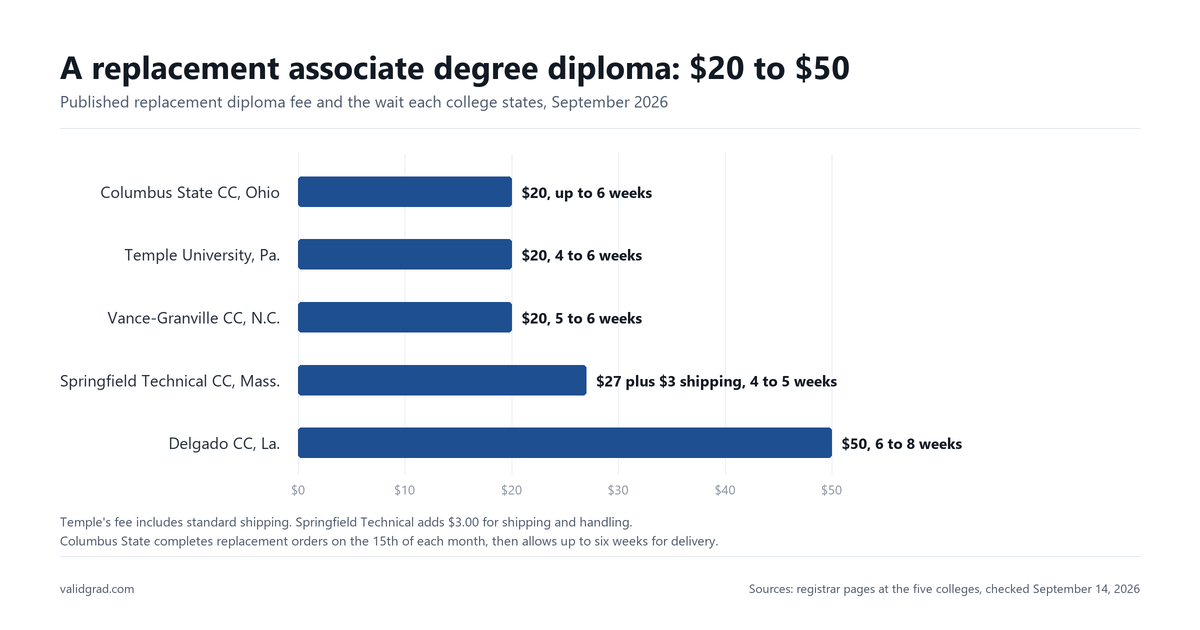
A copy of an associate degree comes from the registrar or records office at the college that awarded it. Published replacement fees at community colleges run from about $20 to $50, and colleges tell graduates to allow four to eight weeks for the printed diploma to arrive. An official transcript costs less, arrives sooner, and is the document colleges themselves treat as the record of the credential.
Colleges handle these requests from graduates who finished decades ago as readily as from last year’s class. The sections below cover the request itself, the fees and wait times colleges publish, how to confirm the degree was posted to the record, and what changes when the college has closed or changed names.
How to get a copy of your associate degree from your college
Every version of this question leads to the same office. The registrar or records office at the school that awarded the degree holds the student record and issues both replacement diplomas and official transcripts. Many colleges hand the ordering step to a credential vendor, and Columbus State Community College and Temple University both route replacement diploma orders through Parchment.
Step 1: Find the right office
Start at the website of the college that granted the degree and look for pages titled “registrar,” “student records,” “transcripts and diplomas,” or “replacement diplomas.”
If the details are not published, call the main college number and ask which office handles replacement diplomas and official transcripts. Make sure the request goes to the school that granted the associate degree and not to a later school where a few transfer classes were taken.
Step 2: Gather the details they will ask for
Before any form goes in, gather the information that helps the office find the record:
- Full name used while enrolled
- Current name, if it has changed
- Date of birth
- Student ID number, if it is still on hand
- Program or major for the associate degree
- Approximate dates of attendance and graduation
- Current mailing address, email, and phone number
Colleges match requests against a record that may be forty years old, so an old student ID number or a former surname often settles a search that would otherwise stall.
Step 3: Follow the school’s request process
Most colleges publish one method for requesting a replacement diploma or degree copy. Common options include:
- An order placed with a credential vendor such as Parchment, linked from the registrar page
- Online forms in a student or alumni portal
- Downloadable PDF forms that are printed, signed, and mailed
- Email instructions that set out what a written request must contain
The methods are not interchangeable. Columbus State Community College and Temple University both send graduates to Parchment, while Delgado Community College takes a completed paper form in person at the Registrar’s Office or by mail. ValidGrad’s guide to replacing diplomas and transcripts covers the same steps for other credentials.
Step 4: Prove your identity and pay the fee
Student records are protected, so the college confirms that the requester is the person named on the degree. That step can mean:
- Uploading a scan of a government issued ID
- Including a photocopy of a driver’s license or passport with a mailed form
- Signing in to a secure portal that already holds the student account
The replacement diploma fee is set by the college and is separate from transcript fees. Delgado Community College charges a $50.00 processing fee and accepts a cashier’s check or money order, declining cash and personal checks. Springfield Technical Community College charges $27 plus a $3.00 shipping and handling charge.
Step 5: Wait for printing and mailing
Replacement diplomas are printed on a schedule at some colleges rather than on demand. Columbus State Community College completes replacement orders on the 15th day of each month and asks graduates to allow up to six weeks for delivery. Clackamas Community College tells students that producing and mailing a diploma takes about four weeks.
When the deadline is close, an official transcript showing the associate degree and its conferral date is the faster document to put in someone’s hands. It is also worth asking the college about:
- Rush processing
- Express shipping
- A written degree verification from the registrar while the diploma is printed
What a replacement associate degree diploma costs and how long it takes
Colleges publish these numbers, and they vary by more than a factor of two. The fees and wait times below are the ones four community colleges and one university state on their own registrar pages.
| Institution | Replacement diploma fee | Published wait |
|---|---|---|
| Columbus State Community College (Ohio) | $20.00 | Orders completed on the 15th of each month, allow up to six weeks for delivery |
| Springfield Technical Community College (Massachusetts) | $27 plus $3.00 shipping and handling | 4 to 5 weeks for processing and mailing |
| Vance-Granville Community College (North Carolina) | $20 per diploma | 5 to 6 weeks for printing and delivery |
| Delgado Community College (Louisiana) | $50.00 processing fee | 6 to 8 weeks, described as normal processing time |
| Temple University (Pennsylvania) | $20.00 including standard shipping | 4 to 6 weeks after the order is placed |
Transcripts sit at the other end of the price range. The Community College of Allegheny County charges $5 for each official transcript, recommends electronic delivery where the receiving school accepts it, and allows up to five working days to process a paper copy. Clackamas Community College charges nothing for transcripts ordered online. ValidGrad tracks the spread in more detail in its guide to replacement diploma wait times.
A replacement is a reprint, so it will not always match the original. Temple University states that the signatures on the diploma are those of the university officials currently in office. Pasadena City College accepts duplicate orders only from students whose associate degree is already awarded and posted to the official transcript.
Proof of an associate degree without the diploma
Much of the effort that goes into replacing the paper is spent on a document nobody asked for. Clackamas Community College states the position plainly for its own graduates, telling them that “your official transcript (not your diploma) is the official documentation” that a credential was earned at the college.
Employers and schools that check a degree usually go through the college’s designated agent. The Community College of Allegheny County and Hudson County Community College both name the National Student Clearinghouse as the authorized provider of degree and enrollment verifications. The Clearinghouse charges $19.95 for each verified confirmation, plus any surcharge the school adds, and states that copies of degrees and diplomas are not provided by any of its verification services.
That leaves four documents that actually answer a verification request:
- An official transcript sent directly from the college
- A secure electronic transcript delivered through the college’s credential vendor
- A written degree verification letter from the registrar or records office
- A Clearinghouse degree verification, which the employer or school requests and pays for
The diploma keeps its place as the display copy that goes in a frame. The transcript is what answers the formal question, and ValidGrad covers the timing of that check in how long degree verification takes.
How to check whether your associate degree was awarded
Finishing the coursework and being awarded the credential are two separate events. Pasadena City College accepts duplicate diploma orders only from students whose associate degree is already awarded and posted to the official transcript, which is a useful reminder that a completed program and a conferred degree are tracked differently. Colleges commonly require a graduation application before a degree is conferred, so the transcript is the place to settle the question.
Three checks cover it:
- Open the unofficial transcript in the student or alumni portal and look for the degree name with a conferral date beside it
- Ask the records office whether a graduation application was ever filed and whether the degree was conferred
- Sign in to the National Student Clearinghouse MyHub service, where participating colleges let former students pull their own verified enrollment and degree records. The University of Houston describes the Clearinghouse as the official provider of its enrollment and degree certifications through MyHub, which produces a printable PDF that can be sent to an organization that asks for one
If the transcript shows no degree, the gap is often paperwork instead of missing credits. The records office can say which requirement is outstanding and whether a graduation application can still be filed for a past term.
What if your college closed or changed names
A closure, a merger, or a new name changes where the records live and who prints what. The record itself is normally passed to a custodian, and the state agency that oversaw the college is the place that names the custodian.
- Check the old college website. Many closed schools leave a page explaining where records went.
- Search the state higher education agency site for its list of closed institutions and record custodians.
- Look for a teach-out partner or another campus that absorbed the programs.
Transcripts are the realistic output here. Whether a replacement diploma can still be printed depends entirely on the custodian, and some cannot print diplomas at all. ValidGrad’s guides to getting a diploma from a closed school and what to do when a school will not reissue a diploma go through the state offices one by one.
Digital copies and paper copies of your associate degree
Colleges issue the associate degree in more than one format, and the order form is the place to ask which ones exist. A paper diploma is the framing copy, it usually carries printed signatures and a seal, and it takes the weeks listed above to print and mail. A certified electronic diploma arrives faster and can be shared by link, and what it may be used for is set by the college and its vendor. ValidGrad’s post on digital diplomas covers how those files are issued.
When the budget is tight, the official transcript is the document to buy first at $5 or less at many colleges, since it is the one that carries the degree into an application. ValidGrad also has a walkthrough of what an associate degree looks like for anyone comparing a copy against the original.
Replica associate degree diplomas are display items
A replica is a novelty item made for display. It is not a credential, it cannot answer a verification request, and ValidGrad’s terms forbid using one to claim a qualification that was not earned. The replica associate degree page shows the display formats available.
For anything official, the college that awarded the degree is the only source, through its transcripts, its diplomas, and its verification agent.
Frequently asked questions about getting a copy of an associate degree
How do you get a copy of an associate degree years after graduating?
Contact the registrar or records office at the college that awarded the degree, give the name used while enrolled, date of birth, program, and graduation date, then follow the published process for a replacement diploma and an official transcript. Age of the record is not a barrier, and many colleges route the order through a credential vendor.
How much does a replacement associate degree diploma cost?
Published fees run from about $20 to $50. Columbus State Community College and Vance-Granville Community College each charge $20, Springfield Technical Community College charges $27 plus $3.00 for shipping and handling, and Delgado Community College charges $50.00. Transcripts are far cheaper, at $5 or free depending on the college.
When does an associate degree diploma arrive in the mail?
Published waits for a replacement run from four to eight weeks. Some colleges print in batches, so the wait depends on the print date as much as the order date. Columbus State Community College completes replacement orders on the 15th of each month and asks for up to six weeks for delivery.
How can you tell whether an associate degree was actually awarded?
Look at the transcript. A conferred degree appears on the record with its name and a conferral date. If it is missing, ask the records office whether a graduation application was filed. Former students at participating colleges can also check their own verified records through the National Student Clearinghouse MyHub service.
Can a copy of an associate degree be requested online?
Often yes. Colleges such as Columbus State Community College and Temple University take replacement diploma orders through Parchment, and transcripts are commonly ordered through Parchment or the National Student Clearinghouse. Identity confirmation and payment are still part of the process, and some colleges, including Delgado Community College, still require a paper form.
What happens if the college that awarded the associate degree closed?
The records pass to a custodian, which may be a partner school, a state higher education agency, or a records service. The custodian can usually issue transcripts, while a reprinted diploma depends on what that office is set up to produce. ValidGrad’s guide on getting a diploma from a closed school lists the state offices.
Is an official transcript enough when a diploma copy will not arrive in time?
For most applications it is. Clackamas Community College tells its graduates that the official transcript, and not the diploma, is the documentation showing a credential was earned. Sending the transcript first and the diploma later is normal practice.
Can ValidGrad issue an official copy of an associate degree?
No. Only the college or its designated records office can issue official diplomas and transcripts, and only the college’s verification agent can confirm a degree. ValidGrad makes replica documents for display, which are not credentials and cannot be used where formal verification is required.
Sources
- Clackamas Community College, transcripts and duplicate diplomas, for the statement that the official transcript is the documentation of an earned credential, free online transcript orders, and the four week diploma production time. Checked September 14, 2026.
- Columbus State Community College, replacement diploma, for the $20.00 fee, monthly print date, six week delivery window, and Parchment ordering. Checked September 14, 2026.
- Springfield Technical Community College, diploma replacement, for the $27 fee plus $3.00 shipping and the 4 to 5 week wait. Checked September 14, 2026.
- Vance-Granville Community College, replacement diplomas, for the $20 per diploma fee and the 5 to 6 week printing and delivery window. Checked September 14, 2026.
- Delgado Community College, duplicate diploma request, for the $50.00 processing fee, the 6 to 8 week processing time, and the cashier’s check or money order requirement. Checked September 14, 2026.
- Temple University Office of the University Registrar, replacement diploma, for the $20.00 fee including shipping, the 4 to 6 week wait, and the use of current officials’ signatures. Checked September 14, 2026.
- Pasadena City College, duplicate diplomas, for the rule that duplicate orders require a degree already awarded and posted to the official transcript. Checked September 14, 2026.
- Community College of Allegheny County, transcripts and degree verification, for the $5 transcript fee, the five working day paper processing time, and the Clearinghouse as authorized agent. Checked September 14, 2026.
- Hudson County Community College, degree and enrollment verification, for a second college naming the Clearinghouse as its authorized verification provider. Checked September 14, 2026.
- National Student Clearinghouse, verification services, for the $19.95 per verified confirmation price, school surcharges, and the statement that copies of degrees and diplomas are not provided. Checked September 14, 2026.
- University of Houston, MyHub enrollment verification, for the Clearinghouse as official provider of enrollment and degree certifications and the printable PDF students can pull. Checked September 14, 2026.