Updated September 2026 · Sources listed at the end
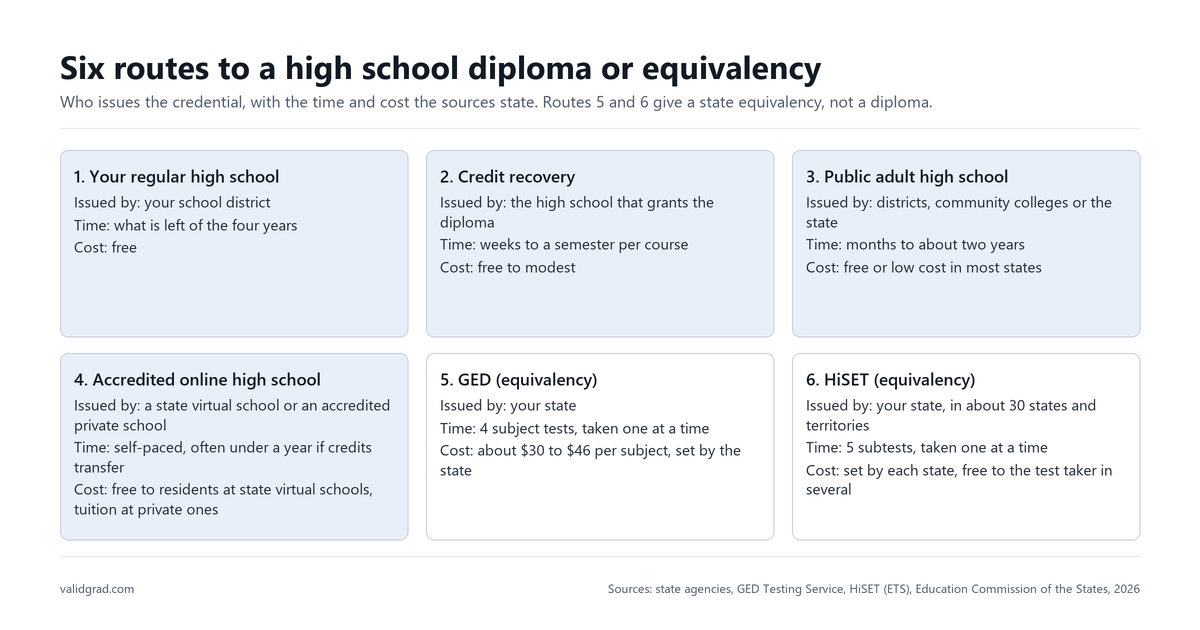
There are six real ways to end up holding a US high school diploma or its legal equivalent. You can finish at your regular high school, make up missing credits through credit recovery, enroll in a public adult high school program, enroll in an accredited online high school, or pass a high school equivalency exam, either the GED or the HiSET. Which one fits depends on your age, how many credits you already earned, and which state you live in.
If you already graduated and you’re just trying to get hold of the document, that’s a different job. See how to find your high school diploma online. This guide is about earning one.
Three questions that decide your route
- How old are you? Under the compulsory attendance age in your state (usually 16 to 18), you have the right to be enrolled in a public school and the district has to place you. At 18 and over, the regular high school is usually closed and the adult routes open up.
- How many credits do you already have? Order your transcript from your last school before anything else. Someone who left in twelfth grade three credits short has a very different path from someone who left in ninth grade.
- Which state are you in? States set the credits required to graduate, the minimum age for equivalency testing, the residency rules, the fees, and even which equivalency exam is offered. There is no national high school diploma.
The six routes compared
| Route | Typical time | Typical cost | Who it suits |
|---|---|---|---|
| Finish at your public high school | Whatever’s left of the four years | Free | Teens under the compulsory attendance age, and anyone who can re-enroll before the district’s cut-off age |
| Credit recovery | Weeks to a semester per course, and a summer session can clear several | Free to modest | Anyone short a handful of specific credits |
| Public adult high school | Months to about two years | Free or low-cost in most states | Adults 18+ with some high school behind them who want a diploma, not an equivalency |
| Accredited online high school | Self-paced, often under a year when credits transfer in | Free at state virtual schools for residents, while private schools charge tuition | People studying around a job, far from a campus, or who moved states |
| GED | Four subject tests, taken one at a time | Set by each state, roughly 30 to 46 dollars per subject | Adults with few credits or years away from school, who test well |
| HiSET | Five subtests, taken one at a time | Set by each state, and free to the test-taker in several | Same as the GED, in the ~30 states and territories offering it |
Costs and timelines vary by state and provider. Fee figures are the published GED and HiSET ranges as of September 2026, so check your state’s page before registering.
Route 1: Finish at your regular high school
The cheapest diploma is the one you were already enrolled for. Every state sets a compulsory attendance age, and below it a district must enroll you. Above it, many districts still accept students up to 19, 20 or 21. That cut-off is policy and not law, so call the district office instead of assuming you’ve aged out.
Graduating means a set number of credits in set subjects. The Education Commission of the States, which tracks requirements in all 50 states, finds at least 46 states and the District of Columbia set a minimum credit requirement, most landing between 22 and 28 credits. A few set only a floor. Colorado requires one credit of civic education at state level and leaves the rest to districts. For the subject-by-subject picture, see high school diploma requirements by state.
If you moved states partway through, expect friction, because credits earned under one state’s requirements don’t always map onto another’s. Get your transcript evaluated by the receiving district before you enroll.
Route 2: Credit recovery
Credit recovery is for people who completed most of high school but failed or never finished specific courses. Instead of repeating a year you retake only what’s missing, often online and often compressed into a summer. Districts run these programs, as do state virtual schools and community colleges. Three things to check before enrolling:
- Will your school accept the credit? Get it in writing from the counsellor who signs off on your graduation, before you pay anything.
- Is the provider accredited? An unaccredited credit can be refused by the very school you’re trying to graduate from.
- Does it satisfy the subject requirement, not just the credit count? A generic elective won’t discharge a lab science requirement.
If you finished the coursework but never received the diploma itself, that has a simpler fix. See how to get your high school diploma if you missed graduation.
Route 3: Public adult high school programs
Most states run a publicly funded route for adults to finish an actual diploma rather than an equivalency, through districts, community colleges or the state education agency, usually free or close to it.
Washington’s High School+ shows how the good ones work. The State Board for Community and Technical Colleges describes it as “a competency-based program for students who are at least 18 years old” that “turns life experience into high school credits.” You demonstrate what you know from work, life and military experience, then “take courses to fill in the gaps and earn a high school diploma.” Ohio runs a comparable program for adults 22 and older, and Virginia publishes its own adult secondary completion options. All three were cited by Google’s AI Overview for this query.
The competency-based design is the point. Fifteen years in a trade can become credit instead of a class you sit. To find yours, search your state’s education department plus “adult high school diploma”, or call your nearest community college.
Diploma vs. certificate of completion. Some students finish with a certificate of attendance or completion rather than a diploma, typically where a required exam or credit was never satisfied. It is not the same credential, and employers and colleges treat it differently. An adult high school program or an equivalency exam is how you convert it into something recognized. See certificate of secondary education: meaning and equivalents.
Route 4: Accredited online high schools
Online high schools fall into three groups that get confused constantly:
- State-run virtual schools. Public, usually free to residents of that state, usually the best value. Residency is normally required.
- Private college-prep online schools. Built for teenagers heading to university, with AP and NCAA-approved coursework. Legitimate and often excellent, but designed for full-time teen students and not for a 34-year-old finishing four credits.
- Adult-focused online high schools. Private and tuition-charging, built around transferring in prior credits and self-paced completion. This is what most adults searching for an “online high school diploma” want, and it is the group diploma mills hide in.
How to check a school is real
Accreditation is the whole game. An accredited school’s diploma is accepted by employers, colleges and the military, while an unaccredited one’s is not, and you may not find out until you try to use it. Before you pay:
- Look the school up in the accreditor’s own registry, not on the school’s website. Cognia, one of the largest school accreditors, accredits digital and virtual schools among its roughly 40,000 institutions and publishes a searchable public registry. Regional accreditors keep their own directories.
- Check with your state education agency that the school is approved to issue a diploma in your state.
- Treat speed claims as a warning. A diploma advertised in days, or one “based on life experience” with no coursework and no assessment, is a document for sale and not an education.
Recovering from a diploma mill is expensive, since unaccredited coursework usually has to be repeated. That half-hour of checking is the cheapest part of this process.
Routes 5 and 6: The GED and HiSET equivalency exams
Both are high school equivalency credentials. You don’t take classes. You pass tests, and the state issues a credential that employers, colleges and the military accept in place of a diploma.
The GED
The GED is four subject tests: Mathematical Reasoning, Reasoning Through Language Arts, Social Studies and Science. GED Testing Service is explicit that you don’t have to take them together. Its guidance says “You don’t have to take all 4 tests at once” and that “you can space them out however it suits you and go at your own pace.” They can be sat at a test center or online with a proctor.
Price, age and residency rules are set by each state, so what the GED costs depends on where you live. In California it is 41 dollars per subject, the minimum age is 18 with narrow exceptions at 17, you must be a resident or a service member stationed there, and the credential is called the California High School Equivalency Certificate. Across states the per-subject fee commonly runs from about 30 to 46 dollars. Check your state’s rules on GED.com before booking, and see how to get a GED certificate plus what a high school diploma costs.
The HiSET
The HiSET is the main alternative, offered in around 30 states and territories including California, Illinois, Massachusetts, Michigan, Missouri, New Jersey, Ohio, Pennsylvania and Tennessee. It runs as five subtests instead of four, also taken one at a time. Several states subsidise it heavily. Massachusetts pays for a first attempt at each subtest plus two retakes. Pennsylvania covers up to five subtests for residents, including the proctoring fee the first time. Minnesota residents test free using a state promotional code, as do Maine residents on proof of residency. In California, where no subsidy applies, the published figures are 34 dollars per subtest, 54 for the first subtest booked (it carries a one-time state administration fee), and about 190 dollars to finish with no retakes.
Retakes are built in. Two retests per subtest within 12 months of purchase carry no additional test fee, up to three attempts per subtest a calendar year.
Diploma or equivalency?
An equivalency is faster and cheaper. A diploma is more widely accepted at the margins. The military applies stricter enlistment rules to equivalency holders, and some employers and selective colleges still distinguish between the two. With most of your credits already earned, an adult high school program is usually the better trade. After leaving school early or long ago, the exam route is. The longer comparison is in high school equivalency diploma or GED: what’s best for you.
Is it worth finishing?
For most people yes, mostly for what it makes possible. Apprenticeships, trade schools, community colleges, the military and most certificate programs ask for a diploma or equivalency to enroll, so “skip the diploma, learn a trade instead” runs into the diploma requirement anyway. There is real work available without one, and jobs that don’t require a high school diploma covers it, but the ceiling is lower. For what each level pays, see average salary by education level, and for the shorter credentials alongside it, how long it takes to get a certificate.
If you already earned it and want a copy to frame
If you graduated and the diploma was lost, damaged or never framed, start with the official channels. Your district or the registrar reissues diplomas and transcripts, and where a school has closed the records usually transfer to the state education agency.
For a copy to hang on a wall, ValidGrad makes replica high school diplomas, GED diplomas and high school transcripts for display. They are novelty documents. They are not official records, they do not replace anything your school issues, and they must never be used to claim a credential you have not earned, because employers and schools verify education with the institution, not with the paper in the frame.
Frequently asked questions
What’s the easiest way to get a high school diploma?
If you have most of your credits, credit recovery through your old district is the shortest path, because you only make up what’s missing. With few credits, or after years away, an equivalency exam is usually easiest, with four GED tests or five HiSET subtests, taken one at a time at your own pace. Easiest is not cheapest. Adult high school programs are typically free, while the exams carry per-subject fees.
Can you go back to high school as an adult?
Yes. Most states fund adult high school diploma programs through districts, community colleges or the state education agency. Washington’s High School+ is open to students 18 and older and converts documented work, life and military experience into credits, with coursework filling the gaps. Some programs set a higher entry age, and Ohio’s is aimed at adults 22 and over, so check your state’s rules.
What’s harder, the GED or a diploma?
They test different things. The GED compresses high school into four timed exams, so it’s harder for people who don’t test well and faster for people who do. A diploma means sustained coursework across 22 to 28 credits in most states, which is much longer, but it rewards consistency over test performance. Neither is a shortcut, and anything promising either in days without coursework or testing is a diploma mill.
Can I get a high school diploma online?
Yes, from an accredited online high school, either a state-run virtual school if you’re a resident or a private accredited school otherwise. What makes it a real diploma is accreditation and not the delivery method, so verify the school in its accreditor’s registry and with your state education agency before paying. Programs and rules vary by state, which is why the answer in Texas differs from the answer in Ohio.
Sources
- GED Testing Service, GED test subjects (four subject tests, which may be taken separately).
- GED Testing Service, California GED policies (per-subject price, minimum age, residency, credential name) and Price & state rules.
- HiSET / ETS, HiSET exam requirements by state or jurisdiction (participating states, plus state-set age, residency and fee rules).
- HiSET / ETS, California HiSET requirements (per-subtest fee, first-subtest fee, total cost), Massachusetts, Pennsylvania, Minnesota and Maine (state-funded testing).
- Washington State Board for Community and Technical Colleges, High school diploma options for students (High School+ competency-based adult diploma).
- Ohio Department of Education, 22+ Adult High School Diploma Program.
- Virginia Department of Education, Adult secondary completion options.
- Education Commission of the States, 50-State Comparison: High School Graduation Requirements (minimum credit requirements by state).
- Cognia, Accreditation and certification and the institution registry.
Fees, ages and program rules are set by each state and change. Figures checked against these sources on September 13, 2026.