A diploma carries the name a school had on file when it conferred the degree. After a marriage, a divorce, a court-ordered name change or a gender transition, that name can stop matching the name a graduate uses every day.
Whether a school will print a new one depends on the institution, and there is no national rule that settles it. Penn State reissues a diploma in the name currently on the Penn State record once a name change form and supporting documentation are on file. Drexel states that the name on a replacement or duplicate diploma must match the name listed on the original diploma issued, and asks graduates who want a different name to email the Office of University Registrar before placing the order.
For work and licensing, the framed certificate is rarely the document that gets checked. Employers and background screeners verify degrees against data the institution itself supplies to the National Student Clearinghouse, which reports coverage of 96 percent of four-year postsecondary degrees in the United States. Updating the student record and the transcript therefore does more work than reprinting the diploma.
Does your legal name have to be on your diploma?
Most registrars default to the legal name in the student record. The University at Buffalo prints diplomas using the legal name it has on file for each student, and Boston University prints the legal first and last name as it appears in university records.
Several schools publish a separate diploma name that does not have to match. The University of Washington states that a student’s diploma name does not have to match the student record name. UNC Chapel Hill lets a graduate choose a first name that conforms with a genuine expression of gender identity, an alternate form of a first name, and a middle name, an initial or no middle name at all. UC Berkeley allows either a legal name or a lived name. Pittsburg State publishes a longer list that adds suffixes, former or maiden names, accents and maternal surnames.
Choosing a name other than the legal one has costs, and registrars spell them out. Buffalo warns that a chosen name can prevent degree verification through the National Student Clearinghouse, cause complications for graduates working abroad, create licensing problems for professional school graduates and block apostille certification. Syracuse states that enrollment and degree verifications are provided using the full legal name and that a diploma apostille can only be provided on a diploma carrying it. UNC recommends the legal name for anyone who plans to live, study or work outside the United States.
Should your middle name be on your diploma?
At most colleges the middle name is optional and its form is a choice. Boston University lets a graduate add, remove, abbreviate or expand the legal middle name. UNC lists a middle name, an initial, or omission of the middle name altogether. Buffalo accepts a chosen middle name as long as the last name matches the legal surname. UC Santa Cruz prints the diploma name, middle name included, in capital letters.
High school diplomas follow the district’s student record instead of a national format, so the middle name appears the way the record holds it.
Timing decides what this costs. Boston University states that once diplomas are produced no changes can be made without purchasing another copy. The University of Texas at Austin requires diploma name changes to be completed by the Monday prior to the official graduation date. Washington and Lee accepts a written change up to 60 days before the graduation date and charges a replacement fee after that.
Do you need to change your name on your degree after marriage or divorce?
Nothing obliges a graduate to do it. A degree stays valid under the name it was awarded in, and the registrar’s file links the old name to the new one once the record is updated. Carnegie Mellon treats every post-graduation name change request the same way whatever the reason for it, and asks for documentation of the individual’s current legal name before updating transcripts, diplomas and doctoral theses.
The practical question is whether the school can connect both names when a verification request arrives. Syracuse notes that a preferred diploma name is not reflected on the transcript and that the transcript carries the full legal name. Ordering an updated transcript and confirming how the registrar records a former name is the step that affects background checks and licensing applications.
A graduate who wants the paper itself updated is making a replacement diploma request, which is governed by the school’s own policy, deadline and fee.
How to change the name on your college diploma
The order of operations is similar across institutions.
- Update the legal name on the student record first. UCLA requires evidence of a court order changing the legal name. UT Austin asks for original supporting documentation such as a driver’s license, passport or marriage license, processes it and returns it.
- Ask the registrar whether diplomas are reissued for a name change at all, and whether a deadline or time limit applies.
- Submit the replacement diploma form and pay the published fee.
- Expect the original graduation date with current signatures. UC Berkeley states it is unable to reissue diplomas with signatures contemporary to the time of graduation.
- Check whether the original has to be returned. Yale and Washington and Lee require it. Berkeley dropped that requirement in spring 2023.
The documents registrars ask for cover the same ground. A certified court order, a marriage certificate, a divorce decree or dissolution of marriage, an updated government-issued photo identification, or a birth certificate all appear on published lists.
UCLA makes a new diploma available about three weeks after it receives a replacement request. Yale runs about six months at standard speed and four weeks for an extra fee, and prints a line in the lower margin saying the document replaces one previously issued, with a statement on the reverse giving the earlier name and the date of the change.
How to change the name on your high school diploma
High school records sit with the school or with the district office, and the request goes to whoever holds them. State law sometimes settles the answer. California Education Code section 49062.5 requires a school district, charter school or county office of education to update a former pupil’s records when it receives government-issued documentation that the pupil’s legal name or gender has changed, and the same section covers reissuing documents already conferred on request.
The statute names the documentation that counts, a useful checklist outside California too.
- A state-issued driver’s license
- A birth certificate
- A passport
- A Social Security card
- A court order indicating a name change or a gender change, or both
Elsewhere the district sets the process, so it varies. Most records offices ask for a written request, legal proof of the current name, and the original diploma if the graduate still has it.
A misspelling is a correction and usually moves faster than a legal name change, which needs the documentation above. A diploma that has gone missing is a separate request altogether, and replacing a lost diploma covers that route. Where the district refuses to reprint, what to do when a school will not reissue a diploma sets out the alternatives.
How to change your name on a professional certificate or license
Licensing boards hold the name change in their own register, and the printed certificate is a separate order. The California Board of Registered Nursing takes a name change through its online portal with two uploads. One is a current government-issued photographic identification such as a driver’s license or passport. The other is a second form of legal documentation as proof of the change, such as a certified court order, a marriage certificate or a dissolution of marriage.
A replacement wall certificate is a separate duplicate request with its own fee and form. Boards update the register whether or not a new certificate is ordered, and an employer checking a license reads that register, so it is what has to be right.
Can you get a new diploma if you change your name?
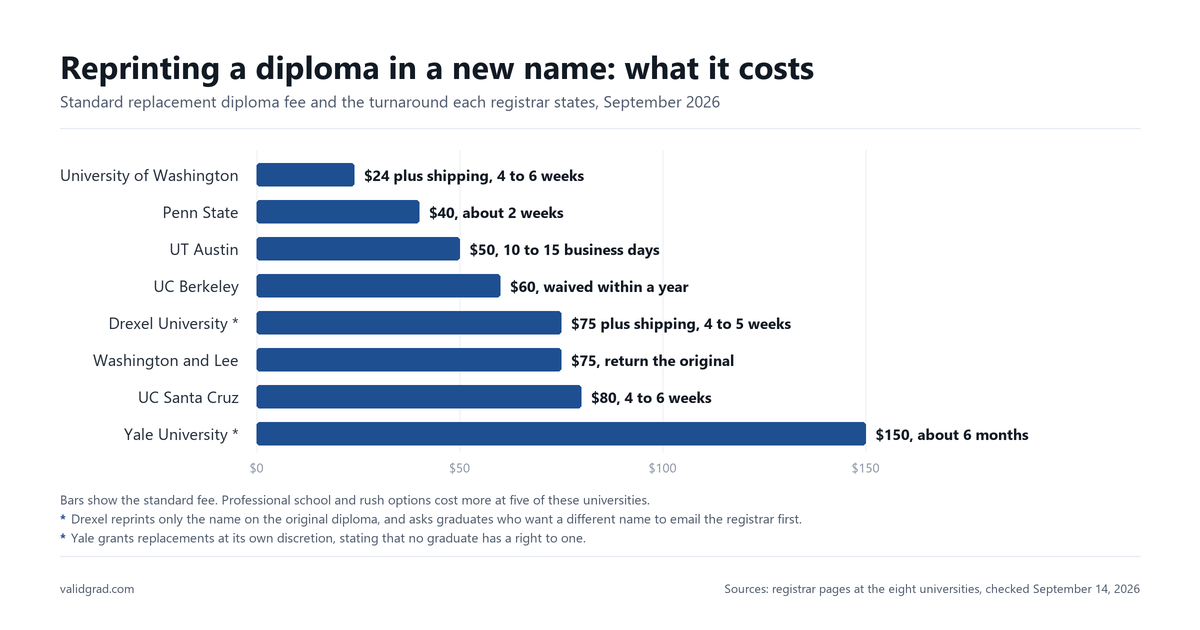
Published policies split three ways. Some schools reissue in the new legal name for a standard fee. Some will only reprint the name that was on the original, which is how Drexel words its replacement policy. Some grant replacements at the registrar’s discretion rather than by right, which is how Yale words its own, stating that no graduate has the right to a replacement diploma.
Institutions publish these replacement diploma fees and timings.
| Institution | Published fee | Stated turnaround or condition |
|---|---|---|
| University of Washington | $24 plus shipping | 4 to 6 weeks, 2 to 3 weeks expedited |
| Penn State | $40 undergraduate or graduate, $50 medical and law | About 2 weeks |
| University of Texas at Austin | $50 for a paper replacement | 10 to 15 business days |
| UC Berkeley | $60, or $75 for Law and Optometry | Fee waived within one year of the original shipping date |
| Drexel University | $75 plus shipping, $29.95 to expedite | 4 to 5 weeks, or 3 to 5 business days expedited |
| Washington and Lee | $75 standard, $125 rush | Original diploma must be returned |
| UC Santa Cruz | $80 | 4 to 6 weeks |
| Yale University | $150, plus $100 to expedite | About 6 months, or 4 weeks expedited |
Two limits show up across almost all of these policies. The reissued diploma carries current signatures instead of the ones in office at graduation, and the graduation date stays as it was.
Where a school declines, the transcript and the record it reports to the Clearinghouse still show the current legal name once the registrar updates the file, and those are the records a verifier reads. The difference between the two documents is covered in diploma versus transcript.
What to do while the paperwork is pending
Replacement diplomas take weeks at most schools and months at a few. While a request is open, an official transcript carrying the updated name is the document that answers an employer, a licensing board or a graduate admissions office. Clearinghouse verification works from the institution’s own data, so it reflects the updated record as soon as the school reports it. How employers verify degrees goes through what a screener actually checks.
For the wall at home, some graduates order a display copy. ValidGrad makes replica diplomas as novelty items for display. A replica is not a credential, it does not replace a school record, and it must never be used to claim a degree or to answer a verification request. The terms of service set out that limit.
Frequently asked questions about names on diplomas
Can you change your name on your degree after you graduate?
At many institutions yes, through a replacement diploma request backed by proof of a legal name change and the school’s fee. At others the replacement carries the original name, so the transcript becomes the document that shows the current one.
Does your legal name have to be on your diploma?
It depends on the school. Buffalo and Boston University print the legal name of record, while the University of Washington, UNC and UC Berkeley publish a separate diploma name that does not have to match. A name other than the legal one can block Clearinghouse degree verification and apostille certification.
Can you get your name changed on your college diploma?
Through the registrar, in two steps. Update the legal name on the student record with the required documents, then order a replacement diploma if the school reissues them. Published fees run from $24 at the University of Washington to $150 at Yale.
Do you put your middle name on your college diploma?
That is a choice at most schools. Boston University allows the legal middle name to be added, removed, abbreviated or expanded, and UNC allows a middle name, an initial, or none at all.
Do high school diplomas have middle names?
They follow the district’s student record, so a middle name appears when the record holds one. Districts correct the record on request, and California requires the update once a former pupil supplies government-issued documentation.
What is the difference between a name correction and a name change on a diploma?
A correction fixes an error such as a misspelling. A name change reflects a legal change through marriage, divorce, a court order or a gender transition, and it needs documentation and, at most schools, a paid replacement diploma.
Can you use a different name on a replica diploma?
A replica is a display item, so the name on it is a design choice. It carries no weight with an employer, a school or a licensing board, all of which read the official record and legal identification instead.
Sources
- University at Buffalo, diploma names. Legal default, chosen names, verification and apostille warnings. Checked September 14, 2026.
- Boston University, diploma name. Middle name options and the production deadline. Checked September 14, 2026.
- UNC Chapel Hill, diploma name FAQs. Permitted variations and replacement in an alternate name. Checked September 14, 2026.
- University of Washington, diplomas. Diploma name need not match the record, and the fee. Checked September 14, 2026.
- UC Berkeley, diplomas. Legal or lived name, fees, current signatures. Checked September 14, 2026.
- UC Santa Cruz, diplomas. Middle name printed in capitals, fee and timing. Checked September 14, 2026.
- UCLA, replacement diploma. Court order evidence and the three week turnaround. Checked September 14, 2026.
- Yale University, replacement diploma. Discretionary replacement, fees, and the earlier name statement. Checked September 14, 2026.
- Drexel University, diploma replacement. Replacement must carry the original name, plus fees. Checked September 14, 2026.
- Penn State, reissued diploma. Name change form, fees by degree type, timing. Checked September 14, 2026.
- University of Texas at Austin, diplomas. Name changes on the reissued diploma, deadline, fee. Checked September 14, 2026.
- Washington and Lee University, diplomas. Legal proof, return of the original, fees. Checked September 14, 2026.
- Carnegie Mellon University, alumni names. Equal treatment of requests and the reprint rate. Checked September 14, 2026.
- Syracuse University, diploma FAQ. Transcripts, verifications and apostilles use the legal name. Checked September 14, 2026.
- Pittsburg State University, diploma names. The published list of accepted name variations. Checked September 14, 2026.
- California Education Code section 49062.5. Duty to update records and the documentation accepted. Checked September 14, 2026.
- California Board of Registered Nursing. Documents for a license name change and the duplicate order. Checked September 14, 2026.
- National Student Clearinghouse, education verifications. Verifications run on institution data, with coverage figures. Checked September 14, 2026.