
A certificate of completion is a one-page document stating that a named person finished a defined course, training or program, on a given date, issued by whoever ran it. It records completion. It is not a degree, an occupational license, or a professional certification, and no accreditation is needed to issue one.
Below is a blank template you can print and fill in today, followed by what belongs on each line, how to word it, how to number and verify what you issue, and how a recipient can list it on a resume without overstating it.
Download the blank template
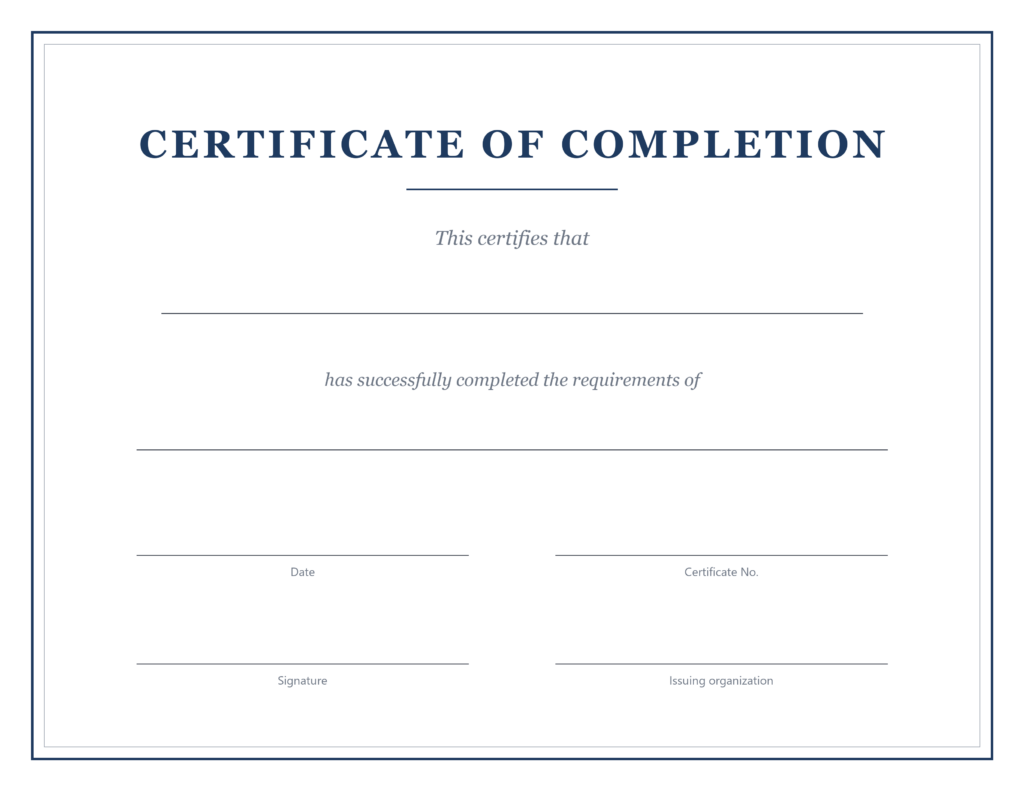
- Certificate of completion template (PDF), print-ready, U.S. Letter landscape, 11 by 8.5 inches. Print at 100% or “actual size” so the frame is not shrunk to fit.
- Certificate of completion template (PNG), the same layout as an image, for dropping into Word, Google Docs, Slides or Canva and typing over the lines.
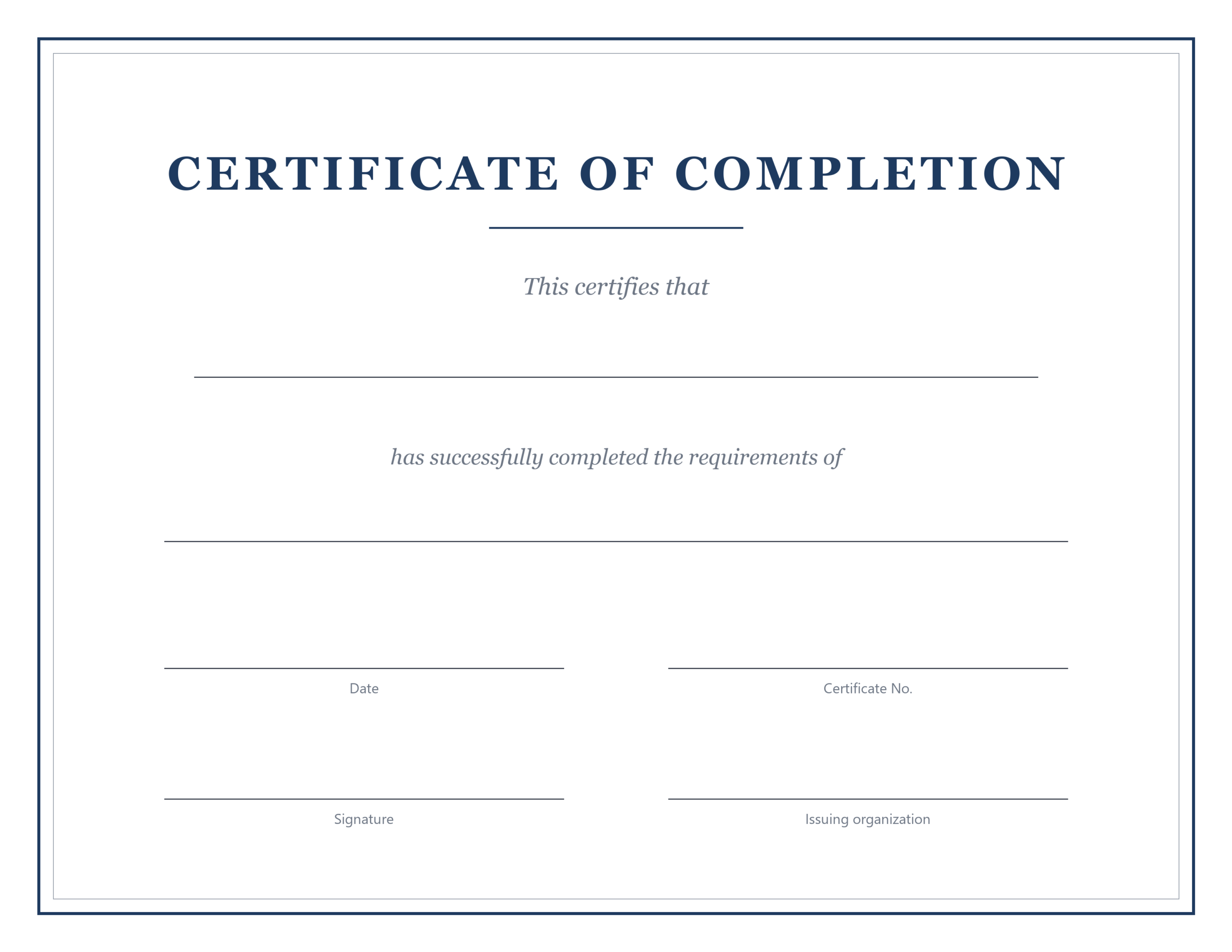
Both files are free, carry no watermark and no logo, and can be used for courses, workshops, internal training and volunteer programs. The design is deliberately plain: a navy double frame, a serif title, and ruled lines for the fields that matter.
Certificate of completion, achievement, participation or certification?
Four documents get called “certificates” and only one of them is a certificate of completion. The distinction matters most when the recipient puts it on a resume or an employer is asked to accept it.
| Document | What it records | Who issues it | Assessment | Typical use |
|---|---|---|---|---|
| Certificate of completion | That a named person finished a defined program | The provider that ran it, whether employer, trainer, school or association | Optional, and attendance may be enough | Courses, workshops, onboarding, continuing education |
| Certificate of achievement | That the person met or beat a defined standard | The same provider, or a competition organizer | Yes, against a stated benchmark | Top scores, sales targets, competition placings |
| Certificate of participation | That the person attended or contributed | Event or program organizer | No | Conferences, volunteer days, speakers |
| Assessment-based certificate | Completion plus a pass on the provider’s own assessment of the stated learning outcomes | A certificate issuer, optionally accredited to ANSI/ASTM E2659 | Yes, built and run by the issuer | Structured training programs |
| Professional certification | Current proficiency, usually time-limited and renewable | A certifying body, often accredited to ISO/IEC 17024 | Yes, a standardized exam independent of any course | Licensure-adjacent and industry credentials |
The line between the last two is the one people cross by accident. In a certificate program the learning events and the assessment are built and run by the same issuer, and the certificate is awarded after the issuer verifies that the person completed everything. In certification, the certifying body does not usually provide the training at all. It checks eligibility and administers a standardized assessment of current competence, then grants recognition for a limited time. ANAB accredits the first kind against ANSI/ASTM E2659 and the second against ISO/IEC 17024.
A certificate of completion is also not a degree. If you are weighing one against the other, see is a certificate a degree. If what you are recognizing is performance rather than attendance, achievement certificates covers the wording for that case. And for how long the underlying programs usually run, the certificate timeline hub collects typical durations by field.
One more meaning is worth knowing because it is written into state law. In Florida, a student with a disability whose parent and IEP team declare that intent may graduate with a certificate of completion rather than a standard high school diploma (Fla. Stat. s. 1003.4282). In that context the phrase describes a formal, state-defined outcome, not a training document, and the two should never be confused on a resume or an application.
What belongs on the certificate, line by line
The template has seven lines. Here is what goes on each one and wording that reads correctly in the United States.
| Line | What goes on it | Wording example |
|---|---|---|
| Title | The document type, set as the largest text on the page | Certificate of Completion |
| Certifying line | The short statement that opens the sentence | This certifies that |
| Recipient | The person’s full legal name, spelled the way they use it professionally | Jordan A. Reyes |
| Program | The full official title of the course, plus hours or CEUs if the program awards them | has successfully completed the requirements of Forklift Operator Safety Training (8 contact hours) |
| Date | The date the requirements were finished, written out | Completed September 13, 2026 |
| Signatures | Two lines: the instructor or program director, and the issuing organization | Instructor, Training Services · Northside Community College |
| Certificate number | Optional, but the single field that makes later verification possible | NCC-2026-FLS-0147 |
Two wording rules keep a certificate honest. Say what was completed instead of what the person is now (“completed Forklift Operator Safety Training”, not “is a certified forklift operator”), and name the issuer in full, because the issuer is the only party that can confirm the document later. If the program awards continuing education units, state them. Under the ANSI/IACET standard, one CEU means ten contact hours of participation in an organized learning experience delivered under responsible sponsorship, capable direction and qualified instruction, a definition that has been in use since 1970.
When organizations issue them
Certificates of completion show up wherever a program ends but no licensing body is involved.
- Employer training. Onboarding, compliance refreshers, equipment training. The certificate is the employee’s copy of a record the employer already keeps.
- Continuing education. Providers that award CEUs issue a completion document showing the program, the date and the units, because licensing boards ask learners to produce it at renewal.
- Safety training. OSHA’s Outreach Training Program is the clearest example of the split between a card and a certificate. Trainers must issue the official student course completion card within 90 days of class completion, and OSHA notes there is no program requirement to issue any other documentation. Trainers are encouraged to hand out a training certificate at the end of class so the student has something to show while the card is processed. Whether an employer accepts that interim certificate is up to the employer.
- Online courses. Platform completion certificates are generated automatically and usually carry a verification URL. See how course platform certificates work.
- Community programs and volunteering. Workshops, bootcamps, youth programs, volunteer hours.
How to number and verify what you issue
A certificate is only as credible as the issuer’s ability to confirm it a year later. Three habits cover most of it.
Number every certificate. A readable scheme beats a random string: issuer code, year, program code, sequence, for example NCC-2026-FLS-0147. Put the number on the certificate and use it as the key in your own records.
Keep a register. One row per certificate: number, recipient name, program, completion date, hours or CEUs, instructor, and the date it was issued. A spreadsheet is enough for most providers. OSHA’s five-year record rule for authorized Outreach trainers is a reasonable default retention period if nothing in your field sets one.
Say how to verify it. Add a line such as “Verify this certificate at training@example.org, quoting the certificate number”, or a short URL or QR code that resolves to a page confirming the number, the program and the date. Note who is doing the verifying. OSHA itself does not verify individual student cards for privacy reasons, so verification falls to the trainer or the education center that processed the card. The same is true of your certificates. If you issue them, you are the verification desk.
Recipients should expect that scrutiny to be light for a workshop certificate and heavier for anything attached to a job requirement. Formal education claims are checked through the registrar or the National Student Clearinghouse instead of by looking at a document, which is why a certificate of completion should never be offered as proof of a degree. How education background checks work covers what employers actually do.
How recipients use one on a resume
A certificate of completion belongs in a section named for what it is, usually “Professional Development”, “Training” or “Certificates and Training”, kept separate from “Licenses and Certifications”, which is for credentials issued by a certifying or licensing body.
List it as program title, issuing organization, completion date, and hours or CEUs if they were awarded. For example: “Forklift Operator Safety Training, Northside Community College, September 2026 (8 contact hours).” Do not convert it into a title the document does not support, and do not move it into an education section, where it reads as a degree claim. The same restraint applies to any short credential. How to list a GED on a resume works through the parallel case.
Printing, framing and display
The PDF is sized for U.S. Letter in landscape orientation. Print at 100%, on the heaviest stock the printer handles cleanly. Text-weight copy paper is what makes a certificate feel disposable, and the trade-offs between weights and finishes are covered in what paper diplomas are printed on. Sign in ink instead of pasting a signature image when the certificate will be handed over in person.
For recipients who want to hang what they earned, how to display certificates on a wall covers frame sizes, spacing and light exposure. A landscape certificate at 11 by 8.5 inches fits standard frames without custom matting.
If you want a designed certificate instead of a blank one
The template above is free and plain by design. Organizations that want a finished, printed piece for a ceremony, a wall or a keepsake can use ValidGrad’s certificate maker, which produces novelty replica certificates on certificate stock, laid out and printed for display and recognition instead of issued by any school or certifying body.
These are display replicas. A replica must never be used to claim a credential a person does not hold, or to answer a verification request from an employer, a school or a licensing board. That limit is part of our terms of service. Current options and pricing are on the product page.
Frequently asked questions
Can I make my own certificate of completion?
Yes. Anyone who ran a course, workshop or training can issue one, and no accreditation or approval is required. What you may not do is describe it as a license, a degree or a professional certification, or word it so that it implies a credential the recipient does not hold.
What should a certificate of completion look like?
One landscape page, usually U.S. Letter, with the document title as the largest element, a certifying line, the recipient’s full name, the exact program title, the completion date, at least one signature, and the issuing organization. A certificate number is optional and is what makes later verification possible.
How do I create a certificate of completion in Word?
Set the page to Letter, landscape, with narrow margins, then insert the PNG above (Insert, Pictures) and set its text wrapping to “Behind Text” so it fills the page. Type the name, program and date in text boxes over the ruled lines. Print at 100%, not “fit to page”. For handwritten certificates, print the PDF and skip Word entirely.
Is a certificate of completion the same as a certification?
No. A certificate of completion records that a person finished a program run by the issuer. A certification is a time-limited recognition granted by a certifying body after a standardized assessment of current competence, usually independent of any particular course. The two are accredited against different standards, ANSI/ASTM E2659 for certificate programs and ISO/IEC 17024 for certification bodies.
How long should an issuer keep the records?
Long enough to answer a verification request. Where nothing in your field sets a period, OSHA’s requirement that authorized Outreach trainers keep training records for five years is a defensible default.
Sources
- IACET, About the CEU. The ten-contact-hour definition of one CEU. Checked September 13, 2026.
- ANAB, Certificate Accreditation (ANSI/ASTM E2659-24) and ANAB, Standard Practice for Certificate Programs. Certificate programs versus certification. Checked September 13, 2026.
- OSHA, Outreach Training Program FAQs. The 90-day card rule, the five-year trainer record rule, training certificates versus cards, and OSHA’s position on verifying individual cards. Checked September 13, 2026.
- Florida Statutes s. 1003.4282. Certificate of completion as a state-defined graduation outcome. Checked September 13, 2026.