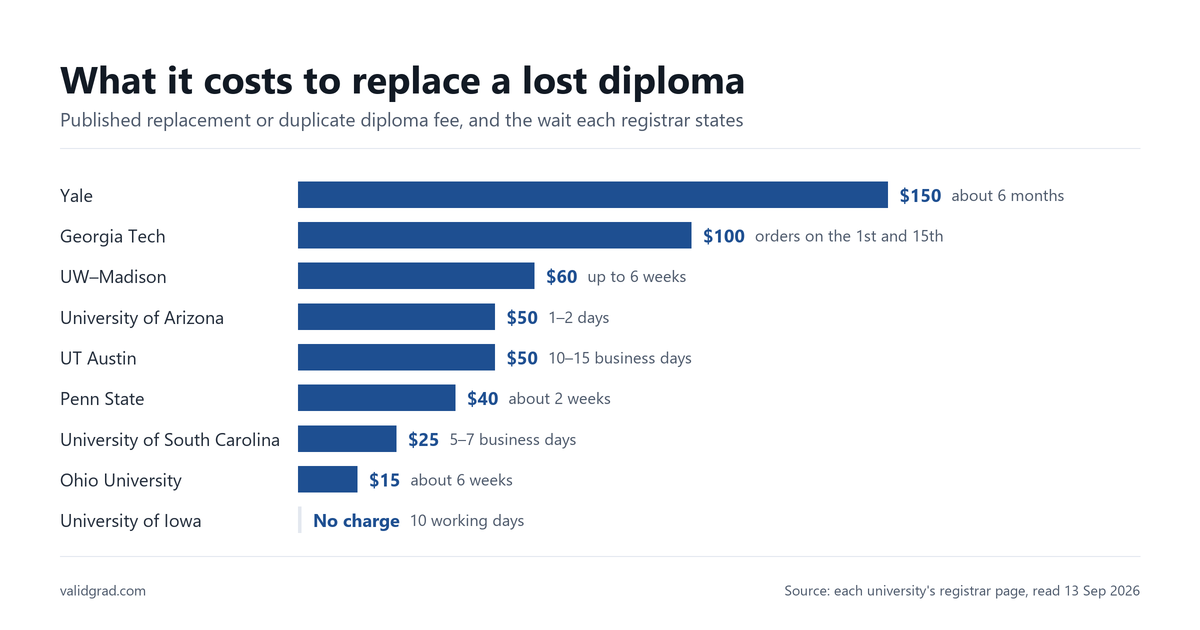
Only the institution that issued a diploma can issue another one: a college or university registrar, the school district that granted a high school diploma, or the state agency that awarded a GED credential. Published replacement fees at nine US universities range from nothing to $150, and the stated waits run from one to two days to about six months. While the reissue is in the post, an official transcript is the document that actually proves the degree.
Who replaces what
| Credential | Who reissues it | What to ask for |
|---|---|---|
| College or university diploma | The registrar’s office at the institution that conferred the degree | A replacement or duplicate diploma, plus an official transcript for immediate proof |
| High school diploma | The school district (not the state). For a closed school, the district that absorbed it or the state archive holding its records | A replacement diploma if the district issues one, otherwise a certified transcript or a letter of graduation |
| GED credential | The state that awarded it, through GED Testing Service or the state’s own provider | A duplicate credential (“diploma”) and a transcript of test scores |
Replacing a lost college or university diploma
Step 1: Contact the registrar, and gather what they will ask for
Replacement diplomas are handled by the registrar or a degree-services unit inside it, not by the alumni association or the academic department. Most universities run the order through an online portal or a printed form. Expect to supply the name under which the degree was awarded, date of birth, the degree and major, the graduation year or conferral date, a current mailing address, and a government-issued ID. Some schools also route the printing through an outside vendor. The University of South Carolina takes replacement orders through its diploma vendor, Michael Sutter Company, and the University of Wisconsin-Madison passes approved orders to a vendor before mailing.
If the name on the original has changed, the rules tighten. Ohio University requires the original diploma to be returned in a legal name-change case, and the University of South Carolina asks for a marriage certificate or passport as supporting documentation before it will print a different name.
Step 2: The notarized affidavit
Because a second diploma puts a second original into circulation, many registrars require a sworn statement that the first one is gone. Ohio University’s replacement request is explicit. The notarized statement must attest that “the original diploma or certificate was lost, destroyed, never received,” or that the student had a legal name change. Yale asks for “a statement regarding the loss of or damage to the original that is satisfactory to the University Registrar,” requires a damaged original to be sent back, and requires applicants to return the replacement if the original later turns up.
Notarization is not universal. Penn State’s reissue form and Wisconsin’s duplicate order carry no such requirement, so read the form before paying a notary. Where it is required, a bank, credit union, shipping store or public library will usually have a notary, and the maximum a notary may charge per signature is set by state law.
Step 3: Budget for the fee, and above all for the wait
Fees and processing times published by nine universities, read on September 13, 2026:
| University | Published fee | Stated wait | What the replacement shows |
|---|---|---|---|
| University of Iowa | $0.00 | 10 working days plus delivery | Notation “duplicate diploma issued” with the issue date in the lower left corner, plus current officials’ signatures |
| Ohio University | $15.00 per diploma or certificate | Allow six weeks for delivery | Notation “Official Replacement” at the bottom, with current titles and signatures |
| University of South Carolina | $25.00 plus shipping | Printed and mailed within 5–7 business days (standard shipping) | Notarized copies available for $25.00 each |
| Penn State | $40 undergraduate or graduate; $50 medical | Mailed about two weeks after the request is received | Form mailed or faxed to Academic Records |
| University of Arizona | $50.00 per replacement | Printed and mailed within 1–2 days | Ordered online with a university login |
| UT Austin | $50 paper, non-refundable | Shipped within 10–15 business days | Electronic CeDiploma also offered; free notarization at the Texas One Stop |
| UW-Madison | $60 | Up to six weeks in total | Current administration’s signatures and no notation marking it a duplicate |
| Georgia Tech | $100.00 per copy | Orders placed on the 1st and 15th of each month | Signed by the current President, Registrar and Chancellor |
| Yale | $150.00, plus $100.00 to expedite | About six months; four weeks expedited | Printed with the marking “iteratum” |
Two more data points sit outside that table because the fee is not published: UCLA says a replacement is available in about three weeks after the request is received, and the University of Florida says replacements “take two to three months to ship from the date a request is submitted to the Registrar.” The practical lesson is that price is a poor predictor of speed. Arizona prints within two days for $50. Yale takes roughly half a year for $150 unless the expedite fee is paid.
What a reissued diploma looks like
A replacement is rarely a photocopy of the original. It is printed fresh, which has two consequences worth knowing before the envelope arrives.
- The signatures change. Georgia Tech’s replacements are signed by the current President, Registrar and Chancellor. Wisconsin’s carry the current UW System President, President of the Board of Regents and Chancellor, and Iowa’s and Ohio University’s carry current officials as well. The people who signed the original are not reproduced.
- Many are marked as reissues. Iowa prints “duplicate diploma issued” with the issue date, Ohio University prints “Official Replacement,” Yale prints “iteratum,” and UCLA prints a re-issue date. Wisconsin is the exception among the nine. It states the duplicate carries no notation identifying it as a replacement.
None of this makes the document less valid, because it is the university’s own record of the degree, reissued. It does mean a framed replacement may not match the original that hung there before. For how long the first diploma took to arrive in the first place, see how long it takes to get a college diploma after graduation, and for the broader picture of replacing both documents at once, replacing diplomas and transcripts.
Replacing a lost high school diploma
High school diplomas are issued by districts, not by states, and that is the single fact that decides where to write. Start with the school itself, then the district’s records or student-services office. Districts vary widely. Some reprint a diploma for a modest fee, and some will only produce a certified transcript or a letter confirming the graduation date, which is what employers and admissions offices generally want anyway.
If the school has closed, the trail runs to whichever body inherited the records, usually the district that absorbed it, the county office of education, or the state education agency or state archive for a defunct private school. That search has its own guide: how to get a diploma from a closed school. For the ordinary case where the school still exists, obtaining a high school diploma after graduation walks through the request, and finding a high school diploma online covers the district and state lookups that locate the record in the first place.
Replacing a lost GED credential
The GED diploma is issued by the state, not by GED Testing Service, and the transcript is the record of the test subjects and scores. GED Testing Service is direct about the consequence. There is no national replacement process, and each state handles it differently, with some going through the organization where the test was taken and others through the state agency that holds the records.
For tests taken on or after January 1, 2014, duplicates are ordered from inside the GED.com account under “My Scores,” using the “Order Duplicates” option. For older tests, or in states with their own provider, the request goes to the state department of education or its designated transcript service, generally with a small processing fee payable by certified check or money order. GED Testing Service says orders take roughly one to two days to process, with mailing adding up to several weeks, so do not start the request the week an employer asks for it. If the credential was never earned in the first place, how to get a GED certificate covers the testing route.
What to show as proof while you wait
A diploma is a ceremonial document. The transcript is the institution’s official record, and it is what registrars send when a degree has to be confirmed. That is why an official transcript ordered today is nearly always faster and more useful than a reissued diploma that arrives in six weeks. Employers and background screeners typically verify a degree directly with the institution or a verification service instead of inspecting a piece of parchment. Diploma vs. transcript sets out which document does which job, and the degree timeline hub covers the surrounding questions about how long each credential takes.
Two practical moves help while the replacement is in production. Order the official transcript at the same time as the diploma, since it is a separate request at nearly every school, and ask the registrar whether a notarized copy or a letter of degree conferral is available. Iowa, for example, provides up to five notarized copies of a diploma at no charge once you hold an original or a duplicate, and UT Austin notarizes paper diplomas at no additional charge at its One Stop counter, which is useful for overseas employers and apostille requests.
Keeping the replacement safe
Replacing a diploma once is an argument for not doing it twice. Scan the new document at high resolution and store the file where it will survive a computer failure. Keep the paper flat rather than rolled, away from direct sunlight and away from basements and attics where humidity swings. If it is going on a wall, a frame with UV-filtering glazing and acid-free matting protects it from the fading and yellowing that turn a diploma into a “damaged” case years later, and framing and displaying a college diploma goes through the options. Note that several universities require a damaged original to be surrendered before they will print a replacement, so a diploma kept badly can cost the fee twice.
A replica for the wall while the reissue is pending
The gap between ordering a replacement and receiving it is measured in weeks or months, and an empty frame is part of what makes people order in the first place. ValidGrad makes replica college diplomas and replica high school diplomas as novelty documents for display: a stand-in for the frame, a keepsake for a parent’s wall, or a stage prop. Current pricing and turnaround are on the product pages.
A replica is not a credential and is never a substitute for one. It must not be used to claim a degree you were not awarded, submitted to an employer or school, or offered in answer to a verification request. The official reissue from the registrar, district or state agency is the only document that does that job. Those limits are set out in the ValidGrad terms.
Frequently asked questions
Can I get a copy of my diploma online?
The order is usually online. The diploma itself is not. Most universities take replacement requests through a portal or an emailed form, then print and mail a physical document. The exception is an electronic diploma where the school offers one, as UT Austin does with a CeDiploma alongside the paper copy, and transcripts, which are routinely delivered as certified PDFs within a day or two. What is actually sold under that phrase, and how to tell an official reissue from a replica, is set out in online replacement diplomas.
How much does a replacement diploma cost?
Among the nine universities checked on September 13, 2026, published fees ran from $0.00 at the University of Iowa to $150.00 at Yale, with $50 the most common figure. Add shipping, and a notary fee of a few dollars where a sworn statement is required.
How long does it take to get a replacement diploma?
Stated production times ranged from 1–2 days at the University of Arizona to about six months at Yale, with roughly two to six weeks being typical. Universities that batch their orders add to that: Georgia Tech places diploma orders only on the 1st and 15th of each month.
Do I need a notarized affidavit to replace a lost diploma?
At some institutions, yes. Ohio University requires a notarized statement that the original was lost, destroyed or never received. Others, including Penn State and UW-Madison, ask only for a signed form. Check the specific form before scheduling a notary appointment.
Will the replacement look exactly like my original?
Usually not. It carries the signatures of whoever holds the offices now, and at most schools a notation identifying it as a reissue, whether “duplicate diploma issued” at Iowa, “Official Replacement” at Ohio University, or “iteratum” at Yale. UW-Madison is unusual in printing no such notation.
My school closed. Who has my records?
For a closed high school, the district that absorbed it, the county office of education, or the state education agency or archive. For a closed college, the state higher education agency usually names a custodian of record, which may be another institution or a state archive. Start with the state agency rather than the shuttered campus.
Sources
- University of Iowa Office of the Registrar, Duplicate Diploma (fee, 10 working days, “duplicate diploma issued” notation, notarized copies)
- Ohio University Office of the Registrar, Replacement Diploma or Certificate Request (notarized statement wording, $15.00 fee, six weeks, “Official Replacement” notation)
- University of South Carolina University Registrar, Duplicate and Replacement Diplomas (fee, 5–7 business days, notarized diploma, name-change documents)
- Penn State Office of the University Registrar, Reissued Diploma Form (fees, two-week mailing)
- University of Arizona Office of the Registrar, Diploma Replacement (fee, printed and mailed within 1–2 days)
- The University of Texas at Austin, Texas One Stop, Degrees and Diplomas (paper fee, 10–15 business days, CeDiploma, free notarization)
- University of Wisconsin-Madison Office of the Registrar, Diplomas (fee, up to six weeks, current signatures, no duplicate notation)
- Georgia Tech Registrar’s Office, Replacement Diplomas (fee, 1st and 15th order dates, current signatories)
- Yale University Office of the University Registrar, Replacement Diploma (fee and expedite fee, six months, statement of loss, “iteratum”)
- UCLA Registrar’s Office, Replacement Diploma (about three weeks, re-issue date and current signatures)
- University of Florida Office of the University Registrar, Diplomas (two to three months to ship)
- GED Testing Service, How to Obtain a Copy of Your GED Transcript (state-by-state process, post-2014 duplicate ordering, processing time, fees)
Fees, waits and policies above were read from the institutions’ own pages on September 13, 2026 and change without notice. Confirm with the registrar or agency before sending payment.