Yes, it is possible to work without a high school diploma. The U.S. Bureau of Labor Statistics assigns every occupation a typical entry-level education, and in 2025 about 40.2 million U.S. jobs, 23.6 percent of all employment, sat in occupations that need no formal educational credential to enter. That group covers 109 detailed occupations, from fast food counters and warehouse floors to roofing, drywall finishing and Postal Service routes.
The trade is pay and steadiness. The median annual wage in that group was $36,400 in May 2025, against $48,050 for occupations that typically ask for a high school diploma or equivalent and $50,980 across all occupations. Among adults 25 and over, the 2025 unemployment rate was 6.1 percent for people without a high school diploma and 4.3 percent for people with one. The full earnings ladder is in salary by education level, and why jobs require a high school diploma explains what employers are screening for.
A GED closes part of that gap. Federal education rules list a GED certificate, and a state certificate earned by passing a state-authorized equivalency exam, as recognized equivalents of a high school diploma, which is what a listing means when it says “diploma or equivalent.” The sections below name the occupations BLS actually places in the no-credential group, what they pay, and which familiar jobs are not in it.
Can you get a job without a high school diploma or GED?
Job listings fall into three patterns:
- Clear requirement, “high school diploma or GED required.”
- Flexible requirement, “high school diploma or equivalent preferred.”
- No stated education requirement, because the employer is screening for availability, reliability or experience instead.
The BLS categories line up with those patterns. Occupations that need no formal educational credential held 40.2 million jobs in 2025; occupations that need a high school diploma or equivalent held 60.3 million, 35.4 percent of all employment, at a median wage of $48,050. Between them they account for roughly three jobs in five.
Even where nothing is required on paper, a diploma is common among the people already doing the work. For Postal Service workers, BLS says no formal education is typically required to enter, that most postal workers have at least a high school diploma, and that every applicant has to pass a written exam. Requirements are set by the employer, not by the occupation, so two listings for the same job can differ.
Jobs that don’t require a high school diploma
These are the largest occupations BLS places in the no-credential group. Wages are median annual pay for May 2025 and the last column is the projected change in employment from 2025 to 2035.
| Occupation | Median annual wage, 2025 | Jobs, 2025 | Projected change to 2035 |
|---|---|---|---|
| Retail salespersons | $35,410 | 3,998,100 | -0.3% |
| Fast food and counter workers | $31,200 | 3,855,900 | +5.8% |
| Cashiers | $32,880 | 3,106,300 | -6.5% |
| Laborers and freight, stock and material movers, hand | $40,240 | 2,940,300 | +1.8% |
| Stockers and order fillers | $37,330 | 2,804,300 | +8.9% |
| Janitors and cleaners | $36,840 | 2,432,600 | +2.2% |
| Waiters and waitresses | $35,230 | 2,284,400 | +2.0% |
| Construction laborers | $47,120 | 1,489,300 | +7.3% |
Openings matter as much as headcount. Fast food and counter work alone is projected to average 827,400 openings a year through 2035, and janitorial work 321,800, most of them replacing people who move on.
1. Food service and hospitality
Restaurant cooks are the fastest-growing occupation in the whole no-credential group, projected to add 171,400 jobs by 2035, a rise of 12.1 percent, at a median of $37,390. Fast food and counter workers earn $31,200, waiters and waitresses $35,230, bartenders $34,340, dishwashers $34,810, and dining room attendants and bartender helpers $33,980. BLS says cooks typically learn their skills through on-the-job training and related work experience, though some attend culinary school.
2. Construction and outdoor work
Construction laborers hold 1.49 million jobs at $47,120 and are projected to grow 7.3 percent, with about 120,000 openings a year. The finishing trades pay more. Roofers earn $55,440 and are growing faster than average, drywall and ceiling tile installers $58,930, cement masons and concrete finishers $57,020, and tapers $68,270. Landscaping and groundskeeping workers earn $39,150; BLS notes that states may require a license for workers who apply pesticides and fertilizers.
Registered apprenticeship is the usual route from a labor job into a licensed trade. Federal rules let each program sponsor set its own minimum qualifications, with an eligible starting age of at least 16, so entry rules differ from program to program and some sponsors do ask for a diploma or GED.
3. Cleaning and maintenance
Janitors and cleaners are the sixth-largest occupation in the group, 2.43 million jobs at $36,840. Maids and housekeeping cleaners earn $35,510, cleaners of vehicles and equipment $35,830, and laundry and dry-cleaning workers $34,890. Training is short and on the job in all four.
4. Warehouse, driving and delivery
Material handling is the biggest single door. Laborers and freight, stock and material movers earn $40,240 across 2.94 million jobs, and BLS says they usually face no formal educational requirement and learn through on-the-job training that lasts a month or less. Stockers and order fillers earn $37,330 and are projected to add 250,700 jobs, while industrial truck and tractor operators, the forklift roles, earn $46,420.
Driving is more mixed than the job boards suggest. Taxi drivers ($42,100, up 11.5 percent), shuttle drivers and chauffeurs ($37,290, up 7.1 percent) and parking attendants ($35,150) need no credential. Light truck drivers ($44,860) and driver/sales workers ($38,770), the delivery roles most people picture, are listed under high school diploma or equivalent, and heavy and tractor-trailer truck drivers ($58,640) typically need a postsecondary nondegree award such as commercial driver training.
5. Personal services and seasonal work
Seasonal and recreation work sits in the group as well, including amusement and recreation attendants at $32,150, lifeguards and other recreational protective service workers at $33,580, ushers and ticket takers at $32,910, counter and rental clerks at $41,300, and crop, nursery and greenhouse farmworkers at $35,660.
Childcare and pet care are the common exceptions. BLS lists childcare workers ($34,980), animal caretakers ($35,360) and home health and personal care aides ($35,800) as occupations that typically need a high school diploma or equivalent, so they are not reliable no-diploma routes, even though a family hiring a sitter sets its own rules.
Best-paying jobs without a high school diploma
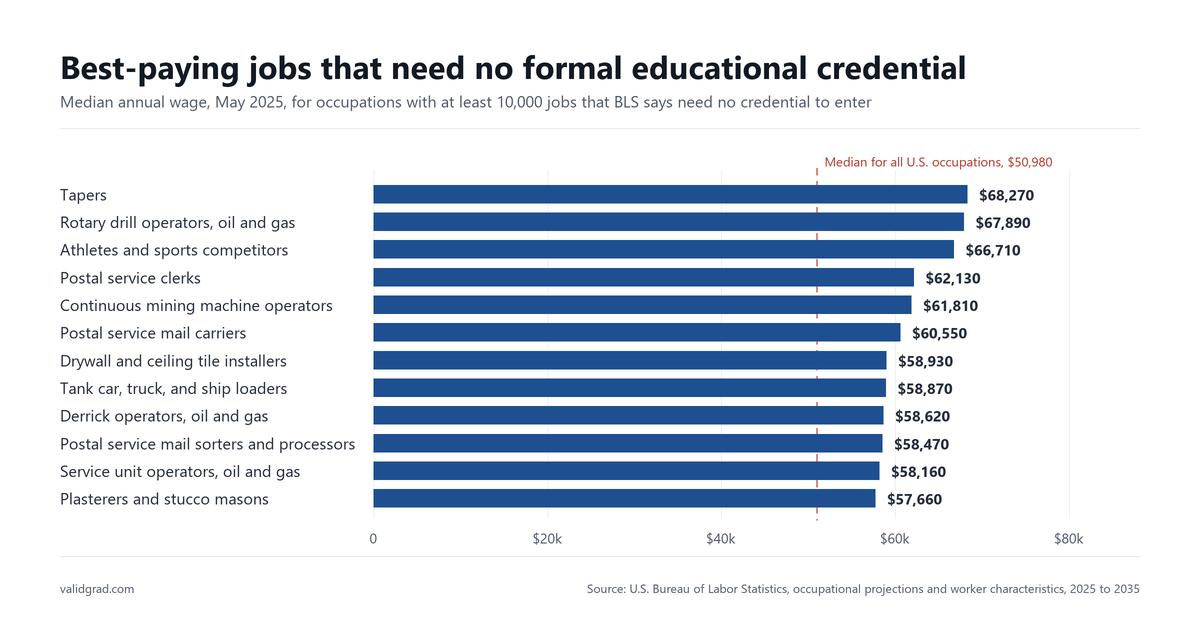
The best-paid no-credential work clusters in construction finishing, oil and gas field work, underground mining and the Postal Service. Every occupation below pays more than the $50,980 median for all U.S. occupations.
| Occupation | Median annual wage, 2025 | Jobs, 2025 |
|---|---|---|
| Loading and moving machine operators, underground mining | $74,500 | 5,900 |
| Tapers | $68,270 | 15,800 |
| Rotary drill operators, oil and gas | $67,890 | 12,700 |
| Athletes and sports competitors | $66,710 | 22,900 |
| Postal service clerks | $62,130 | 70,900 |
| Continuous mining machine operators | $61,810 | 14,000 |
| Postal service mail carriers | $60,550 | 316,400 |
| Drywall and ceiling tile installers | $58,930 | 102,200 |
| Tank car, truck and ship loaders | $58,870 | 12,800 |
| Derrick operators, oil and gas | $58,620 | 10,700 |
Size is the catch. Underground mining loading operators number 5,900 and are projected to shrink 15.8 percent by 2035, and Postal Service employment overall is projected to decline 1 percent by 2035, with an entrance exam to pass first. The steadiest of the well-paid group are the construction finishing trades, where drywall installers, cement masons and roofers are all projected to grow through 2035.
Limits of jobs that don’t require a diploma
The BLS numbers show the ceiling clearly:
- Pay. The group median of $36,400 is $11,650 below the $48,050 median for diploma-level occupations and $14,580 below the all-occupation median.
- Growth. No-credential employment is projected to rise 2.3 percent from 2025 to 2035, against 3.5 percent for all occupations, so the group is shrinking as a share of the workforce.
- Competition. More applicants qualify for each opening, and the 2025 unemployment rate for adults without a diploma was 6.1 percent, well above the 3.4 percent rate for everyone 25 and over.
- Training. Apprenticeship sponsors and employer programs set their own entry rules, and a diploma or GED is a common one.
Those limits are reasons to treat an entry-level job as a starting point. Costs and options for finishing school are in how much a high school diploma costs and how to get a high school diploma.
Getting a diploma or GED while you work
Work and school are not an either-or choice for most adults. The common routes are:
- Adult high school programs run by a district or community college, often at night or on weekends.
- Accredited online high school, at your own pace.
- A state high school equivalency exam. The GED is the best known; several states use HiSET instead, and the state issues the certificate.
Federal rules treat both a GED certificate and a state equivalency certificate as recognized equivalents of a diploma, which is why “or equivalent” appears in so many listings. How to get a GED certificate covers the testing steps, and how to list a GED on a resume covers the wording once you pass.
Replacing a lost high school diploma
Some people searching for no-diploma jobs did finish school and lost the paper. Proving what you already earned is faster than starting over. Two steps cover it:
- Ask your old high school or district for an official transcript or a verification letter. Employers and schools normally work from the transcript, which the district can reissue.
- Ask whether the school issues replacement diplomas and what it charges. Finding a high school diploma online walks through the district and state offices that hold the records.
ValidGrad also makes a replica high school diploma, a novelty item for framing and personal display only. It is not a school record and cannot answer an education verification, and the terms forbid using it to claim a credential. Questions about how replicas sit alongside official records are answered on the FAQ page.
Job search tips if you have no diploma
- Be accurate about your education. Many employers verify it, and a false claim can cost the job later. How employers verify degrees explains what a check actually looks at.
- Apply where the openings are. Fast food, stocking, janitorial work and material handling together account for well over a million projected openings a year.
- Lead with what the listing asks for. Reliability, availability, safety habits, customer service and any equipment you have used carry more weight than schooling in these roles.
- Collect references, including from informal work. A supervisor or client who will vouch for you offsets a thin resume.
- Say that you are in a program if you are. An adult diploma or GED in progress is a point in your favor, not something to hide.
Common questions
Can a job see if you graduated high school?
An employer can ask, and a background check can include education verification, which goes to the school or district that holds the record. Employers do not have open access to school files, so the check normally runs with your written consent. How employers verify degrees covers the process and the timing.
What are three careers that don’t require a high school diploma?
Three that BLS places in the no-credential group and that pay above the group median are construction laborer ($47,120, growing 7.3 percent), roofer ($55,440, growing faster than average) and postal service mail carrier ($60,550, with a written entrance exam).
What jobs can you get without a GED?
The same 109 occupations. A GED matters for the listings that ask for a diploma or equivalent, which cover another 60.3 million jobs, so it widens the search rather than opening the no-credential group, where nothing is required on paper.
Is it hard to get a job without a high school diploma?
Harder than average, and measurably so. The 2025 unemployment rate was 6.1 percent for adults 25 and over without a high school diploma, against 4.3 percent for those with one and 3.4 percent overall. The openings exist, but competition for each one is heavier.
Key points
- About 40.2 million U.S. jobs, across 109 occupations, need no formal educational credential to enter.
- They pay a median of $36,400, about $14,600 below the all-occupation median.
- The best-paid of them are finishing trades, oil and gas field work, underground mining and Postal Service roles.
- A GED or state equivalency certificate counts as a diploma equivalent and opens a further 60.3 million jobs.
- If you graduated and lost the paperwork, a transcript from the school settles it faster than retaking anything.
Sources
- BLS, employment and wages by typical entry-level education, 2025 and projected 2035. Employment, share of jobs, projected change and median wage for each education category. Checked September 14, 2026.
- BLS, occupational projections and worker characteristics, 2025 to 2035. Median wage, employment, projected change and entry-level education for every detailed occupation named here. Checked September 14, 2026.
- BLS, Education pays, 2025. Unemployment rates by educational attainment. Checked September 14, 2026.
- BLS Occupational Outlook Handbook, Postal Service workers. Entry requirements, the written exam and the projected decline. Checked September 14, 2026.
- Handbook, construction laborers and helpers and roofers. Pay, outlook and how workers enter the trades. Checked September 14, 2026.
- Handbook, drywall and ceiling tile installers and tapers and grounds maintenance workers. Wages, training and state pesticide licensing. Checked September 14, 2026.
- Handbook, cooks, janitors and building cleaners and hand laborers and material movers. Training length and entry requirements. Checked September 14, 2026.
- 34 CFR 600.2, U.S. Government Publishing Office. Defines the recognized equivalent of a high school diploma, including the GED. Checked September 14, 2026.
- 29 CFR 29.5, U.S. Government Publishing Office. Apprenticeship program standards, including sponsor-set minimum qualifications and a starting age of at least 16. Checked September 14, 2026.