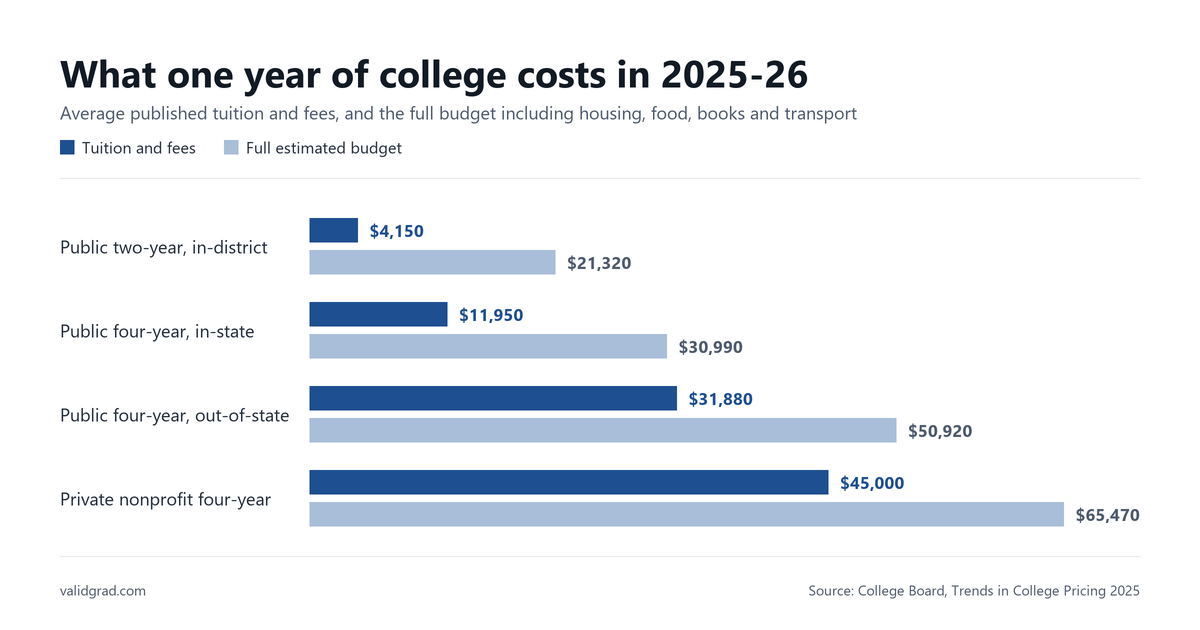
For 2025-26 the average published price of one year of tuition and fees is $4,150 in-district at a public two-year college, $11,950 in-state at a public four-year college, $31,880 out-of-state at the same public four-year colleges, and $45,000 at a private nonprofit four-year institution. Those are College Board’s enrollment-weighted averages, and they are sticker prices. The average first-time full-time in-state student at a public four-year college is estimated to pay about $2,300 in net tuition and fees after grant aid. The gap between those two numbers is the single most useful thing to understand about what a degree costs.
Published prices for 2025-26
Tuition and fees are only part of a college’s own estimate of what a year costs. College Board also publishes average full-time undergraduate budgets, which add housing and food, books and supplies, transportation and personal expenses to the tuition line.
| Sector, 2025-26 | Published tuition and fees | Change on 2024-25 | Average total budget for the year |
|---|---|---|---|
| Public two-year, in-district | $4,150 | +$110 (2.7%) | $21,320 |
| Public four-year, in-state | $11,950 | +$340 (2.9%) | $30,990 |
| Public four-year, out-of-state | $31,880 | +$1,060 | $50,920 |
| Private nonprofit four-year | $45,000 | +$1,750 (4.0%) | $65,470 |
Sourced from College Board, Trends in College Pricing 2025 (Table CP-1 and Figure CP-1), published November 2025. The for-profit sector is not shown because College Board’s most recent tuition figure for it comes from 2023-24 IPEDS data instead of the current year.
State averages sit a long way either side of the national one. In-district tuition and fees at public two-year colleges run from $1,440 in California and $2,250 in New Mexico to $8,900 in Vermont. In-state tuition and fees at public four-year institutions run from $6,360 in Florida and $7,430 in Wyoming to $18,000 in New Hampshire and $18,090 in Vermont. A residency line on a form is worth more than any scholarship most students will win, which is why reciprocity agreements between neighboring states are worth checking before anything else, since residents of one state pay in-state or discounted rates at another’s public institutions.
What students actually pay
Most full-time undergraduates receive grant aid, and grants do not have to be repaid, so the published price overstates what the average student is charged. College Board estimates average net tuition and fees for first-time full-time students in 2025-26 at about $2,300 in-state at public four-year institutions, down from a 2012-13 peak of $4,450 in inflation-adjusted terms, and about $16,910 at private nonprofit four-year institutions, down from $19,810 in 2006-07. At public two-year colleges, grant aid covers the tuition line for the average first-time full-time student. What is left to cover is an estimated $9,660 of housing and food and a further $6,320 in books, supplies, transportation and other personal expenses.
Two different “net” numbers circulate and they are not interchangeable. Net tuition and fees subtracts grant aid from the tuition line only. Net price subtracts grant aid from the whole cost of attendance, living costs included, and is therefore much larger. NCES publishes the second kind for students receiving federal aid:
| Institution type | Average net price, 2021-22 | Average total cost of attendance, 2022-23 (on campus) |
|---|---|---|
| Public four-year | $15,200 | $27,100 |
| Private nonprofit four-year | $29,700 | $58,600 |
| Private for-profit four-year | $24,400 | $33,600 |
| Public two-year | $8,300 | Not published on the same basis |
Sourced from NCES, Price of Attending an Undergraduate Institution, in constant 2022-23 dollars, for first-time full-time students awarded Title IV aid. Living arrangements move these figures as much as institution type does. NCES puts the average cost of attendance for a public four-year student living off campus with family at $15,700 against $27,100 on campus. Living at home is, in pure cash terms, a larger discount than most merit awards.
The practical version of all this is to ignore the sticker price on a college’s website and use its net price calculator, which every institution receiving federal aid is required to publish. It asks about income and family size and returns an estimate for a student like you rather than an average across everybody.
What four years adds up to
Multiplying a single year by four is the crudest possible estimate, and it is still the one most people want. At 2025-26 prices, holding them flat:
| Route | Tuition and fees over four years | Full budget over four years |
|---|---|---|
| Two years at a public two-year college, then two years in-state at a public four-year | $32,200 | $104,620 |
| Four years in-state at a public four-year college | $47,800 | $123,960 |
| Four years out-of-state at a public four-year college | $127,520 | $203,680 |
| Four years at a private nonprofit four-year college | $180,000 | $261,880 |
These are ValidGrad’s own arithmetic on the College Board averages above, not published four-year figures, and they carry three caveats. Prices rise most years, so a student starting now will pay more in year four than in year one. Grant aid pulls the real number down, often a long way. And the budget column includes housing and food, which a person not in college would still be paying for in some form, so the honest comparison for that portion is the difference between the college’s charge and what living elsewhere would have cost, not the whole line.
The fifth year is the expensive one
The four-year degree is not a four-year degree for most people who start one. Of first-time full-time students who began a bachelor’s program in fall 2017, 49.1% had graduated within four years. Within five years the figure was 61.7%, and within six, 64.5%. At public institutions the four-year rate was 46.1%, at private nonprofits 56.5%, and at private for-profits 26.4%.
A fifth year at an in-state public four-year college adds roughly another $30,990 budget year on College Board’s 2025-26 averages, more than the entire two-year-college portion of the transfer route above, and it also postpones a year of full-time earnings, which is usually the larger of the two costs. Anything that shortens time to degree is therefore worth money twice. How long it takes to get a degree sets out the normal timelines for each level and what stretches them. The common culprits are credits that do not transfer, changing major late, and part-time enrollment forced by work.
Cheaper routes to the same credential
Start at a community college. The transfer route in the table above saves $15,600 in tuition and fees and about $19,340 across the full budget, and the degree is conferred by the four-year institution, so the diploma reads the same. The risk is entirely in credit transfer. Check the receiving institution’s articulation agreement before enrolling rather than after, because credits that do not transfer convert the saving straight back into an extra year. It is also worth knowing what two-year outcomes look like in aggregate. Of students starting at two-year institutions in fall 2017, 34% had completed a credential within 150% of normal time and a further 14% had transferred.
Buy credit by examination. A CLEP exam costs $97 plus the test center or remote proctoring administration fee, and College Board says more than 3,000 institutions grant credit for CLEP. Against a public four-year in-state rate of $11,950 for a full-time year, a handful of exams is a rounding error that can remove a semester. Accelerated routes to a bachelor’s degree covers credit-by-exam, competency-based programs and credit for prior learning, with the fees for each.
Check what the employer pays. Employer tuition assistance is the one discount that does not appear in any national average, because it is negotiated per employer. It is also the only one with no academic qualifying threshold.
For the other end of the ladder, what a high school diploma costs covers the equivalent figures for a secondary credential, and degrees in order, from associate to doctorate sets out what each level involves before you price it.
What the diploma itself costs
The document is the cheapest part of the whole exercise, and it is priced separately. Across nine US university registrars checked in September 2026, published replacement or duplicate diploma fees ran from nothing at the University of Iowa to $150 at Yale, with $50 the most common figure, and waits ran from one or two days to about six months. Replacing a lost diploma has the full fee and wait table and the notarized-statement requirements several registrars impose.
Two related costs are easy to forget. Official transcripts are charged per copy and are the document that actually proves a degree to an employer or a graduate program. And the original diploma does not arrive on graduation day, so how long it takes to get a college diploma after graduation covers the gap between the ceremony and the mail. The steps that come before it are covered in how to get a college diploma, from admission and the FAFSA to conferral and the wait for the envelope.
The other side of the ledger
Cost only means something against what the credential returns, and that varies far more by field and by whether the degree is finished than by the price paid for it. Instead of repeating earnings figures here, the pay by education level hub carries the current Bureau of Labor Statistics medians by credential, including the unemployment differences that usually matter more than the pay gap during a downturn.
One number from this page belongs in that calculation, the four-year completion rate of 49.1%. The worst financial outcome in higher education is not an expensive degree. It is debt taken on for a degree that was never finished, which returns the cost without the credential.
Replica college diplomas for display
ValidGrad makes a replica college diploma as a novelty item for display, either a second copy for an office wall when the original is framed at home, or a stand-in while a registrar’s replacement is in the post. Wording, layout and paper are yours to specify; current pricing and turnaround are on the product page.
These are display replicas. One must never be used to claim a credential that was not earned, submitted to an employer or a school, or offered in answer to a verification request, as set out in our terms and conditions. Degrees are checked against the issuing institution’s records or the National Student Clearinghouse, as how employers verify degrees explains, and no document buys its way into that database.
Frequently asked questions
How much does a four-year degree cost on average?
At 2025-26 published prices, four years of tuition and fees averages $47,800 in-state at a public four-year college and $180,000 at a private nonprofit. Adding housing, food, books and transport takes the four-year budget to roughly $123,960 and $261,880 respectively. Almost nobody pays the second set of figures. Average net tuition and fees after grant aid is around $2,300 a year in-state at public four-year institutions and $16,910 at private nonprofits, and NCES puts the average net price of a year at a public four-year institution, living costs included, at $15,200 for aided students.
How much does a two-year college degree cost?
In-district tuition and fees at public two-year colleges average $4,150 for 2025-26, so two years of tuition is about $8,300 before aid. For the average first-time full-time student, grant aid covers that tuition line entirely. What remains is living costs, which College Board estimates at $9,660 for housing and food plus $6,320 in books, transport and personal expenses for the year.
What is the cheapest way to get a bachelor’s degree?
Two years in-district at a public two-year college followed by two years in-state at a public four-year, with credit-by-examination used where the receiving institution accepts it, and living at home if that is possible. Each of those three levers is worth more than any single scholarship most students will receive, and they stack.
Is a college degree still worth the cost?
The question has no single answer because the cost varies by a factor of five between sectors and the return varies by field. What the data supports is narrower. Finishing matters more than where you finish, since only 49.1% of bachelor’s students graduate within four years and an unfinished degree carries the cost without the credential. The earnings side is on the pay by education level hub.
How much does it cost to replace a college diploma?
Among nine university registrars checked in September 2026, published fees ranged from no charge to $150, with $50 the most common. The wait is the real cost, since one registrar prints within two days and another states about six months.
Sources
- College Board, Trends in College Pricing Highlights (2025-26 published tuition and fees by sector and the change on 2024-25, state ranges, estimated net tuition and fees of $2,300 in-state public four-year and $16,910 private nonprofit)
- College Board, Trends in College Pricing 2025, November 2025 (Table CP-1 average published prices, Figure CP-1 average estimated full-time undergraduate budgets by sector)
- College Board Newsroom, Trends in College Pricing and Student Aid 2025 release (average total budgets of $21,320, $30,990, $50,920 and $65,470, plus the $9,660 housing and food and $6,320 other-expenses estimates for public two-year students after grant aid)
- NCES, Price of Attending an Undergraduate Institution (average net price by sector, 2021-22; total cost of attendance 2022-23; on-campus versus living with family)
- NCES, Fast Facts: Tuition costs of colleges and universities (average total cost of attendance for first-time full-time undergraduates by control)
- NCES, Digest of Education Statistics, Table 326.10 (graduation rates within four, five and six years for the fall 2017 cohort, by control)
- NCES, Fast Facts: Graduation rates (outcomes for students starting at two-year institutions: 34% completed, 14% transferred)
- College Board, Register for a CLEP Exam (exam fee of $97 plus the test center or remote proctoring administration fee)
- University of Iowa Office of the Registrar, Duplicate Diploma and Yale University Office of the University Registrar, Replacement Diploma (the ends of the published replacement-fee range)
Prices checked September 13, 2026. College Board publishes updated pricing each fall and NCES updates net price annually. Confirm current figures with the institution’s own net price calculator before making a decision.